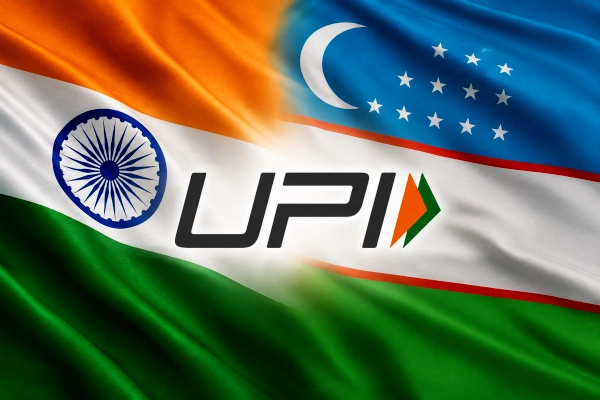
India’s Unified Payments Interface is set to expand further into Central Asia after NPCI International Payments Limited and Uzbekistan’s National Interbank Processing Centre JSC signed a commercial agreement enabling Indian UPI applications to work with Uzbekistan’s national UZQR merchant-payment network.
The agreement was announced on 30 August 2026 during Prime Minister Narendra Modi’s State Visit to Uzbekistan. Under the arrangement, Indian travellers will eventually be able to use supported UPI applications to scan UZQR codes displayed by participating merchants in Uzbekistan and make payments directly through their Indian bank accounts.
The development is significant because it links India’s domestic real-time payment ecosystem with Uzbekistan’s emerging national QR infrastructure. It also places digital payments alongside trade, investment, artificial intelligence, cybersecurity and other technology sectors in the expanding India-Uzbekistan relationship, which has now been elevated to a Comprehensive Strategic Partnership.
UPI Connects with Uzbekistan’s National QR Infrastructure
The Indian side of the agreement is represented by NPCI International Payments Limited, or NIPL, the international subsidiary of the National Payments Corporation of India. NIPL has been tasked with expanding Indian payment technologies overseas through partnerships with banks, payment networks and national financial institutions.
Its Uzbek partner, the National Interbank Processing Centre JSC, is involved in the country’s digital-payment infrastructure. At the centre of the new arrangement is UZQR, Uzbekistan’s unified national QR-code payment system.
UZQR has been designed to provide merchants with a common QR infrastructure rather than requiring separate QR codes for multiple banking and payment applications. A customer using a supported banking or payment application can scan the same merchant QR code, while the underlying payment infrastructure handles the transaction.
Uzbekistan formally introduced procedures for accepting payments through its unified QR infrastructure from 1 July 2026. The system also enables merchants to register QR codes digitally, monitor transactions and access payment reports.
The India-Uzbekistan agreement effectively adds a cross-border layer to this domestic network. Rather than requiring Indian visitors to depend entirely on cash, international cards or local payment applications, the planned integration will allow compatible Indian UPI applications to interact directly with participating UZQR merchant codes.
How an Indian Traveller Could Use the System
The proposed system is expected to operate broadly along the lines of the international UPI merchant-payment model already available in several countries.
An Indian traveller entering a restaurant, hotel, shop or other participating establishment in Uzbekistan would be able to open a supported UPI application and scan the merchant’s UZQR code. The application would display the transaction details and applicable currency conversion information before the user authorises the payment using the familiar UPI PIN.
The underlying transaction would still require cross-border settlement, foreign-exchange conversion and coordination between payment networks. From the user’s perspective, however, the objective is to preserve the simple QR-based payment experience already familiar across India.
This is what distinguishes UPI’s international expansion from simply increasing the use of Indian-issued debit or credit cards abroad. The intention is to allow Indian consumers to continue using the same payment interface and bank-linked architecture they use domestically.
Commercial Agreement Signed, Operational Rollout Still Ahead
An important distinction must be maintained. The 30 August announcement confirms the signing of the commercial agreement needed to enable the service, but it does not mean every Indian UPI application can immediately scan every UZQR code in Uzbekistan.
Cross-border payment integration normally requires technical implementation, participating-bank enablement, foreign-exchange arrangements, compliance checks, transaction testing, application updates and merchant-network readiness before full commercial operation begins.
The official announcement has not yet specified a public launch date, participating Indian UPI applications, transaction limits, exchange-rate mechanism or fee structure for the Uzbekistan service.
The most accurate description at present is therefore that India and Uzbekistan have concluded the commercial agreement that will allow Indian UPI applications to make merchant payments through UZQR once the integration becomes operational.
Uzbekistan Is Building a Unified QR Economy
The timing of the agreement is particularly important because Uzbekistan is simultaneously consolidating its own domestic digital-payment architecture.
UZQR is intended to reduce fragmentation in merchant payments by giving businesses a common QR standard. Instead of displaying several QR codes for different banks or payment applications, participating merchants can operate through a unified national interface.
This approach can reduce costs for merchants, simplify payment acceptance and encourage wider adoption of cashless transactions. It can also create a convenient foundation for international interoperability because foreign payment networks can connect to a national QR infrastructure rather than negotiating separately with thousands of individual merchants.
The Indian agreement therefore gives UPI a potential pathway into a much broader merchant network once technical implementation is completed.
Uzbekistan is also exploring similar international connections with other global payment ecosystems, suggesting that UZQR is being positioned not merely as a domestic payment standard but as infrastructure capable of supporting foreign visitors and cross-border commerce.
UPI Has Become an Exportable Indian Digital Platform
UPI’s emergence as an instrument of international economic cooperation represents a major evolution from its original purpose.
The system was created primarily to provide an interoperable domestic platform through which users could access bank accounts and make immediate digital payments. Over the following decade, UPI became one of the largest real-time payment systems in the world.
By FY2025-26, UPI had processed more than 24,162 crore transactions valued at approximately ₹314 lakh crore, while the number of participating banks had grown from 44 in FY2016-17 to more than 700.
That extraordinary domestic scale has made India’s payment architecture increasingly attractive to countries seeking faster, interoperable and relatively low-cost digital-payment systems.
India has therefore moved from presenting UPI primarily as a domestic financial-inclusion tool towards using payment connectivity as part of its economic and technological relationships with other countries.
By August 2026, UPI had established an international presence across multiple markets through merchant-payment arrangements, payment-system linkages and cross-border remittance partnerships.
Uzbekistan represents another important step in that international expansion.
UPI’s International Network Continues to Grow
UPI’s overseas presence does not follow a single model in every country.
In some markets, Indian travellers can use UPI applications directly for merchant payments. In others, UPI has been connected with local real-time payment systems to facilitate cross-border transfers. Other countries have explored Indian technology and operating experience while developing their own domestic payment infrastructure.
India has already expanded UPI capabilities into markets including Bhutan, Nepal, Singapore, the United Arab Emirates, France, Sri Lanka, Mauritius and Qatar, among others.
The network has continued to grow during 2026 through additional partnerships in Asia, Europe and the Indian Ocean region.
The Uzbekistan agreement is particularly notable because it extends UPI’s geographic reach deeper into Central Asia, a region where India is simultaneously seeking greater trade, transport, technology and strategic connectivity.
Digital Payments Become Part of India-Uzbekistan Diplomacy
The UZQR agreement was not an isolated fintech announcement.
Prime Minister Modi and Uzbek President Shavkat Mirziyoyev discussed digital public infrastructure and payment connectivity during their official talks in Tashkent alongside trade, investment, defence, critical minerals, healthcare, pharmaceuticals, agriculture, education, space and cybersecurity.
Their summit resulted in the elevation of bilateral ties to a Comprehensive Strategic Partnership, with digital transformation identified as one of the priority areas for future cooperation.
The two countries have also agreed to strengthen cooperation in e-commerce, digitisation of trade procedures and digital platforms serving small and medium enterprises.
UPI connectivity therefore fits within a broader effort to make digital infrastructure part of the economic foundation of the India-Uzbekistan relationship.
Unlike many diplomatic agreements that remain largely visible only to governments and businesses, payment interoperability can eventually be experienced directly by ordinary travellers, students, entrepreneurs and merchants.
That gives digital payments an unusually practical role in diplomacy.
Tourism and People-to-People Links Could Benefit
The integration could be particularly useful for Indian visitors travelling to Uzbekistan.
International travellers often depend on a combination of cash, international payment cards and locally accepted payment applications. Each additional interoperable option reduces payment friction, particularly for small purchases at restaurants, shops and tourism-related businesses.
India and Uzbekistan are simultaneously seeking to expand tourism and cultural exchanges. The two countries have adopted a tourism cooperation programme for 2026-28, while their wider bilateral relationship includes growing educational, cultural and business links.
Indian students also represent an important component of people-to-people ties, especially in Uzbekistan’s medical-education sector.
A functioning UPI-UZQR connection could therefore serve tourists, students, business travellers and other Indians spending extended periods in the country.
Small Merchants Could Also Gain
The benefits would not be limited to Indian consumers.
QR-based payments have spread rapidly in India partly because merchants can accept digital payments without investing in expensive point-of-sale infrastructure. Uzbekistan’s unified QR model is based on a similar principle.
If international payment networks connect successfully with UZQR, participating Uzbek merchants could potentially accept payments from domestic customers and eligible foreign visitors through the same QR infrastructure.
For restaurants, shops, taxis, tourism businesses and smaller establishments, this could reduce dependence on cash and broaden the range of customers able to make digital payments conveniently.
It could also support Uzbekistan’s wider effort to formalise economic activity and expand the use of electronic payments.
Digital Public Infrastructure Becomes an Indian Diplomatic Asset
The agreement illustrates a wider transformation in the instruments available to Indian diplomacy.
Traditional economic diplomacy has generally focused on trade agreements, infrastructure construction, development assistance, investment and credit lines. India’s expanding digital ecosystem has added another category in the form of digital public infrastructure and interoperable technology platforms.
UPI is one of the most visible examples.
Instead of constructing physical infrastructure, India can now establish technological connections through payment networks, digital identity systems, document platforms and other population-scale technologies.
These systems can create durable institutional relationships because they become embedded in everyday economic activity.
A railway or port connects economies physically. A payment network connects them each time an individual completes a transaction.
That gives digital infrastructure a different but potentially powerful form of diplomatic relevance.
Central Asia Is an Important New Geography for UPI
Uzbekistan’s location gives the agreement additional strategic importance.
India has long sought greater economic engagement with Central Asia, but geography has complicated physical connectivity because India does not share a direct land border with the region.
Trade therefore depends heavily on multimodal transport corridors, aviation links and transit through third countries.
Digital connectivity faces far fewer geographic constraints.
Payment networks, fintech platforms, information technology services, online education and digital commerce can connect Indian and Central Asian economies even when physical connectivity remains difficult.
India and Uzbekistan are therefore pursuing transport and digital connectivity simultaneously, with the UZQR-UPI agreement providing a potentially scalable digital bridge between the two economies.
Uzbekistan Is Positioning Itself as a Regional Fintech Hub
The agreement also fits closely with Uzbekistan’s own economic strategy.
During the Silk Road Finance & Technology Forum held in Tashkent from 24 to 26 August 2026, Uzbekistan presented a National FinTech Strategy aimed at attracting substantial technology investment and positioning the country as a financial and digital gateway for Central Asia.
Connecting UZQR with major international payment ecosystems could support that ambition.
A national payment network capable of interacting with Indian and other foreign payment platforms would make Uzbekistan’s digital infrastructure more convenient for travellers and businesses operating across the region.
For India, establishing UPI connectivity at this stage provides an opportunity to position its payment architecture within an emerging Central Asian fintech ecosystem.
UPI and UZQR Will Remain Separate Systems
The agreement does not mean Uzbekistan is replacing its national payment infrastructure with UPI.
UZQR will remain Uzbekistan’s national QR-payment system, while UPI will remain India’s payment ecosystem.
The significance lies in interoperability between the two.
Indian UPI applications will be able to communicate with participating Uzbek merchant infrastructure, enabling the customer to initiate a cross-border transaction through a familiar Indian interface while the merchant continues using Uzbekistan’s own national QR system.
This model allows each country to retain control of its domestic financial infrastructure while building a bridge between the two networks.
That principle is increasingly becoming central to international real-time payment systems.
From Domestic Payment Platform to Foreign-Policy Instrument
UPI’s first decade transformed digital payments inside India. Its next phase is increasingly about whether that domestic success can be translated into international interoperability.
The NIPL-National Interbank Processing Centre agreement announced in Tashkent on 30 August 2026 represents another step in that transition.
Once implementation is completed, Indian travellers with supported UPI applications should be able to scan participating UZQR merchant codes in Uzbekistan and make payments from their Indian bank accounts through a payment process similar to the one they already use at home.
For Uzbekistan, the arrangement connects its newly established national QR infrastructure with one of the world’s largest real-time payment ecosystems. For India, it expands the international reach of an indigenous digital platform while strengthening a bilateral relationship that has just been elevated to a Comprehensive Strategic Partnership.
The agreement is therefore more than a fintech convenience. It demonstrates how India’s digital infrastructure is increasingly becoming part of its economic diplomacy, linking markets not only through trade corridors, investment and transport networks, but through the simple act of scanning a QR code.
You may also like
-
India’s Economic Warfare Challenge: Strategic Autonomy, Energy Security and the Rise of a Global Power
-
India-US Trade Deal Stalemate: Why Washington’s Tariff Pressure Has Failed to Secure an Agreement
-
US Double Standards in Foreign Policy: 16 Recent Cases Involving India, Russia, China and Global Trade
-
India’s Arctic Energy Ambitions: Russian Oil, LNG and a New Sea Route to Indian Ports
-
Indian Navy Vice Chief Inspects Japan’s Mogami-Class Stealth Frigate as India-Japan Shipbuilding Cooperation Expands
