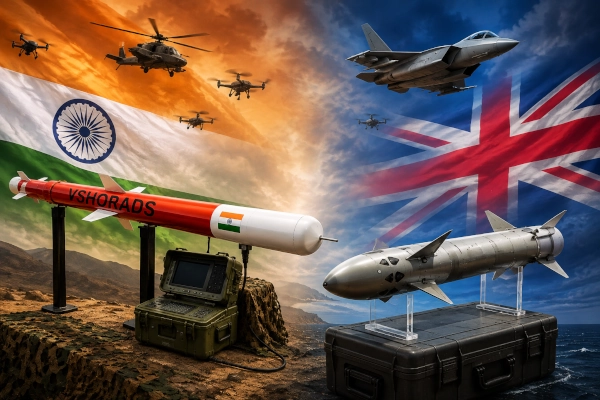
India is moving towards fielding two distinctly different very-short-range air-defence missile technologies at a time when drones, attack helicopters, low-flying aircraft and precision-guided weapons are reshaping the threats faced by frontline formations.
On one side is the British Lightweight Multirole Missile, or LMM, better known as Martlet in Royal Navy service. India and the United Kingdom formally announced in October 2025 that the initial supply of LMM systems to the Indian Army would proceed through the government-to-government route. The British government subsequently described the package as a £350 million programme covering missiles and launchers manufactured by Thales in Belfast.
On the other side is DRDO’s indigenous VSHORADS, a fourth-generation Man-Portable Air Defence System developed by Research Centre Imarat in collaboration with other DRDO laboratories and Indian industry. Development of the missile has been completed, production partners have participated in its trials, and the Defence Acquisition Council granted Acceptance of Necessity for procurement of VSHORADS for the Indian Army in July 2026.
At first glance, Martlet and VSHORADS appear to occupy almost the same battlefield space. Both are compact guided missiles intended to defeat threats operating at relatively short ranges and low altitudes. Their design philosophies, guidance systems and tactical employment, however, are markedly different.
VSHORADS is fundamentally a dedicated fire-and-forget air-defence missile built around an imaging-infrared seeker. Martlet is a lighter laser-beam-riding multirole missile capable of attacking aerial as well as selected surface targets. Rather than being identical competitors, the two weapons represent different technological approaches to the increasingly difficult problem of protecting troops from threats operating close to the ground.
Same Battlefield, Different Missile Philosophy
The clearest distinction between the two missiles lies in the missions around which they were originally designed.
DRDO developed VSHORADS specifically as a modern very-short-range air-defence system. Its principal task is to detect, acquire and destroy fast-moving and manoeuvring aerial targets operating at low altitude. During development, the system has been tested against high-speed targets as well as targets with reduced thermal signatures intended to reproduce some of the challenges presented by modern unmanned aerial vehicles.
Martlet emerged from a broader requirement. Thales developed the Lightweight Multirole Missile as a compact precision weapon capable of engaging several categories of target rather than functioning exclusively as an anti-aircraft missile. British forces have demonstrated the weapon against drones, helicopters and aircraft as well as small boats and light surface targets.
The distinction is therefore important. VSHORADS is fundamentally an air-defence specialist, whereas Martlet is a multirole precision missile that possesses a significant short-range air-defence capability.
| Parameter | DRDO VSHORADS — India | LMM / Martlet — UK |
|---|---|---|
| Country of origin | India | United Kingdom |
| Developer | DRDO, led by Research Centre Imarat with other DRDO labs and Indian industry | Thales UK |
| Primary role | Dedicated Very Short Range Air Defence / MANPADS | Lightweight multirole precision missile with air-defence capability |
| Core target set | Low-flying aircraft, helicopters, UAVs and other manoeuvring aerial threats | UAVs, helicopters, aircraft, small boats, fast attack craft and selected light surface targets |
| Guidance | Uncooled Imaging Infrared seeker in LWIR band | Laser beam-riding guidance |
| Fire-and-forget | Yes — missile guides itself after target acquisition and launch | No in standard beam-riding employment — target tracking must be maintained during missile flight |
| Countermeasure philosophy | IIR seeker designed to discriminate aircraft from IR flares and resist conventional seeker jamming | Does not depend on target heat signature, so conventional IR flares do not directly defeat its guidance |
| Official range | 0.5–6 km | Royal Navy material confirms more than 6 km; wider published LMM figures are often around the 8-km class depending on configuration |
| Official altitude envelope | 10 m to 3.5 km above ground level | Comparable official ground-launched altitude envelope not publicly specified in the UK sources reviewed |
| Maximum speed | Around Mach 1.5 | Around Mach 1.5 |
| Missile weight | 21.5 kg | 13 kg |
| Length | 2 m | Approximately 1.3 m in widely published manufacturer data |
| Diameter | 90 mm | Approximately 76 mm in widely published data |
| Propulsion | Dual-thrust solid-propellant rocket motor | Solid-propellant rocket propulsion |
| Terminal manoeuvrability | Incorporates a miniaturised Reaction Control System in addition to aerodynamic control | Highly manoeuvrable missile; does not use the same publicly disclosed RCS architecture |
| Warhead | Blast-fragmentation warhead optimised for aerial targets | Multipurpose warhead suitable for both aerial and surface targets |
| High-altitude capability | Explicitly designed for high-altitude operations | Not specifically marketed around Himalayan/high-altitude MANPADS employment |
| Man-portable configuration | Man-portable system with 25-kg tripod launcher | Can be employed from lightweight launch systems, but LMM is also extensively platform-integrated |
| Vehicle integration potential | Possible and technically logical, but current DRDO configuration is centred on VSHORAD air defence | Strong — designed from the outset for multiple launcher types |
| Helicopter integration | Not a principal publicly demonstrated role | Established operational role on Royal Navy Wildcat helicopters |
| Naval use | Not a primary VSHORADS role | Yes — Martlet is extensively used for maritime strike and defence |
| Surface-target capability | Not its core role | Major advantage — can engage small boats, light vehicles and similar targets |
| Counter-UAV capability | Yes — DRDO has tested VSHORADS against low-signature drone-like targets | Yes — Martlet has successfully destroyed aerial drones during Royal Navy trials |
| Launcher magazine potential | Lower because of heavier missile | High because of 13-kg missile; a Wildcat can carry up to 20 Martlets |
| Operator exposure after firing | Lower because the missile is fire-and-forget | Longer because the target must continue to be tracked during beam-riding engagement |
| Best tactical characteristic | Autonomous, dedicated anti-air engagement | Lightweight, versatile and resistant to conventional IR countermeasures |
| Best suited for | Frontline MANPADS teams, high-altitude troops, mobile air defence and protection of formations | Counter-UAV defence, platform-mounted launchers, helicopter use and multirole engagements |
| Combat experience | Extensive development and user trials; no comparable publicly confirmed combat history yet | Operationally mature, with Royal Navy service and broader LMM wartime use |
| Indian procurement status | DAC granted AoN for Indian Army procurement in July 2026 | India and UK agreed in October 2025 to proceed with initial LMM supply through the government-to-government route |
| Indian industrial involvement | Indigenous DRDO programme with Indian development and production partners | Thales–BDL cooperation intended to expand Indian participation in LMM production |
| Strategic autonomy for India | Very high because design and production are Indian-controlled | Lower than VSHORADS, although Indian industrial participation is planned |
| Long-term Indian role | Strong candidate for India’s standard indigenous next-generation VSHORAD/MANPADS layer | Complementary specialised system adding laser-guided and multirole capabil |
VSHORADS Uses an Imaging-Infrared Seeker
At the heart of VSHORADS is an uncooled Imaging Infrared seeker operating in the long-wave infrared band. This is considerably more sophisticated than the relatively simple heat-seeking principle associated with older generations of shoulder-fired missiles.
An imaging-infrared seeker does not merely follow the strongest source of heat within its field of view. It creates an infrared image of the target and uses that information to distinguish the intended aircraft or drone from background clutter and countermeasures.
DRDO states that the VSHORADS seeker has been designed to provide advanced discrimination against infrared flares and resistance to conventional countermeasures directed against infrared-guided weapons. The missile has also been developed to achieve a high probability of kill against fast and manoeuvring aerial targets.
The most important tactical consequence of this guidance system is that VSHORADS becomes autonomous after launch. Once the seeker has acquired its target and the missile is fired, the operator does not need to continue guiding it throughout the engagement.
This gives VSHORADS the important fire-and-forget characteristic associated with advanced modern MANPADS. The firing team can relocate, seek cover or prepare another missile while the interceptor continues towards its target independently.
Martlet Uses Laser Beam-Riding Guidance
Martlet approaches the guidance problem in an entirely different manner. Rather than relying on an infrared seeker to follow the heat signature of an aircraft or drone, the missile primarily employs laser beam-riding guidance.
The launcher or associated sighting system maintains its line of sight on the target and projects a coded laser guidance beam. Sensors aboard the missile determine its position within that beam and continually make corrections so that the weapon remains aligned with the target during flight.
This guidance method provides an important advantage against traditional infrared countermeasures. Flares are intended to create alternative heat sources that can confuse heat-seeking missiles. Martlet is not following the target’s infrared emissions, meaning that conventional flares do not interfere with its guidance in the same way.
VSHORADS and Martlet therefore solve the same countermeasure problem through two different technologies. VSHORADS attempts to distinguish the genuine target from false infrared signatures through advanced imaging, while Martlet largely avoids the infrared-countermeasure contest by relying on laser guidance.
Fire-and-Forget Gives VSHORADS a Tactical Advantage
Laser beam-riding provides strong resistance to conventional infrared countermeasures, but it also places greater responsibility on the launching system during the engagement. The target must continue to be accurately tracked while the missile travels towards it.
VSHORADS does not impose the same requirement after launch. Its imaging-infrared seeker takes over the terminal engagement, freeing the operator from continuously tracking the target.
This difference can become highly important for small air-defence detachments operating near the frontline. The launch of a missile produces an obvious visual and infrared signature that can reveal the approximate location of the firing position.
A fire-and-forget weapon allows the team to begin moving almost immediately after launch. In an environment saturated with reconnaissance drones, artillery sensors and other surveillance systems, reducing the amount of time spent at the firing point can considerably improve survivability.
Martlet is better suited to configurations in which an electro-optical tracking system or another stabilised sight can maintain the target track automatically. The two missiles therefore favour somewhat different tactical employment even when they are engaging similar targets.
Martlet Is Considerably Lighter
One of Martlet’s clearest physical advantages is its low missile weight. British specifications place the missile at approximately 13 kilograms, making it substantially lighter than the Indian system.
DRDO’s current specification places the VSHORADS missile at approximately 21.5 kilograms, with a length of around two metres and a diameter of 90 millimetres. The associated man-portable tripod launcher adds further weight to the complete system.
The difference of roughly 8.5 kilograms per missile is operationally significant. A vehicle, helicopter or fixed launcher operating within a given weight limit can carry considerably more Martlets than heavier missiles.
This directly improves magazine depth. The Royal Navy’s Wildcat helicopter, for example, can carry large numbers of Martlet missiles, demonstrating how the lightweight architecture can be exploited when a platform is expected to confront numerous relatively small targets.
That characteristic has become increasingly important in counter-drone warfare, where a defender may need to engage several inexpensive UAVs during a short period rather than one high-value aircraft.
VSHORADS accepts greater missile weight in exchange for the additional seeker, autonomous guidance and manoeuvring technologies required for its dedicated air-defence role.
VSHORADS Has an Official Six-Kilometre Engagement Range
DRDO’s current official specification gives VSHORADS an engagement range of approximately 0.5 to 6 kilometres. Its published target-altitude envelope extends from approximately 10 metres to 3.5 kilometres above ground level.
The missile reaches approximately Mach 1.5, placing it in the supersonic category and leaving a relatively short reaction period for aircraft or drones operating within its engagement zone.
Martlet also reaches approximately Mach 1.5, while widely published data places its maximum engagement reach around the eight-kilometre class in suitable configurations.
Maximum range figures should nevertheless be treated carefully. The practical engagement distance against a hovering helicopter, a small UAV, a crossing fighter aircraft or a receding target can differ substantially. Target altitude, speed, aspect and atmospheric conditions all influence the actual intercept envelope.
The more meaningful distinction therefore lies in how the missiles achieve an engagement rather than in a simple comparison of their maximum published range.
VSHORADS Incorporates a Miniaturised Reaction-Control System
One of the most technically significant features of VSHORADS is its miniaturised Reaction Control System, which operates alongside the missile’s aerodynamic controls and dual-thrust solid-propellant motor.
Reaction-control technology can generate additional control forces during important stages of the missile’s flight, improving its ability to make rapid trajectory corrections. DRDO specifically identified the miniaturised RCS as one of the advanced technologies demonstrated during development.
This capability is particularly valuable against manoeuvring aerial targets. A fighter, helicopter or agile UAV may alter its direction rapidly once the engagement develops, leaving the interceptor only a few seconds to correct its trajectory.
The reaction-control system, imaging-infrared seeker and dual-thrust propulsion system therefore form a package optimised specifically for air interception.
Martlet does not approach the terminal-engagement problem in exactly the same manner because its guidance architecture and broader multirole design impose different engineering priorities.
Martlet’s Major Strength Is Multirole Flexibility
Where Martlet gains a significant advantage is in the breadth of targets it can engage.
The missile can perform short-range air defence against drones, helicopters and other aerial targets, while its warhead and precision guidance also make it suitable against small boats, light vehicles and selected surface targets.
The Royal Navy originally developed substantial operational experience with Martlet as an air-launched weapon carried by Wildcat helicopters against small maritime targets. The missile was subsequently demonstrated successfully in the air-to-air role against drones.
This means a force equipped with Martlet does not necessarily need to reserve every missile exclusively for aircraft defence. The same weapon family can provide precision engagement options against threats arriving from the air or across the surface.
For mobile formations, such flexibility can be extremely useful. The weapon can contribute to counter-UAV defence while also retaining usefulness against selected lightly protected targets.
VSHORADS does not attempt to provide this breadth. Its design remains centred overwhelmingly on the air-defence mission.
VSHORADS Carries a Dedicated Air-Defence Warhead
VSHORADS employs a blast-fragmentation warhead intended specifically for aerial targets. The design allows fragments and blast effects to damage critical components of an aircraft or drone even when the missile does not strike precisely through the centre of the target.
This approach is well suited to air defence because an interceptor does not necessarily need to destroy every part of an aircraft. Damage to flight controls, propulsion systems, fuel systems, sensors or structural components can be sufficient to produce a mission kill.
The warhead works together with the missile’s terminal manoeuvrability and imaging seeker to maximise the effectiveness of an interception against aircraft and UAVs.
Martlet uses a multipurpose warhead designed around its broader target set. That makes it more versatile but again illustrates the different design philosophies behind the two missiles.
Drones Have Changed Very-Short-Range Air Defence
The proliferation of drones has fundamentally altered the mission of VSHORAD systems.
Traditional shoulder-fired missiles were designed principally around helicopters and low-flying combat aircraft. Modern battlefield air-defence teams must now deal with reconnaissance UAVs, loitering munitions, fixed-wing drones and one-way attack systems.
These targets can be significantly more difficult to detect and engage because they may be physically small, produce limited infrared signatures and operate at low altitude.
DRDO has deliberately incorporated this challenge into VSHORADS trials. The missile has been successfully demonstrated against high-speed targets with reduced thermal signatures intended to reproduce the characteristics of difficult low-altitude threats.
Martlet has undergone a similar evolution. Its relatively low weight, laser guidance and ability to carry many missiles on a single platform have made it increasingly attractive as a counter-UAV weapon.
The rapid growth of drone warfare has therefore caused two missiles originally developed around different philosophies to converge on one increasingly important battlefield requirement.
VSHORADS Was Built Around Indian High-Altitude Requirements
One of the most important advantages of VSHORADS for the Indian Armed Forces is that DRDO explicitly designed the system for high-altitude operations.
India’s northern borders require soldiers and equipment to operate in Himalayan environments characterised by thin air, severe cold, difficult terrain and demanding logistics.
A missile deployed in such areas has to function reliably despite environmental conditions that can affect batteries, sensors, rocket propulsion, mechanical components and the physical endurance of the operator.
Designing VSHORADS around Indian operational requirements gives the indigenous system a particular advantage as the future standard MANPADS for Indian formations deployed in mountainous regions.
Martlet is also engineered for demanding military conditions, but Himalayan high-altitude infantry air defence was not the central requirement around which the British missile was developed.
Martlet Brings Greater Operational Experience
Martlet currently possesses one important advantage that VSHORADS cannot immediately match: a more mature operational record.
The missile has been in British service for several years and has undergone extensive firing from Royal Navy Wildcat helicopters against both surface and aerial targets. The wider Lightweight Multirole Missile family has also gained wartime relevance through British support to Ukraine.
British forces have continued expanding Martlet’s operational role, particularly against unmanned aerial threats. This provides the weapon with a body of real-world operating experience beyond development trials.
VSHORADS has undergone extensive and increasingly realistic testing in India, including repeated firings in final deployment configuration with Armed Forces personnel participating in target acquisition, weapon preparation and firing sequences.
Its advantage lies in being a newer Indian-designed system incorporating technologies selected specifically for the requirements of India’s Armed Forces.
VSHORADS Is Moving Towards Indian Army Induction
VSHORADS has progressed well beyond the experimental stage.
DRDO announced that development of the system had been completed and that two production agencies had participated under the Development-cum-Production Partner model. Missiles manufactured with industry participation have already been used during trials.
In July 2026, the Defence Acquisition Council granted Acceptance of Necessity for procurement of VSHORADS for the Indian Army, formally advancing the programme towards acquisition.
The missile has also been demonstrated as part of India’s wider layered air-defence architecture. During DRDO’s Integrated Air Defence Weapon System test, VSHORADS operated alongside QRSAM and a high-power laser directed-energy weapon under a common command-and-control structure.
This demonstrates the role envisaged for VSHORADS as the innermost guided-missile layer of an increasingly sophisticated indigenous air-defence network.
Martlet Brings a Separate Industrial Partnership
India’s Martlet programme is also important from an industrial perspective.
The October 2025 India-UK agreement envisaged the initial acquisition of Lightweight Multirole Missiles and launchers through a government-to-government framework while also supporting a broader partnership in complex weapons.
Thales and Bharat Dynamics Limited have already established cooperation around laser-beam-riding missile technologies. The relationship has developed from earlier work associated with Starstreak towards the Lightweight Multirole Missile family.
This gives India access not merely to another imported missile but to an additional guidance technology and an industrial route through which Indian manufacturing can become integrated with a wider international missile supply chain.
VSHORADS and Martlet therefore represent different industrial models as well as different missile technologies.
VSHORADS Provides Greater Strategic Autonomy
The largest long-term strategic advantage of VSHORADS is Indian control over the weapon.
The missile originates from DRDO, while Indian laboratories and industrial partners have contributed to its seeker, propulsion, electronics, launcher and associated subsystems.
Domestic control gives India greater freedom over production volumes, upgrades, integration and future variants. It also reduces vulnerability to external supply disruptions during periods when demand for air-defence missiles may increase rapidly.
This is especially important for VSHORAD weapons because they are consumable battlefield systems. During sustained operations, large numbers of missiles can be fired in a comparatively short period.
The ability to replenish those stocks through domestic production can become as strategically important as the performance of an individual interceptor.
Martlet Adds Guidance Diversity
The existence of an indigenous VSHORADS does not automatically make Martlet unnecessary.
Operating missiles with two fundamentally different guidance mechanisms gives an air-defence force useful tactical diversity.
An adversary seeking to protect its aircraft or UAVs from VSHORADS must contend with an advanced imaging-infrared seeker capable of discriminating against conventional infrared countermeasures.
The same defensive measures do not automatically defeat Martlet because its guidance relies on laser beam riding rather than target heat emissions.
This forces an opponent to prepare for more than one type of missile threat and reduces the value of relying on a single countermeasure strategy.
In modern warfare, where electronic warfare and defensive aids are increasingly sophisticated, such diversity can provide a meaningful operational advantage.
Martlet Has the Advantage in Magazine Depth
Martlet’s lighter weight becomes especially valuable in the counter-drone role.
At approximately 13 kilograms per missile, vehicle-mounted, naval and airborne launchers can carry significantly larger numbers of weapons within a given payload limit.
This matters because mass drone attacks create a fundamentally different air-defence problem from the interception of individual fighters or helicopters.
A highly capable missile provides limited protection once its launcher has exhausted its available rounds. Magazine depth therefore becomes an important measure of effectiveness.
Martlet’s lightweight architecture provides one possible answer by allowing a platform to carry a large number of guided weapons.
VSHORADS serves a somewhat different requirement by giving dispersed troops an autonomous and highly capable fire-and-forget weapon against demanding aerial targets.
VSHORADS Is Better Suited to the Classic MANPADS Role
For the traditional soldier-operated very-short-range air-defence mission, VSHORADS represents the more natural Indian solution.
Its imaging-infrared seeker allows the operator to launch and disengage immediately. Its reaction-control system improves terminal agility, while its high-altitude suitability directly reflects Indian operational requirements.
The missile has been developed specifically to defeat aerial targets and has undergone repeated testing with the participation of Indian Armed Forces personnel.
These characteristics make VSHORADS particularly suitable for widespread deployment among forward formations and air-defence detachments responsible for protecting troops and strategically important installations from helicopters, low-flying aircraft and UAVs.
Martlet’s strengths lie elsewhere. It is lighter, highly adaptable, resistant to conventional infrared countermeasures and capable of performing both air-defence and surface-attack roles.
Two Complementary Missiles Rather Than One Winner
A simple conclusion that one missile is universally superior to the other would overlook the most important point of the comparison.
VSHORADS and Martlet occupy overlapping ranges, but they solve the engagement problem through different technologies and have been optimised for somewhat different missions.
VSHORADS is the stronger dedicated Indian MANPADS solution. Its imaging-infrared fire-and-forget seeker, high-altitude optimisation, miniaturised reaction-control system and indigenous technology base make it particularly well aligned with India’s requirement for a sovereign very-short-range air-defence weapon.
Martlet provides a different type of capability. Its low missile weight, laser-beam-riding guidance, strong counter-drone utility and ability to engage both aerial and selected surface targets make it attractive for specialised short-range defence and multirole launcher applications.
The two systems can therefore complement each other rather than simply competing for the same role. VSHORADS provides autonomous infrared-guided interception, while Martlet provides operator-controlled laser-beam-riding precision.
VSHORADS places more guidance intelligence inside the missile and allows the firing team to disengage immediately after launch. Martlet achieves flexibility through its lightweight architecture, external tracking and ability to attack a broader range of targets.
India Is Building a Denser Last Line of Air Defence
The larger significance of VSHORADS and Martlet lies in the transformation underway within India’s short-range air-defence architecture.
The lower levels of the battlespace are becoming increasingly crowded. Traditional combat aircraft and attack helicopters are now joined by reconnaissance UAVs, loitering munitions, one-way attack drones and other inexpensive precision systems capable of appearing in significant numbers.
No single missile can provide the ideal answer to every one of these threats.
India is consequently moving towards a layered architecture combining longer-range surface-to-air missiles, very-short-range interceptors, guns, electronic warfare systems and increasingly directed-energy weapons.
VSHORADS provides an indigenous fire-and-forget missile for the inner air-defence layer. Martlet introduces a lighter laser-guided system capable of engaging both aerial and surface threats while offering greater magazine depth on suitable launch platforms.
Rather than representing a duplication of capability, the two missiles demonstrate how the final kilometres of India’s air-defence network can increasingly be protected through multiple guidance technologies, different engagement philosophies and complementary weapon systems.
For India, VSHORADS provides the sovereign foundation for the future MANPADS inventory, while Martlet adds a mature and flexible laser-beam-riding capability. Together, they can make the lowest layer of India’s air-defence architecture considerably more difficult for hostile aircraft, helicopters and drones to penetrate.
You may also like
-
Indian Navy Vice Chief Inspects Japan’s Mogami-Class Stealth Frigate as India-Japan Shipbuilding Cooperation Expands
-
India and Russia Explore Joint Icebreaker Construction as Maritime Industrial Cooperation Expands
-
Philippine Marine Wargames Reportedly Show BrahMos Can Penetrate Chinese Destroyer Air Defences
-
Safran Signs 18 Agreements with Indian Aerospace Suppliers, Expanding Make in India Manufacturing Partnerships
-
Indian Army’s Vajra Corps Certifies First Batch of Drone Operators, Strengthens Battlefield Surveillance
