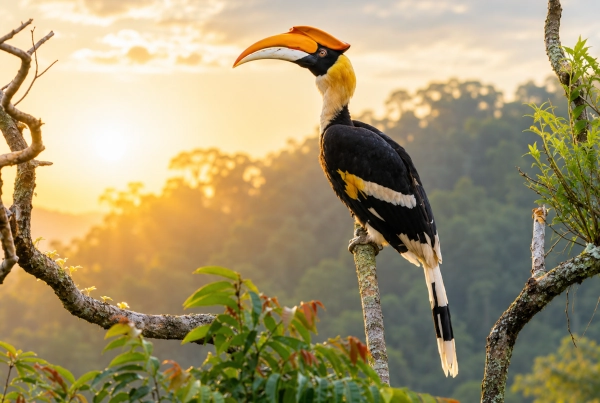
Indian researchers have produced the first high-quality reference genomes for four prominent Asian hornbill species, creating a new scientific resource that could help conservationists study genetic diversity, evolutionary history and the long-term resilience of some of Asia’s most important forest birds.
The work covers the great hornbill, rufous-necked hornbill, Malabar pied hornbill and wreathed hornbill. Researchers from the Nature Conservation Foundation in Mysuru and CSIR-Centre for Cellular and Molecular Biology in Hyderabad, working with scientists from the Manipal Academy of Higher Education and Academy of Scientific and Innovative Research, assembled and analysed the genomes. The research was published in BMC Ecology and Evolution on June 27, 2026.
Beyond creating a genetic reference for each species, the scientists reconstructed aspects of their ancient population history. Their analysis indicates that all four experienced substantial declines in effective population size during climatic fluctuations of the Pleistocene, revealing that the evolutionary history of these birds was shaped by environmental change long before today’s pressures from deforestation, hunting and habitat fragmentation emerged.
Building a Genetic Reference for Four Important Forest Birds
A reference genome can be thought of as a detailed genetic map of a species. It provides scientists with an organised baseline against which DNA collected from different individuals and populations can subsequently be compared.
Until now, genomic resources for Asian hornbills were remarkably limited. Although Asia supports 32 hornbill species, the researchers noted that whole-genome information was previously available for only two of them. The new study therefore substantially expands the genetic foundation available for hornbill research.
The four species selected for the project represent different ecological and geographical patterns. The great hornbill, rufous-necked hornbill and wreathed hornbill are associated largely with evergreen forest landscapes, while the Malabar pied hornbill also occupies moist deciduous habitats across the Indian subcontinent.
These differences make the species useful not only for conservation research but also for examining how forest birds responded historically to changes in climate and vegetation across South and Southeast Asia.
Genomes Between 1.1 and 1.3 Billion DNA Bases
The researchers combined long-read and short-read sequencing technologies to construct what are known as hybrid genome assemblies.
The assembled genomes ranged from approximately 1.1 to 1.3 gigabases, meaning each contains more than a billion DNA base pairs. The great hornbill genome measured about 1.14 Gb, the wreathed hornbill about 1.16 Gb, the Malabar pied hornbill about 1.24 Gb and the rufous-necked hornbill approximately 1.13 Gb.
Importantly, the assemblies were highly complete. Using BUSCO, a standard method for assessing whether expected genes are present in a genome assembly, the scientists obtained completeness estimates of 99% for the great hornbill, 99.4% for the wreathed hornbill, 95.9% for the Malabar pied hornbill and 98.3% for the rufous-necked hornbill.
This level of completeness makes the genomes useful as reference resources for future research rather than simply preliminary genetic sequences.
Scientists Identify More Than 10,000 Shared Gene Groups
Comparing the four genomes also allowed researchers to examine how hornbill genes have evolved.
The study identified 10,525 orthogroups shared among the four species. Orthogroups contain genes that originated from the same ancestral gene and can therefore help scientists trace evolutionary relationships and identify biological functions that have changed over time.
One particularly interesting finding involved genes associated with structural keratin development. The researchers detected significant expansion of some keratin-related gene families in Asian hornbills compared with their ancestors.
Keratin is an important structural protein in birds and forms part of feathers, claws, beaks and other tissues. Hornbills are especially recognisable for their enormous bills and characteristic casques, making the evolutionary expansion of structural gene families an intriguing area for further investigation.
The study does not establish a simple one-to-one genetic explanation for the hornbill casque, but the genomic resources now make much deeper investigation of these distinctive adaptations possible.
Complete Mitochondrial Genomes Were Also Produced
Alongside the nuclear genomes, the researchers assembled and annotated the mitochondrial genomes of all four species.
Mitochondrial DNA is inherited differently from most nuclear DNA and is widely used for studying evolutionary relationships, population history and movement between populations.
Having both nuclear and mitochondrial reference information gives future researchers several different genetic tools with which to investigate hornbill populations.
This could become especially valuable in fragmented landscapes where conservationists need to determine whether populations remain genetically connected or have become isolated from one another.
DNA Reveals a Population Decline Deep in the Past
One of the most significant parts of the research involved reconstructing historical population trajectories.
The scientists used a technique known as the Pairwise Sequentially Markovian Coalescent, or PSMC, which uses patterns within an individual genome to infer broad changes in effective population size over evolutionary time.
Their results indicate an overall decline in effective population size across all four hornbill species during Pleistocene climatic fluctuations.
The Pleistocene, which extended from roughly 2.6 million years ago until about 11,700 years ago, was characterised by repeated glacial and interglacial periods. These climatic oscillations repeatedly changed rainfall patterns, temperatures and the distribution of wet and dry forests.
For birds strongly dependent on tropical forests, such changes could repeatedly expand, contract or fragment suitable habitat.
The genomic evidence suggests these ancient environmental shifts left a detectable mark in the DNA of hornbills living today.
The Wreathed Hornbill Shows a Different Demographic Pattern
Among the four species, the wreathed hornbill displayed a higher historical effective population size than the other three.
Researchers noted that the species is comparatively widespread, abundant and capable of substantial seasonal movements, characteristics that may have helped maintain connectivity across larger landscapes.
This provides an interesting contrast with species whose populations are more geographically restricted or dependent on particular forest conditions.
However, effective population size reconstructed from genomic data should not be confused with a current wildlife census. It is a genetic measure related to the number of individuals contributing genes to subsequent generations and is used to understand long-term demographic history.
The findings therefore tell scientists about evolutionary population trajectories rather than providing estimates of how many hornbills currently survive in the wild.
Three Species Are Vulnerable and One Near Threatened
The genomic work comes at a time when Asian hornbills face significant modern conservation pressures.
The great hornbill, rufous-necked hornbill and wreathed hornbill are classified as Vulnerable, while the Malabar pied hornbill is classified as Near Threatened. The researchers identify habitat loss, forest destruction, hunting and illegal wildlife trade among the continuing pressures affecting hornbill populations across their ranges.
Hornbills are particularly sensitive to degradation of mature forests because of their unusual breeding biology. Females nest inside natural cavities in large trees, sealing themselves inside during much of the nesting period while depending heavily on the male to supply food.
Suitable nesting cavities generally occur in large, old trees. A forest may therefore retain considerable vegetation while still becoming unsuitable for breeding hornbills if mature nesting trees disappear.
This makes protection of old-growth forest structure particularly important for their survival.
Hornbills Are Important Seed Dispersers
The ecological importance of these birds extends well beyond their own conservation.
Many forest-dwelling hornbills consume large quantities of fruit and transport seeds considerable distances before depositing them elsewhere in the forest. The research paper describes them as important ecological representatives of tropical forests and highlights their role in seed dispersal and forest regeneration.
Large-bodied hornbills can swallow fruits and seeds that smaller birds cannot handle, making them especially important dispersers for certain large-seeded forest trees.
When hornbill populations disappear, forests may therefore lose not merely a spectacular bird but an important component of their natural regeneration system.
Their conservation can consequently benefit entire forest communities.
Genomics Adds a New Dimension to Wildlife Conservation
Traditional conservation relies heavily on field surveys, habitat mapping, nest monitoring, satellite tracking and direct estimates of animal populations. Genomics adds another layer by revealing biological information that cannot always be observed directly.
DNA samples collected from different populations can potentially reveal whether populations remain genetically connected, whether diversity is being lost and whether groups that appear similar in the field actually represent distinct evolutionary populations.
Reference genomes are fundamental to this work because they provide the genetic framework against which new samples can be compared.
For hornbills living in increasingly fragmented forests, such information could eventually help researchers determine whether protected areas remain connected enough to permit movement and breeding between populations.
Detecting Genetic Isolation Before It Becomes Visible
Population decline can create genetic problems even before a species becomes visibly rare.
When habitat fragmentation isolates small populations, fewer individuals contribute genes to future generations. Over time, genetic diversity can decline while mating between related individuals becomes more likely.
Such changes may affect a population’s capacity to adapt to disease, environmental change or new climatic conditions.
Genomic monitoring can potentially reveal these processes before they become obvious through conventional population counts.
The new hornbill genomes therefore provide a baseline from which future researchers can investigate the genetic health of populations across India and other parts of Asia.
The Great Hornbill Connects the Western Ghats and Northeast
The great hornbill (Buceros bicornis) is one of India’s most spectacular forest birds and occurs in important landscapes including the Western Ghats and northeastern India.
Its enormous yellow-and-black casque, powerful bill and striking black-and-white plumage make it one of the most recognisable hornbill species on the continent.
Yet populations separated by vast areas of unsuitable or fragmented habitat may experience very different conservation pressures.
Genome-level comparisons could eventually help scientists investigate how much genetic exchange continues between major populations and whether particular regions contain unique genetic diversity deserving special conservation attention.
The Rufous-Necked Hornbill Faces a More Restricted Indian Range
The rufous-necked hornbill (Aceros nipalensis) has a much more restricted Indian distribution and is associated primarily with forests of the eastern Himalaya and Northeast.
Males possess the characteristic reddish-brown neck that gives the species its name, while females have markedly darker head and neck plumage.
Because populations occur across international boundaries in parts of South and Southeast Asia, conservation also requires understanding movement and genetic relationships across political borders.
A high-quality reference genome provides a foundation for precisely this kind of landscape-scale research.
Malabar Pied Hornbill Represents a Different Forest Strategy
The Malabar pied hornbill (Anthracoceros coronatus) differs ecologically from the predominantly evergreen-forest species included in the study.
It occurs primarily across peninsular India and Sri Lanka and can use moist deciduous as well as riverine and other wooded habitats.
Its inclusion therefore gives scientists an opportunity to compare the genomic and demographic history of a hornbill occupying somewhat different environmental conditions.
Although its global conservation category is Near Threatened rather than Vulnerable, habitat degradation and the loss of large nesting trees remain important concerns.
Wreathed Hornbill’s Mobility May Offer Clues to Resilience
The wreathed hornbill (Rhyticeros undulatus) is capable of particularly extensive movements as it tracks seasonally available fruit resources across forest landscapes.
The species’ comparatively greater mobility provides an important ecological contrast to the other hornbills examined.
Its higher historical effective population size detected in the genomic analysis may encourage future research into whether mobility and landscape connectivity influence the maintenance of genetic diversity.
Such questions have direct conservation relevance because roads, dams, agriculture and forest fragmentation increasingly divide once-continuous tropical landscapes.
From Genome Sequencing to Conservation Decisions
The immediate achievement of the study is scientific: four Asian hornbill species now have high-quality genomic references that did not previously exist.
The larger value will emerge as researchers begin applying them.
Future studies could compare populations from different forests, examine the genetic effects of fragmentation, reconstruct movements between landscapes and identify populations carrying particularly important genetic diversity.
Genomics will not replace traditional habitat conservation. Protecting nesting trees, reducing hunting, preserving forest corridors and maintaining fruiting-tree diversity will remain fundamental to hornbill survival.
Instead, genetics can help conservationists understand which populations are becoming isolated and where ecological connectivity may be particularly important.
Indian Conservation Science Builds a Resource for Asia
The significance of the project extends beyond India because all four hornbill species occupy landscapes spanning parts of South and Southeast Asia.
The genome assemblies have therefore created a resource that can support comparative research across their wider geographical ranges.
The collaboration between the Nature Conservation Foundation, CSIR-CCMB, Manipal Academy of Higher Education and AcSIR also illustrates the increasingly important role of Indian institutions in applying advanced genomic science to wildlife conservation.
Sequencing a genome alone cannot save a species. Its value lies in what researchers can subsequently discover by comparing individuals, populations and landscapes against that genetic reference.
For hornbills, those comparisons can now begin at a level of detail that was previously impossible.
The result is a new scientific window into birds that perform one of the oldest services in India’s forests: carrying seeds from tree to tree and helping create the next generation of the forest itself.
You may also like
-
Chhattisgarh Plans Innovative Tree Surgery to Save Over 500 Damaged Trees in Udanti Sitanadi Tiger Reserve
-
Kerala’s Peechi Wildlife Survey Records 395 Species, Adds 36 New Entries to Biodiversity Checklists
-
Tiger Returns to Maharashtra’s Beed Forests After Nearly 100 Years, Highlights Importance of Wildlife Corridors
-
Himachal Pradesh Achieves Major Success in Rare Cheer Pheasant Conservation
-
Blackbucks to Return to Chhattisgarh’s Gomarda Wildlife Sanctuary After Five Decades
