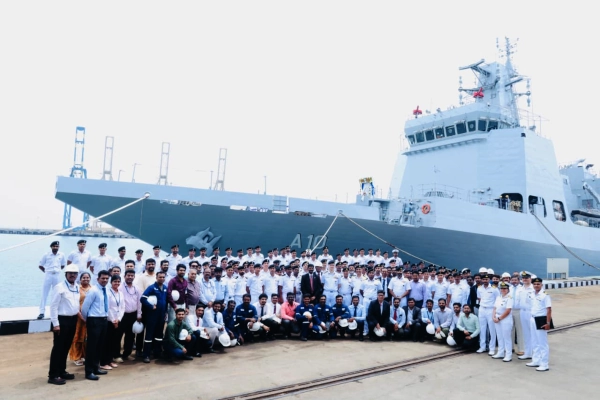
India’s indigenous naval shipbuilding programme has marked another significant milestone with the delivery of Samarthak, the first Multi-Purpose Vessel (MPV) built for the Indian Navy. Constructed by Larsen & Toubro Ltd. at its Kattupalli shipyard in Tamil Nadu, the vessel was formally delivered to the Navy on 27 August 2026, strengthening the service’s growing fleet of domestically designed and manufactured specialised platforms.
Samarthak has been conceived as far more than a conventional support vessel. The ship has primarily been designed to function as a versatile trial and evaluation platform, allowing the Indian Navy to support the testing, assessment and validation of naval systems and technologies at sea. At the same time, its design enables the vessel to undertake a much broader range of operational and support missions whenever required.
The ship incorporates more than 75 percent indigenous content, reflecting the increasing depth of India’s domestic naval manufacturing ecosystem. Indian shipyards, engineering companies, equipment manufacturers and specialised suppliers are now contributing an expanding share of the platforms, machinery, systems and associated equipment required for modern warship construction.
A Ship Designed Around Mission Flexibility
The defining characteristic of Samarthak is its ability to support multiple roles rather than being confined to a single specialised mission. The Indian Navy intends to employ the vessel for trials and evaluation activities, providing a maritime platform from which new equipment and technologies can be assessed under realistic operating conditions.
Such a capability is particularly valuable as the Navy progressively introduces new indigenous sensors, communications equipment, weapons, autonomous systems and other advanced technologies. Shore-based testing can establish whether equipment performs as intended under controlled conditions, but naval systems must ultimately demonstrate their reliability in the far more demanding environment of the sea.
A dedicated multi-purpose vessel can therefore provide valuable flexibility by supporting trials without placing unnecessary demands on frontline warships. It can also enable developers, shipbuilders and naval specialists to carry out evaluation activities from a platform specifically suited to experimentation and support functions.
Beyond its primary trial role, Samarthak has also been engineered to undertake maritime surveillance and reconnaissance, giving the Navy the ability to employ the vessel for monitoring activities when operational circumstances require it.
The ship can additionally perform offshore patrolling, extending its usefulness across missions involving maritime presence, situational awareness and support to naval operations.
Humanitarian and Disaster-Relief Capability
Another important element of Samarthak’s multi-role configuration is its ability to support Humanitarian Assistance and Disaster Relief operations.
India frequently deploys naval assets during cyclones, earthquakes, floods and other emergencies around the Indian Ocean. Naval vessels can transport relief material, equipment and personnel while operating independently in areas where shore infrastructure may have been damaged or disrupted.
A vessel capable of supporting disaster-relief missions consequently adds another layer of flexibility to the fleet. Samarthak could be called upon to supplement other naval assets during emergencies, making its value extend beyond purely military operations.
This ability to move between technical, surveillance, patrol and humanitarian responsibilities is central to the philosophy behind the Multi-Purpose Vessel programme.
Why the Name ‘Samarthak’ Fits the Vessel
The ship has been named Samarthak, a Sanskrit-derived word meaning “The Proponent” or one that supports and enables.
The name reflects the vessel’s intended role as a dependable enabler of multiple naval missions. Rather than being designed exclusively around one combat or support function, Samarthak is intended to provide the Navy with a platform capable of supporting a wide spectrum of activities.
Its name therefore captures the essential character of the vessel: a ship that can facilitate testing, contribute to surveillance, undertake patrol duties and provide assistance during humanitarian emergencies.
Strengthening India’s Naval Test and Evaluation Ecosystem
Samarthak’s significance extends beyond the addition of another hull to the Indian Navy.
India’s naval modernisation programme is increasingly centred on indigenous technologies. Indian organisations are developing new radars, sonars, electronic warfare systems, communication equipment, missiles, underwater technologies, unmanned platforms and other maritime systems. As these technologies move from laboratories and factories towards operational deployment, they require increasingly sophisticated testing environments.
Sea trials are a crucial part of this process because maritime conditions introduce variables that cannot be completely replicated on land. Equipment must withstand vibration, saltwater exposure, humidity, electromagnetic interference, vessel movement and prolonged operation under demanding conditions.
A vessel designed specifically to support trials and evaluation can therefore become an important part of the wider naval innovation infrastructure. It can help bridge the gap between technology development and operational deployment.
In this sense, Samarthak should be viewed not simply as an auxiliary vessel but also as an enabling platform for future naval technologies.
L&T’s Growing Role in Indian Naval Shipbuilding
The delivery also highlights the growing contribution of India’s private sector to complex naval construction.
Larsen & Toubro has developed substantial capabilities in defence engineering and shipbuilding, with its Kattupalli facility playing an increasingly important role in building and supporting naval and maritime platforms.
The construction of Samarthak demonstrates how private Indian shipyards are becoming integrated into the larger national naval shipbuilding ecosystem alongside public-sector shipyards. This broader industrial base gives India additional manufacturing capacity while encouraging domestic development of specialised equipment, subsystems and marine engineering expertise.
Large naval programmes also generate extensive supply chains. Hundreds of smaller manufacturers and engineering companies can contribute components ranging from electrical equipment and valves to communication systems, structural assemblies and specialised machinery.
The more than 75 percent indigenous content achieved aboard Samarthak consequently represents not merely local assembly but the participation of a wider Indian industrial network.
From Indigenous Warships to Indigenous Naval Infrastructure
Over the past several years, the Indian Navy has increasingly emphasised the principle that future maritime capability should be built around domestic design, manufacturing and technology development.
India already constructs a substantial portion of its major naval platforms domestically, including destroyers, frigates, corvettes, submarines, survey vessels, diving support vessels and specialised auxiliary ships.
The importance of indigenous shipbuilding lies not only in the vessels themselves. Each programme helps create skilled manpower, specialised infrastructure, design experience and manufacturing capability that can be reused across subsequent generations of ships.
A locally built platform can also provide greater flexibility for future modifications and upgrades because the domestic industrial ecosystem has a deeper understanding of the vessel and its systems.
Samarthak therefore represents another step towards a naval force whose ships, supporting platforms and increasingly sophisticated onboard technologies are sustained by an Indian industrial base.
Supporting the Navy of the Future
The requirement for platforms such as Samarthak is likely to grow as naval warfare becomes increasingly technology-intensive.
Future fleets will rely heavily on unmanned systems, artificial intelligence-assisted sensors, advanced electronic warfare, long-range precision weapons, networked surveillance systems and increasingly sophisticated underwater technologies. Before these systems can be deployed at scale, they must undergo extensive testing under operational conditions.
A dedicated Multi-Purpose Vessel provides the Navy with an adaptable platform from which such work can be conducted while preserving the availability of major combatants for frontline missions.
Its ability to shift between testing, maritime surveillance, reconnaissance, offshore patrol and humanitarian duties also ensures that the ship remains operationally useful even when it is not supporting dedicated trials.
Another Milestone for Aatmanirbhar Naval Shipbuilding
The delivery of Samarthak on 27 August 2026 is consequently important on several levels.
For the Indian Navy, it provides a flexible new platform capable of supporting technological evaluation as well as operational and humanitarian missions. For Indian industry, it demonstrates the ability of domestic shipyards and suppliers to deliver increasingly specialised naval vessels with high indigenous content.
Most importantly, the ship strengthens the infrastructure required for India to develop, test and eventually deploy its own naval technologies.
As the Navy continues its transition towards a more technologically advanced and increasingly indigenous fleet, vessels such as Samarthak will serve an important enabling role behind the frontline.
Its delivery is therefore more than the completion of a new ship. It represents another step towards a self-sustaining Indian maritime defence ecosystem in which ships, systems, testing capabilities and industrial expertise are progressively developed within the country.
You may also like
-
Bengaluru Startup Paar Autonomy Develops AI-Powered Drone Systems for GPS-Denied Environments
-
Sigma Advanced Systems Secures Fresh ₹973 Crore NATO Artillery Ammunition Order
-
India Advances Indigenous Defence and Space Technologies Through Naval Innovation, Drones and Advanced Electronics
-
Thales Seeks Indian Partnerships for Next-Generation Missiles, Radars and Electronic Warfare Systems
-
Indian and Australian Armies Conduct Jungle and Coastal Warfare Drills in AUSTRAHIND 2026
