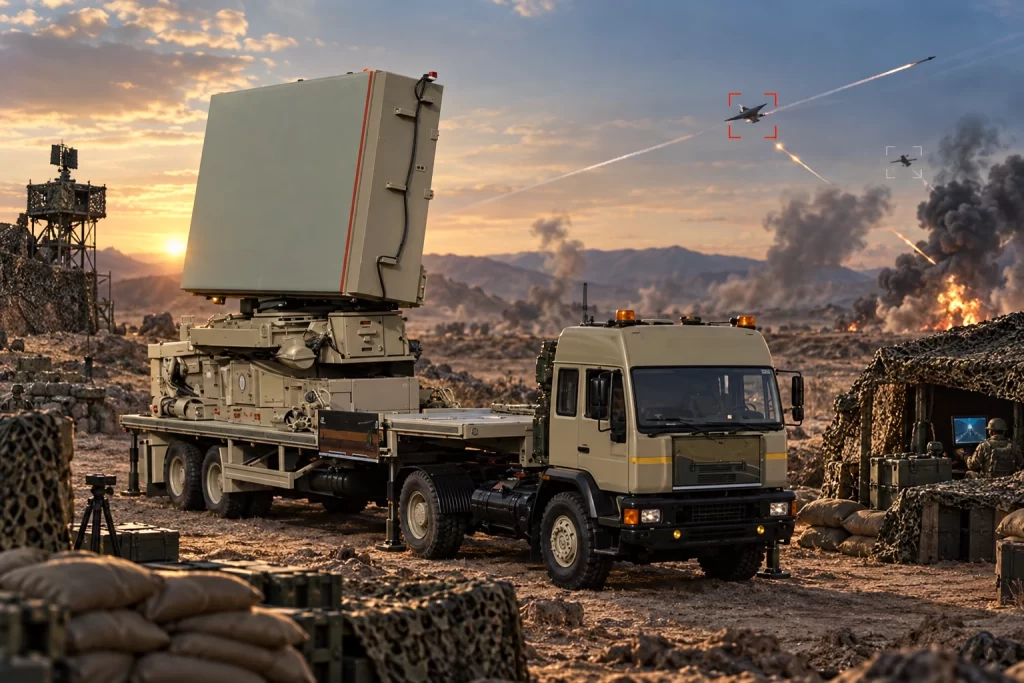
The Indian Navy is set to strengthen surveillance around its naval air stations with the indigenous Arudhra Medium Power Radar, after the Defence Acquisition Council granted Acceptance of Necessity for procurement of the advanced 4D surveillance system on September 7, 2026.
The Ministry of Defence said the Arudhra radars will replace the existing Air Route Surveillance Radars at various Naval Air Stations, giving the Navy a modern indigenous system for detecting, tracking and identifying aircraft and other aerial targets around strategically important aviation facilities. The September approval is an Acceptance of Necessity, meaning the acquisition has received in-principle administrative clearance but has not yet reached the contract stage.
Arudhra is one of India’s most advanced indigenous ground-based surveillance radars. Developed by the Electronics and Radar Development Establishment, or LRDE, of the Defence Research and Development Organisation, it is a rotating active phased-array multifunction 4D radar designed to create an accurate picture of activity across a large volume of airspace.
The radar has an instrumented range of 400 kilometres. According to DRDO’s official technical documentation, Arudhra can detect a target with a radar cross-section of around 2 square metres at distances of up to 300 kilometres, while providing altitude coverage extending from approximately 100 metres to 30 kilometres. This allows the radar to monitor targets ranging from aircraft operating close to the ground to high-altitude aerial platforms.
DRDO describes Arudhra as capable of automatically detecting and tracking aerial targets ranging from conventional fighter aircraft to slower-moving objects. Earlier official descriptions also note that the system incorporates specialised modes for detecting and tracking low radar-cross-section, high-speed and highly manoeuvrable targets, making it considerably more capable than a conventional civil air-traffic surveillance radar.
A major technological feature of Arudhra is its solid-state active aperture phased-array antenna. Instead of relying solely on mechanical movement to point the radar beam, the system electronically controls the beam using large numbers of transmit-receive elements. This allows the radar to shift its surveillance beam extremely rapidly while the antenna itself rotates to provide broad-area coverage.
The radar employs digital beam-forming technology and electronic scanning in both azimuth and elevation. DRDO says its coverage is achieved using a wide transmit beam combined with multiple receive beams, enabling the radar to observe a large volume of airspace while simultaneously determining the position of multiple targets.
Arudhra can operate in two principal surveillance configurations. In its normal rotation mode, the antenna can rotate at either 7.5 or 15 revolutions per minute, providing complete 360-degree coverage in azimuth and approximately 30 degrees of elevation coverage. This mode is suited to continuous surveillance of the surrounding airspace.
The radar can also operate in a staring mode. In this configuration, the antenna remains focused toward a selected sector rather than continuously rotating. DRDO gives the staring-mode coverage as approximately ±60 degrees in azimuth with 30 degrees of elevation coverage. Concentrating the radar on a particular sector allows it to provide a higher update rate when closer attention is required in a specific direction.
This combination makes the system flexible. During routine operations, Arudhra can maintain continuous 360-degree surveillance. If an area of particular concern emerges, the radar can concentrate its resources on that sector and update target information more rapidly.
The system is also capable of Track While Scan, allowing it to continue searching the surrounding airspace even while maintaining tracks on targets that have already been detected. This is a fundamental requirement for a modern military surveillance radar operating in congested or contested airspace.
Another important feature is its resistance to electronic attack. Arudhra was designed to operate in an environment containing intense electronic countermeasures and electromagnetic interference. Bharat Electronics Limited, which manufactures the radar from the DRDO design, has described the system as incorporating advanced Electronic Counter-Countermeasure, or ECCM, capabilities intended to maintain radar effectiveness when an adversary attempts to jam or disrupt it.
The radar also uses technologies such as adaptive data rates and dynamic waveform selection, allowing its operating characteristics to be altered according to the surveillance environment. These capabilities help a military radar adapt when faced with changing target behaviour, interference or deliberate attempts to degrade its performance.
Arudhra incorporates a modern Identification Friend or Foe system, enabling operators to distinguish cooperating friendly aircraft from unidentified contacts. DRDO’s design includes an independently rotating IFF radar, integrating identification with the primary air-surveillance picture.
Mobility was also built into the design. Earlier DRDO descriptions state that the system can be transported by road, rail and air, allowing it to be deployed or repositioned as operational requirements change. This differentiates it from permanently fixed surveillance installations and provides greater flexibility during military operations.
Arudhra represents an important technological milestone for India’s radar-development programme because it was the country’s first indigenous rotating active phased-array multifunction radar incorporating digital beam forming. Technologies established during the programme include rotating active arrays, two-dimensional digital beam forming, multi-beam processing, active-array calibration, synchronisation of multiple receivers and critical real-time radar software and firmware.
The radar was originally developed primarily around Indian Air Force surveillance requirements. In March 2023, the Ministry of Defence signed a contract worth more than ₹2,800 crore with Bharat Electronics Limited for Arudhra Medium Power Radars for the Indian Air Force. The procurement was placed in the Buy Indian-IDDM category, recognising the radar as an indigenously designed, developed and manufactured system.
Under that arrangement, DRDO’s LRDE provided the indigenous design while BEL became the production agency, manufacturing the radar for operational deployment. BEL describes Arudhra as a state-of-the-art 4D surveillance radar based on active-aperture phased-array technology and solid-state transmit-receive modules.
The Navy’s new requirement represents an important expansion of the radar’s role beyond its established Air Force application. Rather than being deployed aboard warships, the Arudhra systems covered by the September 7 approval are intended to replace older surveillance radars at Naval Air Stations ashore.
Naval air stations support a wide range of aircraft, including maritime-patrol aircraft, helicopters, fighters and unmanned systems. Maintaining an accurate picture of the surrounding airspace is therefore critical both for routine flying operations and for protecting strategically important naval aviation bases during a conflict.
Arudhra’s combination of long-range surveillance, low-altitude coverage, electronic-warfare resistance and target identification could substantially improve the ability of naval aviation facilities to detect aircraft approaching from different altitudes and directions.
Its ability to observe targets down to approximately 100 metres is particularly relevant because hostile aircraft, cruise missiles or unmanned systems may attempt to exploit low-altitude flight to reduce the time available for detection. Actual detection range against any particular target will depend on factors including its radar cross-section, altitude, terrain, propagation conditions and electronic-warfare environment, so the radar’s 400-km instrumented range should not be interpreted as a guaranteed detection range against every type of target.
The naval acquisition also demonstrates how technology developed for one branch of the armed forces can increasingly be adapted across services. DRDO itself notes that technologies developed through the Medium Power Radar programme can support shipborne radar applications, mountain radars and future LRDE radar families, extending the value of the Arudhra programme beyond the original system.
The September 7 decision does not disclose the number of Arudhra radars the Navy intends to acquire, the value of the programme or a delivery schedule. Nor has a new production contract with BEL yet been announced. Those details should emerge as the procurement advances beyond the Acceptance of Necessity stage.
What is already clear, however, is that the Navy intends to replace older Air Route Surveillance Radars at multiple naval air stations with a substantially more capable indigenous military surveillance system.
With a 400-km instrumented range, active phased-array architecture, digital beam forming, 360-degree surveillance, staring capability, IFF integration and advanced resistance to electronic countermeasures, Arudhra provides India with a sophisticated domestically developed tool for maintaining a persistent picture of contested airspace.
The Navy’s decision to adopt the system therefore represents another step in the evolution of Arudhra from an indigenous DRDO technology project into a radar family capable of supporting the surveillance requirements of multiple branches of India’s armed forces.
You may also like
-
EON Space Labs and Dhruva Space Advance Indian Space Hardware on Transporter-18 Mission
-
SatLeo Labs’ TAPAS-1 Reaches Orbit, Advancing India’s Private Thermal-Imaging Capability
-
TakeMe2Space’s MOI-1A Reaches Space on Falcon 9 Transporter-18 Mission
-
PRAHAAR: India’s First National Counter-Terrorism Policy and Strategy
-
SCI and India’s Push for a Larger Indigenous Maritime Fleet
