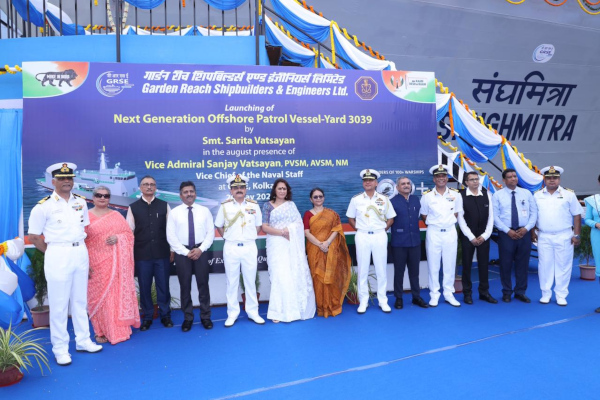
The Indian Navy marked another important milestone in its indigenous shipbuilding journey with the launch of Yard 3039, Sanghmitra, a Next Generation Offshore Patrol Vessel at Garden Reach Shipbuilders & Engineers Ltd., Kolkata. The vessel was launched on 20 May 2026 by Mrs Sarita Vatsayan, in the presence of Vice Admiral Sanjay Vatsayan, Vice Chief of the Naval Staff. Senior officials from the Indian Navy, Ministry of Defence and GRSE attended the ceremony, which was conducted with full naval honours.
The launch of Sanghmitra is part of the Indian Navy’s larger plan to strengthen its offshore patrol and maritime security capabilities. A total of 11 Next Generation Offshore Patrol Vessels are being constructed simultaneously at two Indian shipyards — Goa Shipyard Limited in Goa and GRSE in Kolkata. These vessels are being indigenously designed and built, adding another layer to India’s growing self-reliance in warship construction.
The NGOPVs will augment the Navy’s existing offshore patrol vessel fleet and will be used for a wide range of multi-domain missions. Their operational roles include surveillance in areas of interest, maritime defence tasks, search and rescue, protection of offshore assets, humanitarian assistance and disaster relief operations, and anti-piracy missions. This makes the platform highly relevant for India’s expanding maritime responsibilities across the Indian Ocean Region.
Offshore patrol vessels may not always attract the same public attention as aircraft carriers, destroyers or submarines, but they are essential to daily maritime security. They help maintain presence across vast sea spaces, monitor suspicious activity, protect economic assets, support coastal security and respond quickly to emergencies. For a country like India, with a long coastline, island territories, offshore energy infrastructure and expanding sea trade, such vessels form a practical and necessary layer of naval power.
The name Sanghmitra carries a strong civilisational connection. The vessel is named after Sanghamitra, the daughter of Emperor Ashoka, who is remembered in Indian and Buddhist tradition for carrying the message of Buddhism to Sri Lanka. By naming the vessel after her, the Navy has continued its practice of linking modern warships with India’s historical and cultural memory.
The ship’s crest also reflects symbolic design. According to the Ministry of Defence release, the crest depicts the Ursa Major constellation along with a red and white lighthouse. This imagery is appropriate for a patrol vessel, as both the stars and the lighthouse are associated with navigation, guidance, vigilance and safety at sea.
The launch also underlines the growing importance of GRSE in India’s naval shipbuilding ecosystem. The Kolkata-based shipyard has been a key contributor to several Indian Navy and Coast Guard platforms, and its role in the NGOPV programme reinforces the distributed strength of India’s public-sector defence shipyards. Building these vessels concurrently at GRSE and GSL also helps speed up delivery timelines while strengthening shipbuilding capacity across different regions.
Sanghmitra’s launch fits closely with the Government of India’s Aatmanirbhar Bharat and Make in India vision. Every indigenously designed and built naval platform adds to domestic expertise in ship design, hull construction, marine engineering, systems integration, project management and lifecycle support. In the long term, such programmes reduce dependence on foreign suppliers and create a stronger industrial base for future naval platforms.
The NGOPV programme is especially important because India’s maritime security needs are expanding. The Navy must monitor sea lanes, protect offshore infrastructure, support island territories, assist friendly countries during disasters, counter piracy and maintain a credible presence across sensitive maritime zones. Vessels like Sanghmitra are designed for exactly this kind of persistent, flexible and cost-effective deployment.
Overall, the launch of Sanghmitra is more than a ceremonial shipyard event. It represents the steady growth of India’s indigenous naval construction capability and the strengthening of the Navy’s everyday operational reach. As the NGOPV fleet takes shape, India will gain a more capable patrol force for surveillance, security, humanitarian support and maritime stability across its areas of interest.
You may also like
-
DRDO Opens Indigenous Thermal Tank Target Technology to Indian Defence Industry
-
China Reduced PLA Deployment Along LAC in 2025 as India Maintained Robust Border Posture: Defence Ministry
-
Why Space Is Becoming the Fifth Domain of Modern Warfare
-
S-400 Destroyed Pakistani Special-Mission Aircraft at 314 km During Operation Sindoor: Defence Ministry
-
IIT Madras Develops Morphing Wing Technology to Improve Aircraft Stall Performance
