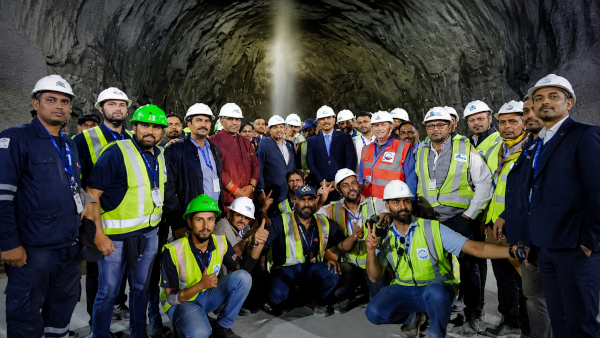
India has crossed a major infrastructure milestone in the Himalayas with the final breakthrough of the Zojila Tunnel on 9 June 2026. The breakthrough connects the two ends of the main tunnel beneath the Zojila Pass, marking the completion of the excavation phase of one of India’s most difficult strategic road projects. The tunnel is being built to provide all-weather road connectivity between Kashmir and Ladakh, a region whose access has long depended on weather windows, snow clearance and seasonal road openings.
The main Zojila Tunnel is about 13.153 km long and runs between Baltal near Sonamarg in Jammu and Kashmir and Meenamarg in the Drass sector of Ladakh. It lies on the vital Srinagar–Kargil–Leh axis, the road that links the Kashmir Valley with Ladakh. NHIDCL lists the Zojila Tunnel Project on NH-01 as an ongoing Sonamarg–Kargil project involving a bi-directional tunnel across Zojila Pass in the Union Territories of Jammu & Kashmir and Ladakh.
The importance of this tunnel comes from the geography of Zojila itself. The pass sits at a high-altitude Himalayan choke point where snow, blizzards and avalanches regularly disrupt road movement. For decades, this route remained one of the most difficult mountain roads in the country. Ladakh’s road access from the Kashmir side has been shaped by harsh winter closures, narrow movement windows and difficult logistics. The tunnel changes that equation by taking traffic below the exposed pass and giving the Srinagar–Leh corridor a protected all-weather shield.
The project carries direct strategic value. Ladakh sits near India’s sensitive frontiers with both China and Pakistan. The Srinagar–Leh highway supports troop movement, equipment transport and supplies for forward areas, including deployments connected with Ladakh and the Siachen region. During the 1999 Kargil conflict, the importance of this road became clear when Pakistani forces attempted to threaten the highway and disturb India’s military supply chain. A reliable tunnel through Zojila strengthens India’s ability to sustain movement across this corridor through the year.
The engineering scale is equally significant. Moneycontrol reported that the larger project extends beyond the main bore and includes approach roads, bridges, cut-and-cover structures, a snow gallery and the Nilgrar twin tunnels. The project also includes vertical shafts for ventilation and emergency access, with one western shaft reported as India’s longest vertical shaft at more than 470 metres. These systems are essential because the tunnel is a long single-tube bi-directional passage built in extreme terrain.
Construction conditions have been severe. The tunnel is being built at nearly 11,578 feet above sea level, with temperatures falling sharply during winter. MEIL, the contractor executing the work for NHIDCL, says the project uses the New Austrian Tunnelling Method, along with planned systems such as automatic lighting, emergency lighting, emergency phones, message signalling and radio communication for traveller safety.
For civilians, the tunnel can reshape life in Ladakh and the upper Himalayan belt. All-weather connectivity means more predictable transport of food, fuel, medicines, construction material and daily-use goods. It can support tourism, trade, healthcare access, education access and emergency movement. MEIL’s project page says the completed tunnel will reduce travel time between Srinagar and Ladakh from around 3.5 hours to 45 minutes on the relevant stretch, while other reports note a sharp reduction on the Zojila crossing itself.
The breakthrough is a historic step, while the tunnel still requires finishing work before traffic can move through it. Lining, electrical systems, ventilation, safety infrastructure and operational readiness remain part of the next phase. Reports indicate that the tunnel is expected to become operational in 2028.
The Zojila Tunnel is more than a road project. It is a statement of India’s border infrastructure policy in the Himalayas. It connects remote citizens with the national economy, gives the armed forces a stronger logistics artery, and turns a weather-exposed mountain pass into a protected strategic corridor. Once completed, it will bring Ladakh closer to the rest of India in distance, time, security and national integration.
You may also like
-
India Moves Towards Five-Year Assured Orders for Defence Startups Under New Procurement Reforms
-
Zen Technologies Introduces Indigenous Hyper-Strike Falcon AI-Guided Counter-Drone Interceptor
-
L&T and Germany’s SCHOTTEL Expand Partnership for Controllable Pitch Propeller Systems in Indian Shipbuilding
-
PM Modi to Inaugurate RBI’s Tier IV Data Centre and Cybersecurity Training Institute in Bhubaneswar
-
India to Train 60,000 Civil Defence Volunteers Across 12 States and UTs with Indian Army Support
