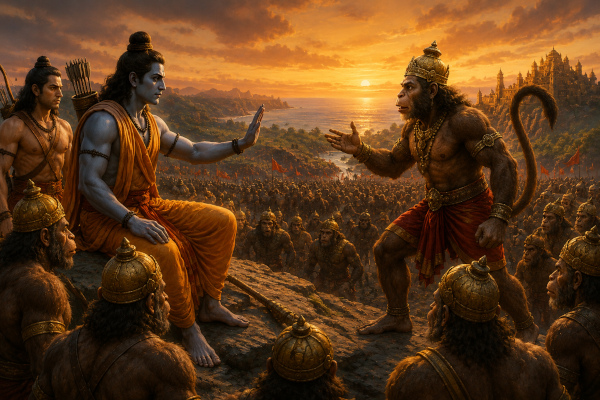
Leadership discipline stands as one of the sharpest military lessons in the Lanka campaign. The Ramayana shows this through a brief but powerful moment when Sugriva, driven by emotion and warrior pride, suddenly leaps toward Ravana and attacks him without consulting Rama or the war council. His courage is unquestionable. His loyalty is complete. His action carries the fire of a warrior who sees the enemy king standing before him and feels the urge to strike. Rama still rebukes him, because courage on a battlefield must move inside the frame of strategy.
The scene unfolds after Rama’s army reaches Lanka and surveys the enemy capital from Suvela mountain. Ravana appears in royal splendour, standing above his fortified city. Sugriva sees him and reacts with sudden aggression. He springs forward, reaches Ravana and engages him in direct combat. The act is bold, dramatic and filled with personal bravery. Yet it takes place outside the planned command structure. Sugriva acts as a warrior first, while Rama expects him to act as a king, ally and commander.
Rama’s rebuke gives the episode its military meaning. He tells Sugriva that such rash conduct does not suit a king. This is a lesson in command responsibility. A ruler carries more than his own life into battle. He carries the morale of his soldiers, the stability of alliances, the rhythm of the campaign and the confidence of the command system. A commander’s personal bravery must serve the army’s mission. When a leader acts alone from impulse, the entire force may be forced to react to his decision.
Sugriva’s action shows the danger of emotional acceleration in war. Battlefields create moments of temptation. A commander may see an exposed enemy, a symbolic target or a chance for personal glory. The mind rushes toward action. Strategy asks a different question: what happens after the strike? If the leader is captured, wounded or isolated, the army loses a key command figure. If the enemy uses the moment as a trap, the campaign suffers confusion. If the action begins before the army is ready, the attacker gives away timing and intent.
Rama’s leadership is therefore rooted in disciplined control. He values courage, yet he places it under purpose. He honours Sugriva’s strength, yet he reminds him of royal duty. This balance makes Rama a military leader rather than a mere battlefield hero. He understands that the Lanka war requires siege planning, gate assignments, intelligence, logistics, morale and timing. A single heroic leap can inspire soldiers, but a disciplined campaign wins the war.
Modern military doctrine expresses the same idea through command and control. Every major operation depends on a clear chain of command, defined objectives, rules of engagement, intelligence assessment and coordinated timing. A platoon, battalion, naval task force or air squadron may contain brave individuals, but their strength comes from synchronised action. A missile fired early, a patrol moving beyond its assigned line, a commander entering a kill zone without clearance or a unit breaking formation can disturb the entire operation.
This is where the modern concept of mission command becomes relevant. Mission command gives subordinate leaders the freedom to act with initiative, while keeping them aligned with the commander’s intent. It encourages boldness within boundaries. It allows field commanders to respond to changing ground conditions, while preserving the larger mission. Rama’s rebuke to Sugriva fits this principle with remarkable clarity. Initiative has value when it supports the plan. Initiative becomes danger when it separates from the plan.
The episode also teaches the difference between warrior instinct and command maturity. A warrior sees Ravana and thinks of combat. A commander sees Ravana and thinks of terrain, reserves, enemy reaction, morale, timing and the next phase of battle. Sugriva’s leap belongs to the first instinct. Rama’s correction belongs to the second. The Ramayana uses this contrast to show that leadership in war demands emotional mastery.
In modern warfare, this lesson applies strongly to urban operations, counter-terror missions and border engagements. A tactical team may see a hostile target inside a building, but entry requires confirmation, coordination, covering fire, escape routes, civilian safety, communication and backup. A fighter pilot may detect a target, but engagement depends on identification, clearance and airspace control. A forward unit may sense opportunity, but its movement must match the operational grid. The bravest soldier becomes most effective when his courage flows through discipline.
Sugriva’s position makes the lesson even stronger. He is not an ordinary fighter in Rama’s army. He is the king of Kishkindha and the leader of the Vanara forces. His safety carries political and military weight. If he falls through impulsive action, the alliance itself faces strain. His army may feel shaken. Command succession may become unclear. Rama’s rebuke protects Sugriva from his own courage and protects the campaign from avoidable uncertainty.
This is a powerful leadership principle. Senior commanders must behave as stabilising centres during war. Their presence gives confidence to soldiers. Their decisions guide movement. Their restraint preserves timing. Their calm under provocation becomes a weapon in itself. Ravana standing visible before the army is a provocation. Sugriva responds with heat. Rama responds with command discipline. The difference between the two responses defines the difference between impulse and strategy.
The moment also reveals Rama’s understanding of alliance management. Sugriva is his friend and ally, yet Rama corrects him directly. This shows that battlefield friendship remains guided by duty. Alliances require trust, but they also require discipline. Each leader must respect the common plan. The Lanka campaign involves many commanders: Rama, Lakshmana, Sugriva, Hanuman, Angada, Jambavan, Nala, Neela and Vibhishana. Their combined strength works because each role fits into the larger design.
In a modern joint operation, this resembles coordination between army, navy, air force, intelligence agencies, special forces and local commanders. Every arm has its own speed and strength. Air power can strike fast, armour can break ground, infantry can hold territory, drones can watch movement and intelligence can guide targeting. The operation succeeds when these parts act in rhythm. One uncontrolled action can pull resources away from the main objective. One disciplined decision can preserve the full force for decisive effect.
Rama’s rebuke also teaches the military value of patience. Patience in war is active strength. It allows commanders to choose the right moment, prepare the ground, study the enemy and preserve surprise. The army standing before Lanka has already crossed the sea, built a bridge, gathered intelligence and arranged commanders around the city’s gates. At such a stage, every action must serve the final assault. A premature duel with Ravana could disturb the unfolding campaign.
Sugriva’s bravery still has value in the story. His leap shows personal loyalty to Rama and fierce hatred of Ravana’s injustice. Rama’s correction does not reduce that bravery; it refines its direction. A good commander does not crush courage. He disciplines it, channels it and returns it to the larger mission. This is why Rama’s leadership feels complete. He inspires warriors to fight with fire, while teaching them to carry that fire within command discipline.
The Ramayana therefore presents leadership discipline as a weapon of war. It is quieter than arrows, maces and flaming torches, yet it decides the quality of the campaign. An army with brave fighters can create impact. An army with disciplined leaders can create victory. Sugriva’s sudden attack shows the danger of unplanned boldness. Rama’s response shows the strength of strategic command.
In the Lanka campaign, this moment stands as a battlefield classroom. A king must think beyond his own arm. A commander must place duty above impulse. A warrior must obey the rhythm of the campaign. A leader must measure every action against the mission. Rama’s rebuke to Sugriva teaches that bravery reaches its highest form when it serves strategy. In war, courage becomes decisive only when discipline holds the reins.
You may also like
-
India Moves Towards Five-Year Assured Orders for Defence Startups Under New Procurement Reforms
-
Zen Technologies Introduces Indigenous Hyper-Strike Falcon AI-Guided Counter-Drone Interceptor
-
L&T and Germany’s SCHOTTEL Expand Partnership for Controllable Pitch Propeller Systems in Indian Shipbuilding
-
India to Train 60,000 Civil Defence Volunteers Across 12 States and UTs with Indian Army Support
-
Indian Army’s Northern Command Opens 75-Day Defence Technology Internship Programme for Young Innovators
