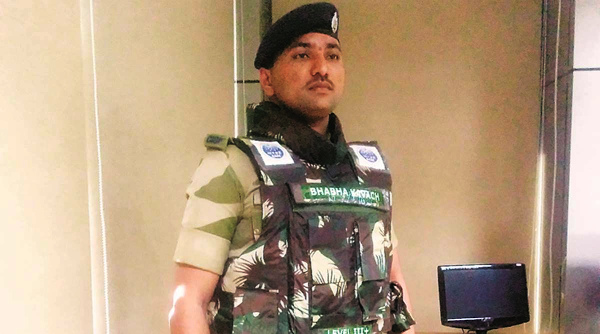
India’s defence manufacturing transformation is increasingly visible not only in missiles, warships, aircraft and artillery systems, but also in the personal protective equipment carried by individual soldiers. Bulletproof jackets, ballistic plates, tactical vests and related body-armour systems have emerged as an important segment of the country’s expanding defence-industrial ecosystem.
Indian manufacturers are now capable of designing and producing modular ballistic-protection systems intended for military forces, police units, paramilitary personnel and specialised security teams. These products combine indigenous research, advanced ceramics, high-strength polymers, technical textiles and ergonomic load-distribution systems.
India has also exported bulletproof jackets and body armour to international markets. Government records identify these products among the principal categories of defence equipment exported by India, alongside patrol vessels, radars, avionics, small arms, ammunition and communication systems.
From Import Dependence to Indigenous Production
For many years, India depended partly on imported materials and foreign-designed protective equipment to meet the requirements of its armed forces and security organisations. The large operational requirement of the Indian Army, Central Armed Police Forces and state police organisations eventually encouraged the development of a domestic ballistic-protection industry.
A decisive step came when the Indian government signed a contract in April 2018 for 1,86,138 bulletproof jackets under the Buy Indian category. The jackets were selected following field trials and were designed to provide extensive protection while retaining the flexibility required for patrolling, close-quarter operations and high-risk interventions.
The scale of the order demonstrated that Indian companies had acquired the manufacturing capacity, material expertise and quality-control systems needed to undertake large defence contracts.
Domestic demand subsequently helped Indian manufacturers establish production lines, testing facilities and supply chains that could also support international customers.
Indigenous Research and Technology
The Defence Research and Development Organisation has played a central role in building India’s body-armour technology base.
DRDO’s Defence Materials and Stores Research and Development Establishment developed a bulletproof jacket conforming to the Indian Army’s General Staff Qualitative Requirement 1438. The technology, designed to meet NIJ III+ protection requirements, was transferred to Indian industry for production.
This technology transfer demonstrated the model increasingly used across India’s defence sector:
government-funded research, military evaluation, technology transfer and industrial-scale manufacturing.
Indian ballistic jackets generally combine two principal protective elements.
The soft-armour panel is manufactured from multiple layers of high-strength ballistic fibres. It is intended to absorb and disperse the energy generated by handgun rounds, fragments and lower-energy projectiles.
The hard-armour panel uses materials such as boron carbide, silicon carbide, alumina ceramics, ultra-high-molecular-weight polyethylene or composite backing structures. These panels are inserted into the front, rear and sometimes side sections of the jacket to protect against rifle ammunition and higher-energy threats.
When a projectile strikes the armour, the ceramic surface helps deform, break or erode the projectile. The composite backing then captures the fragments and spreads the remaining energy across a wider area.
India’s Own Ballistic-Jacket Standard
An important milestone was the introduction of IS 17051:2018, the Indian Standard covering the performance requirements of bullet-resistant jackets.
The standard establishes requirements related to jacket construction, ballistic threat levels, hard- and soft-armour panels, weight, behind-armour deformation, environmental exposure and durability. BIS-recognised testing includes assessments involving ballistic impact, high and low temperatures, water resistance, mechanical drops, vibration and other demanding conditions.
The development of a national standard reduced ambiguity in procurement and enabled security organisations to compare products according to clearly defined performance criteria.
It also helped Indian manufacturers demonstrate that domestically produced jackets were based on formal testing procedures rather than unverified claims of ballistic resistance.
Indian officials have stated that jackets produced according to the BIS standard can weigh approximately five to ten kilograms, depending on the protection level and configuration. The systems may include dynamic weight distribution, quick-release mechanisms and modular protective components.
ABHED: India’s Next Generation of Lightweight Armour
India’s body-armour sector is continuing to evolve beyond conventional jackets.
DRDO and the Indian Institute of Technology Delhi have developed a family of lightweight bulletproof jackets known as ABHED—Advanced Ballistics for High Energy Defeat.
The jackets were developed through the DRDO Industry Academia Centre of Excellence at IIT Delhi. They use indigenous boron-carbide ceramic material and polymer-based components, supported by material characterisation, computer modelling and high-strain-rate analysis.
Different ABHED configurations have minimum stated weights of approximately 8.2 kilograms and 9.5 kilograms. They employ modular front and rear armour and are intended to provide 360-degree protection while remaining below the maximum weight permitted under the relevant Indian Army requirements.
DRDO has also developed a lightweight jacket capable of providing protection against the highest Level 6 threat category under the BIS system.
Reducing weight is operationally important because a soldier may already carry ammunition, communication equipment, water, medical supplies, surveillance devices and other mission gear. Even a modest reduction in armour weight can improve mobility, endurance and combat effectiveness.
Modular Protection for Different Missions
Modern body armour cannot be treated as a single standard vest for every soldier and every operation.
Indian manufacturers are increasingly producing modular systems that can be configured for:
- Infantry combat and border deployment
- Counter-terrorism and close-quarter battle
- Special Forces operations
- Police and paramilitary duties
- Bomb-disposal and explosive-ordnance operations
- Maritime security and boarding operations
- Vehicle crews and aviation personnel
- Female soldiers and police personnel
A basic configuration may contain soft armour for fragment and handgun protection. Hard plates can be added when rifle protection is required. Side plates, groin protection, shoulder guards, collars and throat protection may be fitted for operations where increased coverage is more important than minimum weight.
Quick-release systems allow the jacket to be removed rapidly during medical emergencies, water-related accidents or equipment entanglement. Modern carrier designs can also accommodate ammunition pouches, radios, hydration systems and other mission equipment.
Manufacturing and Material Ecosystem
The growth of India’s body-armour industry supports a wider chain of specialised manufacturing.
The sector requires:
- Ballistic ceramics
- Aramid and polyethylene fibres
- Composite backing materials
- Technical textiles
- Precision moulding and pressing
- High-strength stitching and fastening systems
- Environmental sealing and protective coatings
- Ballistic-testing infrastructure
- Computer-aided design and simulation
- Quality-control and traceability systems
Companies operating in the sector range from major defence manufacturers to specialised textile, ceramic, polymer and composite-material enterprises. This creates opportunities for micro, small and medium enterprises to enter the defence supply chain by producing components rather than complete jackets.
The industry also has applications beyond personal armour. Similar materials and engineering methods can be used for vehicle armour, aircraft crew protection, naval protection panels, ballistic shields, guard posts and protected infrastructure.
Defence Export Potential
Bulletproof jackets and body armour are among the categories already recognised by the Ministry of Defence as Indian defence exports. India has issued export authorisations for ballistic vests, hard-armour plates, helmets, over-vests and related protective products for several countries.
The broader environment for such exports is also becoming stronger. India’s defence exports reached a record ₹38,424 crore during the 2025–26 financial year, representing an increase of 62.66 per cent over the previous year.
Indian defence production simultaneously reached approximately ₹1.78 lakh crore in 2025–26, with the private sector accounting for about 24 per cent of output.
Ballistic protection is particularly suitable for export because it can be adapted relatively quickly to different customer requirements. Jackets can be configured according to the ammunition threat, climate, body dimensions, military doctrine and tactical equipment used by the purchasing country.
Relevance to Australia
Australia operates armed forces, federal security organisations, state police services and specialist tactical units that require advanced ballistic protection. Its military also conducts operations across environments ranging from tropical northern regions and maritime approaches to overseas deployments.
Indian body armour could offer several relevant capabilities:
- Lightweight protection for dismounted personnel
- Modular armour for amphibious and littoral operations
- Corrosion- and moisture-resistant equipment for maritime conditions
- Scalable production for large requirements
- Customisation for different threat levels
- Competitive manufacturing and lifecycle costs
- Potential supply of ceramics, armour plates and composite components
However, publicly available Indian government records require careful interpretation.
A 2020 country-specific export-authorisation list identifies 5.56 × 45 mm Ball Mk N ammunition against Australia. Although the same government record lists ballistic vests, armour plates, helmets and body-protection products against several other countries, it does not identify those products specifically against Australia.
Therefore, the existence of a completed Indian body-armour delivery to the Australian Defence Force should not be stated as confirmed without a contract announcement, customs record or official disclosure.
The stronger and more supportable conclusion is that India possesses an established body-armour export capability that could be offered to Australia through future government procurement, industrial partnerships, component supply or joint manufacturing.
A Growing Bilateral Defence-Industrial Opening
The strategic environment for India–Australia defence trade has improved considerably.
During the second India–Australia Defence Ministers’ Dialogue in June 2026, the two countries announced that they would begin developing a memorandum of understanding concerning the provision of defence articles and defence services. They also agreed to strengthen defence-industrial engagement through trade missions, industry roundtables and the Joint Working Group on Defence Industry, Research and Materiel.
Australian Defence Minister Richard Marles also said that Australia was examining ways to use Indian defence supply chains and Indian industry to contribute to Australian capabilities.
This creates an opening not only for finished bulletproof jackets but also for Indian armour plates, ceramics, ballistic fibres, helmet shells and composite components to enter cooperative supply arrangements.
Australia retains a strong policy preference for sovereign manufacturing. Indian companies may therefore find opportunities through local partnerships, technology cooperation, assembly in Australia or the supply of specialised materials that complement Australian production.
Strategic Importance for Make in India
Ballistic body armour may lack the visual impact of a fighter aircraft or missile system, but it represents one of the most direct applications of defence technology: protecting the life of the soldier.
The sector demonstrates that Make in India is developing capabilities across the complete spectrum of defence production—from major platforms to the equipment worn by individual personnel.
Every domestically produced ballistic plate strengthens Indian expertise in advanced ceramics. Every soft-armour panel supports the technical-textile sector. Every military order expands testing, composite fabrication, precision manufacturing and material-science capabilities.
International sales can further increase production volumes, reduce unit costs and encourage continued research into lighter and more effective materials.
Future Development
The next stage of Indian body-armour development is likely to concentrate on reducing weight while maintaining protection.
Future systems may incorporate:
- Improved boron-carbide and silicon-carbide ceramics
- Advanced polyethylene and aramid composites
- Better heat and moisture management
- Female-specific anatomical designs
- Integrated load-bearing equipment
- Embedded health and impact sensors
- Improved fragmentation protection
- Greater buoyancy for maritime operations
- Modular armour for specialised mission profiles
- Digitally tracked plates with service-life records
Research into modelling and material behaviour will allow manufacturers to predict how armour responds to different projectiles before undertaking physical trials. This can reduce development time and help create protection tailored to specific operational threats.
Conclusion
India’s bulletproof jackets and ballistic body-armour systems represent a significant Make in India defence achievement. Indigenous research, national performance standards, large domestic orders and growing private-sector capacity have transformed India into a producer and exporter of advanced personal-protection equipment.
A specific supply of Indian body armour to Australia cannot presently be confirmed from the available official country-wise export record. Nevertheless, the expanding India–Australia defence partnership and the proposed framework for exchanging defence articles and services create a credible pathway for future cooperation.
Indian manufacturers can approach this opportunity not merely as exporters of finished jackets, but as partners capable of supplying advanced ceramics, armour plates, technical textiles, composite components and customised protection systems.
In this field, India’s strategic contribution is measured not only through export revenue, but through something more fundamental—the ability of indigenous technology to protect the soldier who stands in harm’s way.
Reference Sources
- Press Information Bureau, Ministry of Defence — Export and Import of Defence Equipment, 25 November 2019.
- Press Information Bureau, Ministry of Defence — Government Contracts World Class Bullet Proof Jackets for Army Under Make in India Initiative, 9 April 2018.
- Press Information Bureau, Ministry of Defence — DRDO Transfers Technology for Bullet Proof Jacket, 4 October 2017.
- Press Information Bureau — Bullet Resistant Jackets Made Under Make in India Initiative, 4 October 2019.
- Press Information Bureau, Ministry of Defence — DRDO and IIT Delhi Develop ABHED Lightweight Bulletproof Jackets, 25 September 2024.
- Bureau of Indian Standards — IS 17051:2018, Textiles—Bullet Resistant Jackets—Performance Requirements.
- Australian Department of Defence — Joint Statement on the Second India–Australia Defence Ministers’ Dialogue, 1 June 2026.
You may also like
-
Sigma Advanced Systems Secures ₹174 Crore Export Order for 155mm Artillery Ammunition Subsystems
-
Bharat Electronics Secures ₹1,011 Crore in New Defence Orders for Radar, Communication and Sonar Systems
-
India’s 300 kW Laser Weapon Ambitions Could Strengthen Future Defence Against Cruise Missiles
-
Indian Army Seeks 360-Degree Laser Warning System with Automatic Smoke Protection for Tanks
-
DRDO Seeks Indian Industry Partners for Development and Production of R-59 Air-Launched Weapon System
