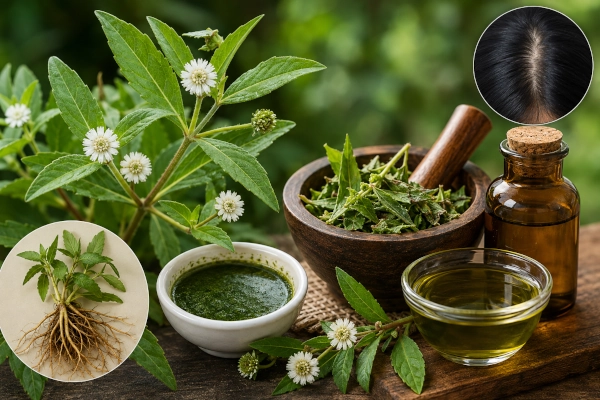
Among the many small herbs that grow almost unnoticed across the moist soils of India, Bhringaraja occupies a remarkably important place in Ayurveda. The plant is botanically accepted today as Eclipta prostrata (L.) L., while the name Eclipta alba (L.) Hassk.—still widely encountered in Ayurvedic literature, pharmacopoeias and herbal medicine—is regarded botanically as a synonym. The Ayurvedic Pharmacopoeia of India itself identifies Bhringaraja under Eclipta alba and recognizes the whole plant as the medicinal drug.
Bhringaraja belongs to the Asteraceae family and is perhaps best known for its association with healthy hair. Indeed, names such as Kesharaja, meaning “king of the hair”, and Kesharanjana, referring to its traditional association with darkening or colouring the hair, reveal how deeply this plant became connected with hair care in the Ayurvedic tradition. Yet Bhringaraja is considerably more than a hair herb. Classical Ayurvedic practice has also employed it in conditions involving the skin, digestion, respiratory system, intestinal parasites and disorders traditionally associated with the liver.
Botanical Identity
Sanskrit name: Bhringaraja — भृङ्गराज
Botanical name: Eclipta prostrata (L.) L.
Common Ayurvedic botanical synonym: Eclipta alba (L.) Hassk.
Family: Asteraceae
English name: False Daisy / Trailing Eclipta
Hindi: Bhangra
Malayalam: Kayyunni
Tamil: Karisalankanni / Kayyantakara
Kannada: Garagada Soppu
Marathi: Maka
Part used: Primarily the whole plant or Panchanga—root, stem, leaves, flowers and fruits.
Although modern botanical authorities accept Eclipta prostrata as the current scientific name, Eclipta alba remains deeply embedded in Indian medicinal literature and is still the name used in several official and educational Ayurvedic sources. Kew’s Plants of the World Online treats Eclipta alba as a synonym of Eclipta prostrata.
The Plant
Bhringaraja is a modest herb that thrives particularly well in moist ground, fields, wetlands and areas close to water. Its stems may grow erect or spread along the ground and sometimes develop roots where the nodes touch moist soil. The leaves grow opposite each other and have a somewhat rough or hairy surface, while the plant produces characteristic small white flower heads.
This preference for moisture explains why Bhringaraja often appears spontaneously during the rainy season around paddy fields, drainage channels, village ponds and damp garden patches. The National Medicinal Plants Board also lists Eclipta alba among medicinal plants prioritized for cultivation in India, reflecting its continuing importance to the country’s medicinal-plant sector.
Bhringaraja in Ayurveda
Ayurvedic Dravyaguna describes a medicinal plant not merely according to its chemical constituents but according to its Rasa, Guna, Virya, Vipaka and Karma—its taste, qualities, energetic potency, post-digestive effect and physiological actions.
Rasa — Taste
Bhringaraja possesses predominantly:
Tikta — Bitter
Katu — Pungent
Guna — Qualities
Its principal qualities are described as:
Laghu — Light
Ruksha — Dry
Virya — Potency
Ushna — Heating
Vipaka — Post-Digestive Effect
Katu — Pungent
Effect on the Doshas
Bhringaraja is traditionally regarded as primarily Kapha-Vata Shamaka, helping pacify aggravated Kapha and Vata. Because the herb possesses an Ushna or heating potency, excessive or inappropriate use may not suit every Pitta-dominant condition.
Important Ayurvedic Actions
Among the traditional actions attributed to Bhringaraja are Keshya, supporting the hair; Twachya, supporting the skin; Krimighna, traditionally used against certain Krimi conditions; Kasahara and Shwasahara, associated with cough and respiratory disorders; and Shothahara, traditionally associated with reducing swelling. Some Ayurvedic Dravyaguna traditions additionally describe Bhringaraja as Rasayana, Balya and Chakshushya.
Why Bhringaraja Became the “King of Hair”
Of all the uses associated with Bhringaraja, its relationship with Kesha—hair—is unquestionably the most famous. The very synonym Kesharaja means the “king of hair”, while Kesharanjana reflects its traditional use in preparations intended to maintain the appearance and colour of hair.
Fresh Bhringaraja juice has traditionally been incorporated into herbal oils, frequently through the classical Sneha Paka process in which herbal liquids and pastes are processed with oils. This gave rise to preparations such as Bhringaraja Taila and helped make the herb a cornerstone of traditional Indian scalp care.
Ayurvedic practice employs Bhringaraja oil particularly where the scalp and hair are affected by dryness, premature greying or excessive shedding. In traditional terminology, conditions such as Khalitya, associated with hair loss, and Palitya, associated with premature greying, are among the best-known indications for the herb.
Modern research provides an interesting, although still preliminary, parallel to this traditional reputation. Experimental studies involving mice and cultured human dermal papilla cells have found that extracts of Eclipta can influence the hair-growth cycle and factors associated with the anagen, or active growth, phase. A 2009 animal study reported dose-dependent hair-growth-promoting activity, while subsequent experimental work observed effects involving FGF-7 and FGF-5 signalling. These findings are promising, but they are principally animal and laboratory studies rather than strong human clinical trials, so Bhringaraja should not be presented as a clinically proven cure for alopecia.
Bhringaraja and the Liver
Bhringaraja also has an important traditional association with Yakrit, or liver-related health.
Ayurvedic physicians have historically employed the plant in conditions described as Kamala and Pandu, terms that overlap only partly with modern concepts such as jaundice and anaemia and should therefore not automatically be treated as exact biomedical equivalents. Bhringaraja’s bitter and pungent qualities, combined with its traditional actions on digestion and metabolism, contributed to its place in formulations used for such disorders.
Modern pharmacological research has likewise investigated Eclipta prostrata for hepatoprotective activity, and experimental studies have reported potentially protective effects in laboratory models. However, reviews of the scientific literature emphasize that much of this evidence remains preclinical and that better-quality human studies are still needed.
For this reason, Bhringaraja should never be regarded as a substitute for medical investigation of jaundice, hepatitis, abnormal liver enzymes or other suspected liver disease.
Bhringaraja for Digestion and Krimi
The bitter-pungent combination of Bhringaraja gives the herb an important place in Ayurvedic discussions of Agni, Ama and Krimi. Within traditional Ayurvedic reasoning, Tikta and Katu substances help counter excessive heaviness and accumulation associated particularly with Kapha.
References compiled from the Charaka Samhita show Bhringaraja or its synonyms appearing in therapeutic contexts that include Krimi Chikitsa, indicating that its medicinal significance extended far beyond external hair applications.
It is therefore traditionally considered useful where sluggish digestion and Kapha-type heaviness accompany other symptoms, although such applications should be understood within the diagnostic framework of Ayurveda rather than as a direct claim that Bhringaraja treats modern gastrointestinal infections.
Skin and Wound Care
Bhringaraja also occupies a place in traditional treatment of Kushtha and other skin disorders, while herbal pastes and preparations containing the plant have historically been used externally.
Traditional Dravyaguna sources describe its use for the skin and for conditions involving swelling and wounds. Modern investigations have identified several groups of phytochemicals within Eclipta prostrata, including coumestans, flavonoids, phenolic compounds, triterpenoids and steroidal saponins, which have encouraged further study of its antioxidant, antimicrobial and anti-inflammatory activities.
These laboratory findings help explain why the plant continues to attract pharmacological interest, although they do not automatically establish clinical effectiveness for human skin disease.
Respiratory Uses
Bhringaraja is traditionally described as Kasahara and Shwasahara, indicating its use in Ayurvedic approaches to cough and certain respiratory complaints. The plant has accordingly been included in traditional therapeutic contexts involving Kasa and Shwasa.
Its bitter-pungent character and Kapha-reducing action provide the Ayurvedic rationale for this application. Nevertheless, persistent cough, wheezing, breathlessness or suspected asthma requires appropriate medical diagnosis rather than unsupervised herbal treatment.
Bhringaraja as Rasayana
Although popular culture has reduced Bhringaraja largely to “hair oil”, Ayurvedic materia medica gives the plant a broader identity. Some Dravyaguna traditions classify it among herbs possessing Rasayana and Balya qualities, implying support for restoration, resilience and healthy ageing when appropriately used.
Seen from this perspective, healthy hair was not necessarily regarded as an isolated cosmetic goal. Ayurveda traditionally viewed the condition of the hair as connected with deeper nutritional and metabolic processes. Bhringaraja therefore became valuable not simply because it could be placed upon the scalp, but because Ayurvedic physicians understood it as a plant acting at several levels of the body.
Classical References
Bhringaraja is found under several names in Ayurvedic literature, including Markava, Margava, Kesharaja, Angaraka and Kesharanjana. A modern scholarly compilation of references from the Charaka Samhita records the herb in contexts including Krimi treatment, Raktapitta, Pittaja Madatyaya and as an ingredient of Mahaneela Taila.
Later Nighantu and Dravyaguna traditions expanded its identity as an important Keshya herb. Bhringaraja is discussed in the Guduchyadi Varga of Bhavaprakasha Nighantu, while modern India’s official Ayurvedic Pharmacopoeia includes a monograph for the whole plant.
Common Ayurvedic Preparations
Several traditional Ayurvedic preparations make use of Bhringaraja.
Bhringaraja Taila is the preparation most immediately associated with the herb and is used externally for the scalp and hair.
Neelibhringadi Taila is another celebrated Ayurvedic hair oil containing Bhringaraja within a larger combination of herbs and traditionally used for hair and scalp care.
Bhringarajasava represents the herb in a fermented Ayurvedic formulation.
Other traditional preparations cited in Ayurvedic teaching sources include Bhringaraja Churna, Markava Rasayana, Narasimha Rasayana and preparations in which the fresh juice of the herb is incorporated into medicinal oils.
Traditional Forms of Use
Fresh Juice — Bhringaraja Swarasa
The freshly collected whole plant may be crushed and its juice extracted. Ayurvedic teaching sources commonly list approximately 5–10 ml of fresh juice as a traditional medicinal dose, but this should be treated as professional Ayurvedic dosage information rather than an instruction for indiscriminate self-medication.
Bhringaraja Churna
The dried plant can be powdered and administered as Churna in traditional practice. One Ayurvedic teaching source lists 3–6 g as a classical teaching dose. The correct quantity, accompanying substance or Anupana, duration and indication depend upon the constitution and condition of the individual.
Bhringaraja Oil
For household use, Bhringaraja is most familiar as a herbal hair oil. Traditionally prepared oil may be gently massaged into the scalp and hair and allowed to remain for a period before bathing. This remains one of the simplest ways of incorporating Bhringaraja into traditional personal care without internally consuming concentrated herbal extracts.
Growing Bhringaraja at Home
Bhringaraja is especially suitable for people who maintain a medicinal garden in regions with warm weather and adequate moisture. Rather than requiring dry, sandy conditions like many medicinal herbs, it prefers damp soil and readily available water.
It can grow close to ponds, wet garden corners and seasonally moist ground, and its spreading stems may root where they contact the soil. Because the medicinal part consists largely of the whole herb, a home gardener can harvest mature plants while allowing some specimens to flower and produce seed for natural regeneration.
Its ability to grow in humble surroundings is one of Bhringaraja’s most distinctive characteristics: an important Ayurvedic medicinal herb may be growing as an unnoticed monsoon plant beside a field or water channel.
What Modern Research Tells Us
Modern investigations into Eclipta prostrata have identified compounds including wedelolactone and related coumestans, along with flavonoids, phenolic compounds, triterpenoids, steroids, saponins and other phytochemicals. Experimental research has examined antioxidant, antimicrobial, hepatoprotective, anti-inflammatory and hair-growth-related activities.
The hair research is particularly interesting because it corresponds closely with Bhringaraja’s centuries-old reputation as Kesharaja. Several animal and laboratory studies have demonstrated effects on hair follicles and pathways associated with the growth phase of the hair cycle.
However, this distinction is important: traditional Ayurvedic use and promising laboratory evidence do not equal proof of clinical effectiveness in humans. Reviews of the scientific literature repeatedly point to the need for more standardized preparations, safety studies and well-designed clinical trials.
Precautions
Bhringaraja has a long history of traditional use, but natural origin does not make unlimited medicinal use automatically safe.
External use of a properly prepared Bhringaraja hair oil is very different from drinking concentrated extracts or taking large quantities of herbal powder. Available safety research remains dominated by animal and laboratory studies, while comprehensive long-term human safety information is limited.
Internal medicinal use is therefore best undertaken under the guidance of a qualified Ayurvedic physician, particularly during pregnancy or breastfeeding, in children, in people receiving regular medication, or in those with significant liver, kidney or other chronic disease.
Any persistent hair loss should also be investigated where appropriate, because nutritional deficiencies, thyroid disorders, autoimmune disease, hormonal factors, medication effects and other medical conditions can produce symptoms that cannot be corrected merely by applying herbal oil.
Bhringaraja: A Small Herb With a Great Ayurvedic Reputation
Bhringaraja demonstrates one of the most fascinating characteristics of India’s medicinal tradition: some of its most valued plants are not rare trees hidden deep within forests but ordinary herbs growing beside fields, ponds and water channels.
Ayurveda remembers this modest white-flowered plant as Bhringaraja—the king associated with the hair—and Kesharaja, the king of Kesha. Its fame certainly rests upon hair and scalp care, yet classical medicine gave it a much wider role involving the skin, digestion, Krimi, respiratory health and disorders traditionally associated with the liver.
Modern science has begun investigating many of these traditional applications, particularly its effects on hair follicles and its diverse phytochemical constituents. The findings are intriguing, but the strongest evidence remains preclinical. Bhringaraja is therefore best understood neither as a miracle cosmetic herb nor as a replacement for modern treatment, but as an important medicinal plant whose enduring reputation demonstrates the depth of India’s Ayurvedic botanical tradition.
References
Ayurvedic Pharmacopoeia of India, Part I — Bhringaraja whole-plant monograph, Pharmacopoeia Commission for Indian Medicine & Homoeopathy, Ministry of AYUSH.
Charaka Samhita Online — Bhringaraja, compilation of classical references, synonyms and Ayurvedic pharmacological properties.
Sri Jayendra Saraswathi Ayurveda College & Hospital — Bhringaraja, Dravyaguna profile including Rasa, Guna, Virya, Vipaka, indications and traditional dosage.
Ahalia Ayurveda Medical College — Bhringaraja, Ayurvedic pharmacological profile and traditional formulations.
Plants of the World Online, Royal Botanic Gardens, Kew — Eclipta prostrata, accepted botanical name and taxonomic status of Eclipta alba.
Datta K. et al., Journal of Ethnopharmacology, 2009 — “Eclipta alba extract with potential for hair growth promoting activity.”
Eclipta prostrata promotes the induction of anagen and sustains the anagen phase through regulation of FGF-7 and FGF-5, experimental investigation of hair-growth mechanisms.
Eclipta prostrata (L.) L. (Asteraceae): Ethnomedicinal Uses, Chemical Constituents, and Biological Activities, review of traditional uses, phytochemistry and experimental pharmacology.
A review on traditional uses, phytochemistry and pharmacology of Eclipta prostrata, Journal of Ethnopharmacology, highlighting pharmacological findings and remaining research gaps.
Health Disclaimer
The information provided in this article is intended solely for educational and informational purposes and is based on traditional Ayurvedic knowledge, published references and available scientific research. It should not be considered medical advice, diagnosis or a substitute for professional medical care.
Herbal medicines, including Bhringaraja (Eclipta prostrata / Eclipta alba), may not be suitable for everyone and may interact with medicines or existing health conditions. Pregnant or breastfeeding women, children, elderly individuals, and people with chronic illnesses or those taking regular medication should consult a qualified healthcare professional or registered Ayurvedic physician before using Bhringaraja medicinally.
Do not discontinue or modify any prescribed treatment on the basis of information contained in this article. Anyone experiencing persistent hair loss, jaundice, liver problems, breathing difficulty, skin disease or other significant symptoms should seek appropriate medical evaluation.
You may also like
-
Why Ayurveda Warns Against Suppressing Hunger, Thirst and Sleep
-
India Strengthens Quality Standards for Ayurveda, Yoga and Sowa-Rigpa Through Nationwide BIS Initiative
-
Sanofi Receives Indian Approval for Qfitlia, a New RNA-Based Treatment for Haemophilia A and B
-
Dr. Reddy’s Receives Indian Approval for Zytorvi Immunotherapy to Treat Advanced Oesophageal Cancer
-
The Ayurvedic Importance of Natural Urges: Why Suppressing the Body’s Signals Can Affect Health
