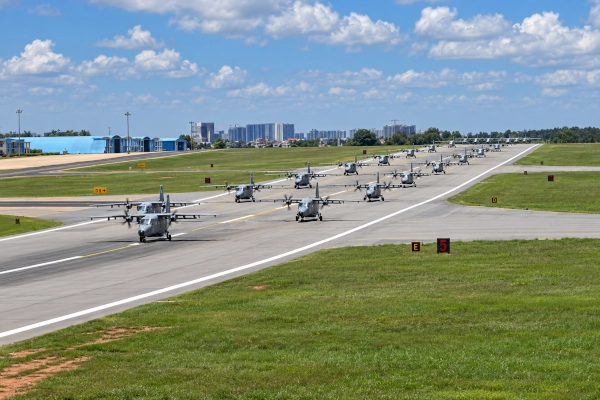
The Indian Air Force has staged an impressive Elephant Walk involving its Dornier-228 aircraft at Air Force Station Yelahanka in Bengaluru, using the coordinated movement of the fleet to demonstrate aircraft availability, maintenance standards, crew proficiency and the ability to generate multiple aircraft for operations.
The Indian Air Force Training Command shared visuals of the activity on September 4, 2026, describing the formation as a demonstration of operational readiness, maintenance excellence and seamless coordination. The event brought together the Do-228 aircraft available at Yelahanka in a closely coordinated ground formation, providing a visible demonstration of the preparation required to place an aviation fleet into service at short notice.
An Elephant Walk generally involves several military aircraft taxiing one behind another at relatively close intervals. Although visually striking, its significance lies in the processes behind the formation. Aircraft must be serviceable, crews have to be prepared, ground movements must be carefully coordinated and maintenance and support personnel must ensure that multiple platforms can be generated simultaneously.
For the IAF, the Yelahanka activity therefore demonstrated much more than the ability to line up several aircraft on a runway. It reflected the combined work of pilots, engineers, technicians, ground crews and other personnel responsible for ensuring that aircraft are available and ready for missions.
The Training Command highlighted the philosophy of “Balamcha Budhischa”, linking strength with wisdom and emphasising the importance of translating training into operational capability. The exercise placed particular emphasis on the standards of training and crew proficiency maintained within the command.
Air Force Station Yelahanka is closely associated with transport aviation training within the Indian Air Force. The presence of the Do-228 fleet there makes the aircraft an important part of the training and support ecosystem, while its relatively compact size and multi-role configuration allow it to perform a broad range of duties.
The Do-228 is produced in India by Hindustan Aeronautics Limited at its Transport Aircraft Division in Kanpur. HAL describes the aircraft as a highly versatile multi-purpose light transport platform capable of undertaking roles ranging from transport and logistics to surveillance, search and rescue, aerial survey and casualty evacuation.
The aircraft has a wingspan of approximately 16.97 metres and an overall length of about 16.56 metres. HAL lists a maximum take-off weight of up to 6,400 kg in the maritime configuration, while the aircraft is powered by two turboprop engines producing about 715 shaft horsepower each. Its design is particularly suited to operations requiring short take-off and landing performance.
The platform’s versatility has enabled different variants of the Do-228 to serve across India’s military and government aviation organisations. Depending on configuration, the aircraft can support transport, logistics, surveillance, training and other specialised missions.
For the Indian Air Force, light transport aircraft such as the Do-228 perform an important supporting role alongside larger transport aircraft and frontline combat platforms. They can move personnel and equipment between bases, support training requirements and undertake missions that would not justify using a larger aircraft.
The Yelahanka Elephant Walk also highlighted another important aspect of military aviation: operational capability depends heavily on maintenance readiness. An air force may possess a large number of aircraft, but their practical value depends on how many can be generated for missions when required. Keeping several aircraft simultaneously serviceable demands reliable logistics, spare parts, trained technicians and disciplined maintenance practices.
By assembling the Do-228 fleet in a coordinated formation, the IAF Training Command provided a visible demonstration of that readiness. The activity showed that aircraft availability, ground support, flight crews and maintenance organisations could be brought together as a single operational system.
Such exercises also test coordination between different elements of an airbase. Aircraft have to be moved safely while maintaining precise spacing, crews must follow common procedures and ground personnel must manage the simultaneous preparation of several platforms. The result provides a useful measure of how effectively training translates into practical readiness.
The Do-228 Elephant Walk at Yelahanka therefore served as both a readiness demonstration and a showcase for a long-established aircraft manufactured by India’s aerospace industry. While the formation itself took place on the ground, the message was centred on the ability to rapidly convert aircraft, infrastructure, maintenance capability and trained personnel into usable air power.
The exercise underlined that operational readiness is built through much more than frontline combat aircraft. Transport and support fleets, their crews and the technicians who keep them serviceable form an essential part of the wider aviation system that allows the Indian Air Force to sustain its missions.
You may also like
-
EON Space Labs and Dhruva Space Advance Indian Space Hardware on Transporter-18 Mission
-
SatLeo Labs’ TAPAS-1 Reaches Orbit, Advancing India’s Private Thermal-Imaging Capability
-
TakeMe2Space’s MOI-1A Reaches Space on Falcon 9 Transporter-18 Mission
-
PRAHAAR: India’s First National Counter-Terrorism Policy and Strategy
-
SCI and India’s Push for a Larger Indigenous Maritime Fleet
