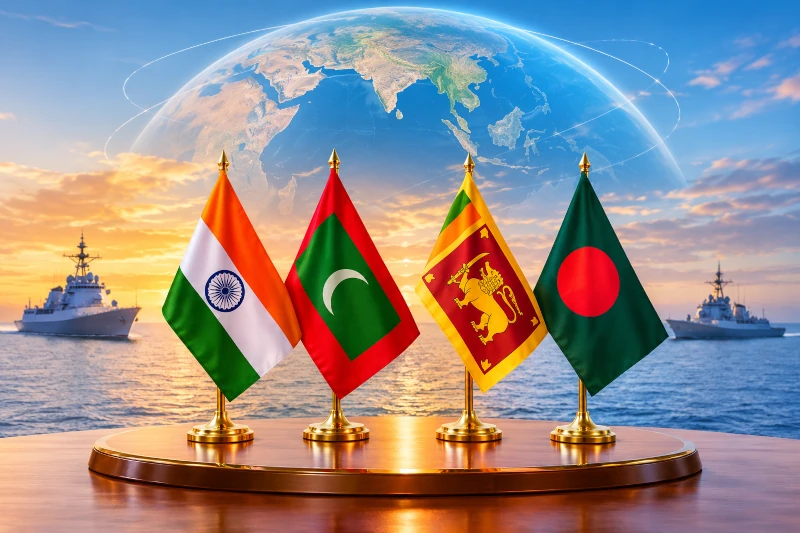
The Colombo Security Conclave (CSC) has adopted a Roadmap of Cooperation for 2026–2027 to strengthen collective security and institutional collaboration across the Indian Ocean region. The roadmap was adopted during the eighth National Security Adviser-level meeting, hosted by the Maldives at Villa Nautica Paradise Island on 25 November 2026. The development provides a structured framework for addressing shared maritime, technological and transnational security challenges through coordinated regional initiatives.
Strengthening Regional Security Cooperation
India’s delegation was led by National Security Adviser Ajit Doval, while the Maldives was represented by National Security Adviser Ibrahim Latheef. Sri Lanka was represented by Defence Secretary Air Vice Marshal Sampath Thuyacontha, and Bangladesh’s delegation was led by Lieutenant General Md Faizur Rahman, Commandant of the National Defence College. Mauritius participated virtually, while Australia and Malaysia attended the meeting as guests.
India, the Maldives, Mauritius and Sri Lanka signed the agreed minutes and adopted the cooperation roadmap, according to the joint statement issued following the meeting. The participating countries reaffirmed their commitment to regional stability through sustained institutional engagement, professional training and the development of collective security capabilities.
Five Pillars of Regional Security
The roadmap establishes priorities across five principal areas of cooperation: maritime safety and security, counterterrorism and prevention of radicalisation, combating trafficking and transnational organised crime, cybersecurity and critical infrastructure protection, and humanitarian assistance and disaster relief. Together, these areas provide a comprehensive approach to regional security that extends beyond conventional military cooperation.
The framework places particular emphasis on developing institutional capabilities through professional training, knowledge exchange and capacity-building programmes. Such cooperation can help participating countries strengthen their preparedness against security challenges that extend across national boundaries and require coordinated responses.
Maritime Security and Protection of Economic Interests
Maritime security remains a central component of the Colombo Security Conclave because of the Indian Ocean’s importance to international commerce, energy transportation and regional economic activity. Protecting commercial shipping, coastal infrastructure and maritime resources represents a shared interest among the countries bordering the ocean.
Greater cooperation between regional maritime institutions can contribute to improved situational awareness, coordinated responses to maritime emergencies and efforts to combat illicit activities at sea. The adoption of the roadmap provides a common framework within which participating countries can develop their respective capabilities while strengthening regional coordination.
Cybersecurity and Critical Infrastructure Protection
The inclusion of cybersecurity and critical infrastructure protection reflects the growing importance of digital technologies in national security and economic development. Ports, telecommunications networks, financial institutions, energy systems and transportation infrastructure increasingly depend on interconnected digital platforms, making their protection an important aspect of regional resilience.
Cooperation in this domain can facilitate the exchange of technical expertise, institutional experience and professional training. The roadmap provides a platform for developing stronger cybersecurity partnerships while recognising the distinct technological requirements and institutional capacities of individual member countries.
Combating Transnational Threats and Strengthening Disaster Preparedness
The roadmap also addresses terrorism, radicalisation, trafficking and organised crime, recognising that these challenges frequently extend beyond individual national jurisdictions. Regional cooperation can strengthen the institutional relationships necessary for addressing such threats through lawful information exchange, professional engagement and coordinated capacity development.
Humanitarian assistance and disaster relief constitute another important dimension of the framework, particularly given the Indian Ocean region’s exposure to cyclones, floods, tsunamis and other natural hazards. Improved preparedness and coordination among participating countries can help strengthen emergency response capabilities and reduce the humanitarian consequences of major disasters.
Institutional Development of the Colombo Security Conclave
The Colombo Security Conclave has evolved from a trilateral maritime security initiative involving India, Sri Lanka and the Maldives into a broader regional security mechanism. Its membership now comprises India, the Maldives, Sri Lanka, Mauritius, Bangladesh and Seychelles, reflecting the expansion of institutional cooperation across the Indian Ocean.
During the eighth NSA-level meeting, the Conclave’s first Secretary General, Vice Admiral S. N. Ghormade (Retd.), reviewed progress in implementing decisions taken during the seventh meeting held in New Delhi on 20 November 2025. The review established continuity between previous commitments and the newly adopted roadmap, reinforcing the importance of sustained institutional engagement.
Significance for India’s MAHASAGAR Vision
For India, the Colombo Security Conclave complements its Neighbourhood First policy and MAHASAGAR vision, which emphasise cooperative security, regional development and shared prosperity. India’s engagement through the Conclave provides an institutional mechanism for working with neighbouring countries on common security priorities while respecting their sovereignty and individual requirements.
The participation of Australia and Malaysia as guests also demonstrates engagement with countries beyond the Conclave’s existing membership. Such dialogue provides opportunities for exchanging regional security perspectives without altering the organisation’s formal membership structure.
Towards a More Secure and Resilient Indian Ocean
The adoption of the 2026–2027 Roadmap of Cooperation represents another step towards establishing sustained and structured security collaboration in the Indian Ocean region. Its significance lies in bringing maritime security, technological resilience, counterterrorism and humanitarian preparedness within a common institutional framework. As the planned activities progress towards implementation, the Colombo Security Conclave offers participating countries an opportunity to strengthen collective preparedness, build mutual confidence and contribute to a peaceful, secure and economically resilient Indian Ocean.
References
- The President’s Office, Republic of Maldives — Joint Press Statement of the 8th NSA Level Meeting of the Colombo Security Conclave, 26 November 2026.
- The President’s Office, Republic of Maldives — Eighth National Security Advisors Meeting of Colombo Security Conclave Concludes in Maldives, 25 November 2026.
- DD News — Colombo Security Conclave Roadmap of Cooperation, 27 November 2026.
- Akashvani News — Colombo Security Conclave Reaffirms Commitment to Promote Regional Peace Through Cooperation, 26 November 2026.
You may also like
-
Five International Russophile Movement Chapters Begin Operations in Kerala
-
India and Mauritius Review Bilateral Partnership Ahead of IORA Ministerial Meeting
-
India and UAE to Accelerate Joint Development and Production of Next-Generation Defence Equipment
-
Colombo Security Conclave Adopts 2026–2027 Roadmap to Strengthen Indian Ocean Security
-
India Reaffirms Commitment to Indian Ocean Security at Eighth Colombo Security Conclave
