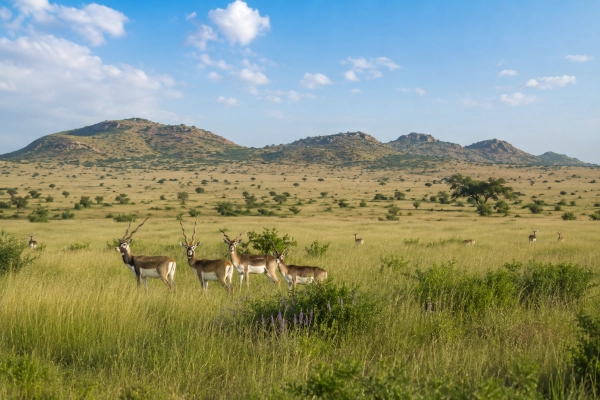
India has launched its first-ever Guide to Grasslands and Other Open Natural Ecosystems of India, bringing national attention to landscapes that have often remained outside the mainstream focus of conservation policy. The publication was unveiled at the 17th Session of the Conference of the Parties to the United Nations Convention to Combat Desertification, or UNCCD COP17, in Ulaanbaatar, Mongolia.
The new guide documents the diversity and ecological importance of India’s grasslands, savannas, scrublands, deserts and other open landscapes. It also examines their links with rural livelihoods, pastoral communities, biodiversity conservation, land restoration and climate resilience.
The initiative marks an important effort to recognise open natural ecosystems as ecologically valuable landscapes in their own right, rather than viewing them simply as land without forests.
Grasslands Need Conservation Alongside Forests
Union Minister for Environment, Forest and Climate Change Bhupender Yadav, addressing the launch through a video message, called for science-based conservation of open natural ecosystems alongside forests.
He said grasslands, scrublands and ravines have often been judged mainly by the absence of trees. Such an approach, he noted, overlooks their ecological value and the unique species and communities that depend on them.
Healthy grasslands support biodiversity, livestock and pastoral livelihoods while also improving the resilience of landscapes to climate pressures. Modern ecological research increasingly recognises that many naturally open ecosystems should not be treated as degraded forests or areas that necessarily require tree planting.
The Minister also spoke about his childhood in Ajmer, Rajasthan, where grazing lands and desert scrub were commonly described as wastelands. He referred to traditional Oran and gauchar landscapes, which local communities have historically protected and used for grazing, water conservation and other common needs.
According to Yadav, such community practices reflected a longstanding understanding that land, livestock and human livelihoods are closely connected.
A National Reference for India’s Open Ecosystems
The guide brings together information on India’s major Open Natural Ecosystems, or ONEs, covering their geographical distribution, ecological characteristics, biodiversity and the communities associated with them.
India possesses a remarkably diverse range of such ecosystems. They include Himalayan and Terai grasslands, the Thar Desert, the Banni grasslands of Gujarat, Deccan savannas, rocky plateaus, scrublands, ravines and several coastal and dryland ecosystems.
Unlike forests, many of these ecosystems evolved naturally with limited tree cover. Their ecology can depend on grazing, seasonal fires, climatic conditions and other processes that maintain open landscapes.
The publication also contains thematic sections on pastoralism, fire ecology and carbon sequestration, reflecting the wider environmental role played by these landscapes.
Grasslands and other open ecosystems contribute to soil formation, nutrient cycling, groundwater processes and carbon storage. In many dryland regions, a significant share of ecosystem carbon is stored below ground in soils and root systems.
Critical Habitats for India’s Wildlife
India’s open natural ecosystems support several species that depend specifically on grasslands, savannas and deserts. Many such species cannot simply move into forests if open habitats disappear.
These landscapes also provide grazing resources for livestock and sustain pastoral communities whose livelihoods depend on seasonal access to natural rangelands.
Conservation experts have increasingly argued that protecting biodiversity requires policies suited to different ecosystem types. Measures designed for forests cannot always be applied directly to grasslands, deserts or savannas.
Recognising such ecosystems accurately can therefore help authorities avoid inappropriate land-use interventions while improving restoration planning.
Guide Developed Through Multi-Institution Collaboration
The guide was launched during an official side event at UNCCD COP17 under the guidance of the Ministry of Environment, Forest and Climate Change.
The publication and associated event were organised by the Ashoka Trust for Research in Ecology and the Environment (ATREE) in collaboration with the International Union for Conservation of Nature, the Centre of Excellence on Sustainable Land Management, the Indian Council of Forestry Research and Education, and the Space Applications Centre of ISRO.
Representatives from government agencies, scientific institutions, international organisations, research bodies and civil society participated in the event.
Discussions examined the distribution and condition of India’s grasslands and other open ecosystems. Experts also assessed their role in achieving national land restoration objectives and India’s commitments on Land Degradation Neutrality.
Better Mapping and Land Assessment Needed
One of the central themes at the COP17 event was the need for stronger scientific data on open ecosystems.
Accurate mapping is particularly important because grasslands, scrublands and other naturally open landscapes can sometimes be classified broadly as wastelands or degraded areas. Such classifications can influence development, afforestation and land restoration programmes.
Improved ecological assessment can help distinguish naturally open ecosystems from genuinely degraded land. This distinction is important when deciding whether an area needs ecological restoration, grazing management, soil conservation or tree planting.
Scientists and policymakers at the event also highlighted the importance of landscape-level planning. Such an approach considers forests, grasslands, agricultural land, wetlands, settlements and rangelands as connected parts of a wider ecological system.
Pastoral Communities Central to Grassland Management
The guide also draws attention to the relationship between pastoral communities and India’s open landscapes.
Pastoralists have traditionally moved livestock across grazing areas according to rainfall, seasons and vegetation availability. These practices have shaped several Indian rangelands over generations.
Participants at COP17 discussed the need for people-centred rangeland governance that combines ecological science with local knowledge. Conservation programmes, they argued, need to account for the livelihoods and traditional practices of communities that depend directly on these landscapes.
Two fireside discussions during the event brought together national and international specialists to examine grassland restoration, dryland conservation, climate resilience and sustainable rangeland management.
Supporting India’s Land Restoration Goals
The launch comes as India expands its focus on combating land degradation and restoring damaged landscapes.
Grasslands and other open ecosystems can play an important role in meeting Land Degradation Neutrality targets, provided restoration programmes recognise their natural ecological characteristics.
Restoring a degraded grassland, for example, does not necessarily mean converting it into a tree-dominated landscape. Effective restoration may instead involve rebuilding native grass cover, protecting soil, controlling invasive species, improving water systems or restoring sustainable grazing patterns.
This ecosystem-specific approach could become increasingly important as India expands land restoration efforts under its domestic environmental programmes and international commitments.
Bringing Grasslands Into Mainstream Conservation Policy
The launch of the guide signals a broader shift in the way open landscapes are being discussed within Indian conservation policy.
For decades, public attention has largely centred on forests when discussing terrestrial biodiversity and carbon storage. Grasslands, savannas and deserts have received comparatively less recognition despite supporting major wildlife populations, pastoral economies and ecological processes.
By documenting these ecosystems in a national reference guide, the government and participating institutions aim to strengthen their visibility in conservation planning, research and land management.
The publication is expected to assist policymakers, researchers, conservation organisations, development agencies and local communities working on grassland restoration and sustainable land use.
Its release at UNCCD COP17 also gives India an international platform to highlight the ecological importance of open natural ecosystems and place grassland and rangeland conservation more firmly within global discussions on desertification, biodiversity and climate resilience.
A Broader Definition of Conservation
India’s first guide to grasslands and open natural ecosystems represents more than a documentation exercise. It reflects a growing recognition that ecological conservation must protect the full diversity of natural landscapes.
Forests remain essential, but they are only one part of India’s ecological heritage. Grasslands, deserts, savannas, scrublands and rangelands are equally important for species adapted to open habitats and for millions of people who depend on livestock and dryland economies.
Treating these ecosystems according to their natural ecological character could help India improve restoration outcomes while protecting biodiversity and livelihoods at the same time.
The launch at UNCCD COP17 therefore places India’s open landscapes more clearly within the national and global conservation agenda, while providing a scientific foundation for their future protection and sustainable management.
Official Source: Press Information Bureau, Ministry of Environment, Forest and Climate Change, Government of India — India Launches First-Ever Guide to Grasslands and Other Open Natural Ecosystems at UNCCD COP17, in Ulaanbaatar, Mongolia, released August 17, 2026.
You may also like
-
ZSI Scientists Identify New Fish Species Bathymyrus perplexus From the Bay of Bengal
-
Rare Afro-Asian Sand Snake Rediscovered in Kutch After More Than 150 Years
-
Indravati Tiger Reserve to Reopen for Wildlife Safaris After Four Decades
-
Tiny 3.3-mm Parasitic Wasp Discovered in Assam Marks First Record of Its Genus in India
-
How India Brought the Greater One-Horned Rhinoceros Back From the Brink
