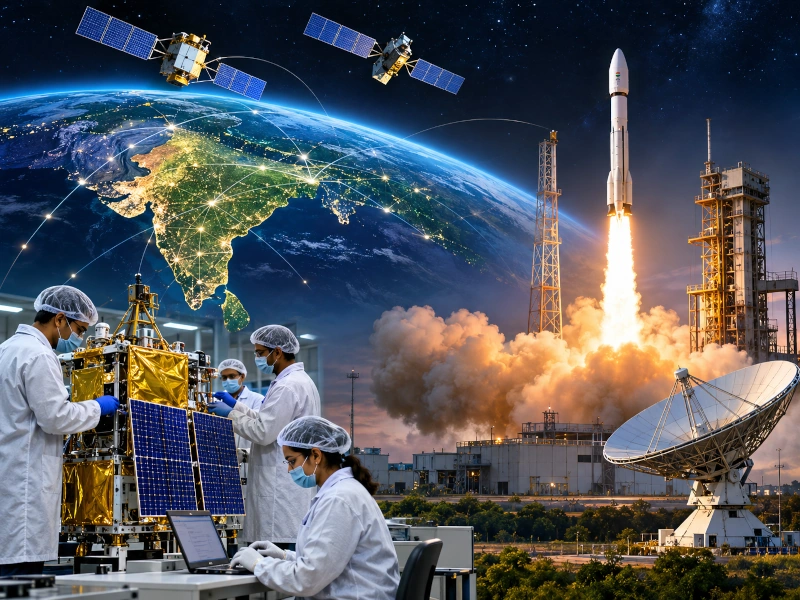
India’s space economy, currently valued at approximately USD 9 billion, is projected to expand to USD 40–45 billion in less than a decade, with private-sector participation emerging as a major driver of growth. Union Minister of State for Science and Technology and Space, Dr. Jitendra Singh, announced the projection while addressing the fifth India International Space Conclave 2026 in New Delhi on November 24, 2026. The Minister highlighted how structural reforms, indigenous technological development and private-sector entrepreneurship are transforming India’s space ecosystem into a globally competitive industry.
India’s Expanding Private Space Ecosystem
India’s space ecosystem has expanded from a single-digit number of startups to approximately 400–500 companies within a few years, according to Dr. Jitendra Singh. The establishment of NewSpace India Limited (NSIL), the creation of the Indian National Space Promotion and Authorisation Centre (IN-SPACe), and the opening of the space sector to private participation have fundamentally transformed the country’s space industry. These reforms have created opportunities for private enterprises to participate in activities that were previously concentrated within government institutions.
The emerging ecosystem encompasses launch vehicle development, advanced propulsion systems, satellite manufacturing, Earth observation, satellite imagery and downstream space applications. The growing participation of established industrial enterprises alongside specialised technology startups is also contributing to the diversification of India’s space economy. This expansion is helping develop an industrial ecosystem capable of supporting domestic requirements while pursuing international commercial opportunities.
India International Space Conclave 2026
The fifth India International Space Conclave was organised by the Indian Space Association (ISpA) in New Delhi on November 23–24, 2026. Centred on the theme Shaping the Future of Space through Innovation, Governance, Human Potential and Global Collaborations, the event brought together industry leaders, researchers, startups and international stakeholders. The conclave also witnessed the release of the report titled Space Economy 2036: The India Blueprint.
The programme was attended by ISRO Chairman and Department of Space Secretary Dr. V. Narayanan, IN-SPACe Chairman Dr. Pawan Kumar Goenka, Indian Space Association Director General Lieutenant General Anil Kumar Bhatt (Retd.) and representatives of India’s space and technology industries. Discussions focused on strengthening indigenous capabilities, expanding commercial opportunities and developing institutional mechanisms to support the next phase of India’s space sector growth.
Indigenous Space Startups Drive Technological Transformation
Highlighting the achievements of India’s emerging private space industry, Dr. Jitendra Singh referred to Skyroot Aerospace’s maiden launch vehicle flight on July 18, 2026, its multi-mission launch agreement and its emergence as a unicorn. He also acknowledged the contributions of Agnikul Cosmos and other enterprises developing advanced propulsion technologies, privately manufactured rocket engines, Earth observation systems and satellite imaging capabilities. These developments illustrate the expanding technological scope of India’s private space industry.
The development of indigenous launch systems, propulsion technologies and satellite platforms is creating opportunities across advanced manufacturing, precision engineering, electronics, materials science and software development. As domestic companies expand their technological capabilities, India can strengthen its participation across the global space value chain. The emergence of such capabilities also supports the development of a more diversified and resilient domestic space industry.
Space Technology Beyond Satellite Launches
Dr. Jitendra Singh emphasised that the economic contribution of space technology should not be assessed solely through launch revenues, satellite manufacturing and commercial space missions. Its wider value also lies in the operational efficiencies, financial savings and improved outcomes it generates across other sectors of the economy. Space-based applications are increasingly becoming integral to infrastructure development, transportation, communication, healthcare, education and defence.
Referring to the PM Gati Shakti National Master Plan, the Minister explained how space-based technologies are improving infrastructure planning, supporting timely project execution, reducing costs and minimising resource wastage. Geospatial intelligence, satellite imagery and remote sensing can assist government departments in coordinating infrastructure projects and monitoring their progress. The wider integration of these technologies creates additional opportunities for Indian companies developing specialised downstream space applications.
Creating Domestic Demand for Space-Based Services
Addressing questions concerning demand generation within India’s space industry, the Minister observed that limited awareness of practical space applications remained an important challenge. Space technology offers considerable opportunities beyond conventional rocket launches and satellite missions, particularly in infrastructure management, communication networks and public service delivery. Greater awareness among government institutions and industrial enterprises could help expand the domestic market for space-enabled products and services.
The government’s whole-of-government approach and inter-ministerial collaboration can facilitate the adoption of space technology across multiple administrative and economic sectors. Such integration could create sustained demand for satellite data, geospatial analytics, remote sensing and specialised digital services. A stronger domestic market would also provide Indian space enterprises with opportunities to refine their technologies and establish commercially sustainable business models.
Technological Sovereignty and International Cooperation
Dr. Jitendra Singh stressed that technological sovereignty and international collaboration should be viewed as complementary objectives rather than competing priorities. India must continue developing indigenous technologies, domestic sources of critical components and nationally developed projects while remaining open to mutually beneficial international partnerships. This approach seeks to strengthen domestic technological capabilities without limiting opportunities for global scientific and commercial cooperation.
The Minister also welcomed suggestions concerning an international space innovation alliance, global startup accelerator programmes and international innovation challenges. He indicated that possibilities for institutionalising broader international space cooperation could be explored. Such initiatives, if developed, could facilitate knowledge exchange, collaborative research and greater international market access for Indian space enterprises.
Convergence of Space, Quantum and Emerging Technologies
The Minister highlighted the growing interconnectedness of space technology, quantum science, semiconductors and nuclear research. Referring to the National Quantum Mission, launched in 2023 with an eight-year mandate, he stated that India had achieved 1,000 kilometres in secure quantum communication within three years, against the original target of 2,000 kilometres over eight years. The progress reflects the government’s broader emphasis on developing capabilities across strategically important emerging technologies.
The convergence of these technological domains presents opportunities for developing advanced communication systems, precision instruments, high-performance electronics and secure information networks. Space platforms could increasingly benefit from advancements in quantum technologies, semiconductor engineering and advanced computing. Coordinated research across these disciplines can help strengthen India’s technological capabilities and create opportunities for new commercial applications.
Strengthening Private Investment and Scientific Research
Dr. Jitendra Singh urged domestic industrial enterprises to increase their investments in the space sector and facilitate greater overseas investment into India’s emerging space ecosystem. He highlighted government initiatives such as the Anusandhan National Research Foundation (ANRF) and the Research, Development and Innovation (RDI) Fund as mechanisms intended to strengthen research, encourage innovation and increase private-sector participation. These initiatives are particularly relevant to technology-intensive industries requiring sustained investment and long development cycles.
The Minister also encouraged industry leaders to allocate greater Corporate Social Responsibility (CSR) resources towards scientific research and technological development. Calling for a stronger culture of scientific philanthropy, he emphasised that investment in research should be regarded as a contribution to society and humanity. Greater cooperation between industry, academic institutions, research organisations and startups could help translate scientific discoveries into commercially viable technologies.
Expanding India’s Space Innovation Ecosystem
The Minister welcomed suggestions aimed at expanding India’s space ecosystem across more states and encouraging greater participation from students and young innovators. Broadening the geographical reach of space entrepreneurship can help integrate regional industrial capabilities, academic institutions and engineering talent into the national space programme. The government, he said, remained open to constructive industry feedback and further policy improvements to facilitate private-sector participation.
The development of regional innovation ecosystems could also strengthen domestic supply chains and create specialised opportunities in advanced manufacturing, electronics, propulsion, software and satellite applications. Encouraging young researchers and entrepreneurs to participate in these emerging fields will be important for building the skilled workforce required by an expanding space economy. A geographically distributed ecosystem can contribute to making space-led industrial development more inclusive and sustainable.
Towards a Globally Competitive Indian Space Economy
India’s projected expansion from a USD 9 billion space economy to USD 40–45 billion represents an ambitious vision for the coming decade. Realising this potential will depend on sustained investment, indigenous research, technological reliability, commercial demand and effective collaboration between government institutions and private enterprises. The benefits of this transformation could extend considerably beyond the conventional space industry, supporting infrastructure development, advanced manufacturing, digital services and scientific research.
With policy reforms establishing the institutional foundation and domestic enterprises increasingly demonstrating their technological capabilities, India is entering a new phase of space-led economic development. Strengthening indigenous innovation while pursuing mutually beneficial international partnerships can help the country establish a larger presence in the global space economy. The combination of scientific expertise, industrial entrepreneurship and expanding domestic applications provides a promising foundation for India’s emergence as a globally competitive space power.
Reference
Press Information Bureau, Government of India — India’s Space Economy Set for a Massive Leap to USD 40–45 billion as Private Sector Rewrites Growth Story: Dr. Jitendra Singh.
Published: November 24, 2026, at 5:13 PM, PIB Delhi.
You may also like
-
Farrukhabad Exports First Consignment of Frozen Vegetables to Qatar
-
India Strengthens Its Indigenous Telecom Technology Ecosystem
-
India’s Unincorporated Services Sector Records 33% Employment Growth
-
Edayur Chilli: Kerala’s Distinctive Mild Chilli and Its Geographical Indication Heritage
-
ISRO Pushes Indigenous Satellite Manufacturing and Semiconductor Self-Reliance
