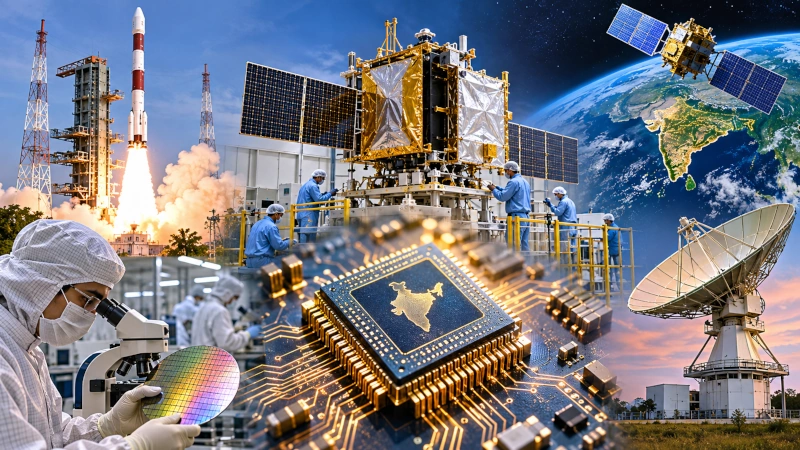
The Indian Space Research Organisation (ISRO) has emphasised the need to expand India’s indigenous satellite manufacturing capabilities, strengthen domestic semiconductor development and reduce dependence on imported critical materials and electronic components. Speaking at the fifth India International Space Conclave in New Delhi on 24 November 2026, ISRO Chairman Dr V. Narayanan called for greater collaboration between research institutions, established industries and emerging space technology startups to address the country’s growing requirements for space-based infrastructure.
Highlighting the development of the indigenous Vikram microprocessor through collaboration between ISRO and the Semiconductor Laboratory (SCL), Chandigarh, the Chairman identified domestic semiconductor development as an important example of India’s technological progress. He also emphasised opportunities in advanced materials, optical systems, artificial intelligence, robotics and satellite data processing, reflecting the need for a comprehensive domestic ecosystem capable of supporting India’s expanding space ambitions.
Expanding India’s Satellite Manufacturing Capacity
India has established considerable expertise in designing, developing, launching and operating satellites for communication, navigation, Earth observation and scientific exploration. However, the increasing demand for space-based services requires a corresponding expansion in satellite manufacturing capacity. Dr Narayanan identified the transition from developing individual satellite systems to manufacturing them in substantially larger numbers as an important challenge confronting the country’s space programme.
According to the ISRO Chairman, India currently possesses 56 space assets and requires a substantial expansion of this infrastructure to meet its emerging requirements. Addressing this demand will require manufacturing capabilities beyond those available exclusively within government institutions. Greater industrial participation could help establish additional production capacity, diversify supply chains and support the deployment of future satellite constellations.
Vikram Microprocessor Strengthens Indigenous Space Electronics
The development of the Vikram series of microprocessors represents a significant achievement in India’s efforts to establish indigenous capabilities in high-reliability electronics. Developed through collaboration between ISRO’s Vikram Sarabhai Space Centre (VSSC) and the Semiconductor Laboratory in Chandigarh, these processors are designed to meet the demanding operational requirements of space applications, particularly launch vehicle avionics.
The indigenous 16-bit VIKRAM1601 processor has been used in ISRO launch vehicle avionics since 2009. A domestically fabricated version was subsequently introduced in 2016 following the establishment of semiconductor fabrication capabilities at SCL. The programme has since progressed towards more advanced processing architectures, strengthening India’s ability to develop critical electronic systems without relying exclusively on overseas suppliers.
During his remarks at the conclave, Dr Narayanan highlighted the existing operational use of the Vikram 16-bit series and indicated that efforts were underway to introduce the newer 32-bit processor to the market. The statement represents a prospective commercialisation development for an existing indigenous semiconductor technology rather than the announcement of a newly developed processor.
VIKRAM3201: India’s Indigenous 32-Bit Space-Qualified Processor
The VIKRAM3201 represents an advancement in India’s development of specialised microprocessors for aerospace applications. According to ISRO, it is the country’s first fully indigenously manufactured 32-bit microprocessor qualified to withstand the demanding environmental conditions encountered by launch vehicles. The processor was fabricated using the 180-nanometre CMOS semiconductor manufacturing facility at SCL.
The processor incorporates a custom instruction set architecture, floating-point computation capabilities and support for the Ada programming language. ISRO has also developed associated software tools domestically, including compilers, assemblers, simulators and an integrated development environment. This combination of indigenous hardware and software strengthens India’s technological control over critical onboard computing systems.
On 5 March 2025, the first production lots of VIKRAM3201 and KALPANA3201 were formally handed over to ISRO Chairman Dr V. Narayanan. The development marked an important milestone in the country’s ability to design, fabricate, package and qualify specialised semiconductor devices for space applications.
Successful Validation of Indigenous Computing Technology in Space
The VIKRAM3201 processor has already undergone successful validation under actual spaceflight conditions. An initial batch of the processors was deployed in the Mission Management Computer of the PSLV Orbital Experimental Module, designated POEM-4, during the PSLV-C60 mission launched on 30 December 2024.
The successful demonstration established an important foundation for the further utilisation of indigenous processing technology in space systems. Such validation is particularly significant because aerospace electronics must satisfy stringent requirements associated with reliability, environmental endurance and operational stability.
The achievement demonstrates how collaboration between India’s semiconductor manufacturing institutions and space research establishments can support the development of specialised computing technologies. However, the qualification of the processor for launch vehicle applications should not be interpreted as confirmation of its deployment across every category of satellite or spacecraft.
Beyond Vikram: Building a Domestic Space Semiconductor Ecosystem
The collaboration between ISRO and SCL extends beyond the Vikram series of microprocessors. The institutions have also developed KALPANA3201, a 32-bit processor based on the SPARC V8 architecture, alongside specialised integrated circuits designed to support the miniaturisation and improved integration of launch vehicle avionics.
Additional developments include integrated data acquisition systems, relay driver circuits and voltage regulator devices intended for high-reliability applications. These technologies contribute to the development of a broader domestic electronics supply chain capable of supporting increasingly sophisticated aerospace systems.
The strategic importance of these developments lies in establishing indigenous capabilities across multiple stages of semiconductor development, including design, fabrication, packaging, software integration and qualification. A mature domestic ecosystem encompassing these capabilities could provide long-term benefits to India’s space programme while creating opportunities for specialised semiconductor enterprises and research institutions.
Reducing Dependence on Imported Optical Materials
Dr Narayanan also highlighted the importance of developing indigenous capabilities in advanced optical technologies and their associated raw materials. India has demonstrated considerable progress in high-resolution imaging systems for space exploration and Earth observation, including the development of sophisticated optical instruments for lunar missions.
However, the Chairman identified continued dependence on imported raw materials required for manufacturing large-diameter optical systems as an area demanding industrial attention. Although domestic institutions possess advanced machining and optical engineering capabilities, developing the underlying materials within India remains an important requirement for achieving greater technological autonomy.
This presents opportunities for Indian enterprises specialising in advanced glass, optical materials, precision engineering, specialised coatings and materials research. Strengthening domestic capabilities across these areas could help reduce supply-chain vulnerabilities while supporting the development of future generations of high-resolution imaging satellites and scientific instruments.
Artificial Intelligence, Robotics and Advanced Data Processing
The expansion of India’s satellite infrastructure must be accompanied by corresponding advances in the technologies required to manage and utilise the information generated by these space assets. Modern Earth observation and communication systems produce substantial volumes of data, creating opportunities for the application of artificial intelligence, machine learning and advanced computing.
The ISRO Chairman identified data management, data processing, artificial intelligence and robotics as important areas for greater participation by domestic technology companies. These capabilities could contribute to more efficient satellite operations, automated analysis of Earth observation imagery and the development of specialised applications for agriculture, infrastructure planning, disaster management and environmental monitoring.
Robotics and automation also offer opportunities to improve manufacturing precision, streamline spacecraft assembly and support complex testing procedures. Collaboration between space research institutions and India’s established software and engineering ecosystem could help transform technological capabilities into practical services with wider economic and societal benefits.
Indian Space Startups to Play a Greater Role
India’s expanding space startup ecosystem represents an important source of innovation, industrial capacity and specialised technological expertise. The opening of the space sector to private participation, supported by institutional mechanisms such as the Indian National Space Promotion and Authorisation Centre (IN-SPACe) and NewSpace India Limited (NSIL), has created opportunities for enterprises to participate across different segments of the space value chain.
Startups specialising in semiconductor design, advanced materials, satellite subsystems, precision manufacturing, artificial intelligence and geospatial analytics are particularly relevant to the requirements identified by ISRO. Their participation could complement the capabilities of national research institutions while encouraging the development of commercially sustainable products and services.
The next stage of India’s space-sector development will require greater coordination between research, industrial production and commercial deployment. Establishing reliable domestic suppliers for critical components and materials could enable Indian satellite manufacturers to increase production while maintaining the quality and reliability required for space missions.
Addressing Space Sustainability and Orbital Debris
The expansion of satellite infrastructure also introduces responsibilities concerning the long-term sustainability of the orbital environment. Increasing numbers of operational satellites and accumulated space debris present challenges to the safe functioning of spacecraft and the continued utilisation of orbital resources.
Dr Narayanan emphasised the need for collective efforts to address space debris and identified opportunities for startups to contribute technological solutions. These opportunities could include space situational awareness, orbital monitoring, collision-risk assessment and technologies supporting responsible spacecraft operations.
For India’s growing space industry, integrating sustainability considerations into satellite design, manufacturing and mission planning will become increasingly important. Such an approach can help ensure that the expansion of space-based infrastructure remains compatible with the long-term availability and safe utilisation of orbital resources.
India’s Space Economy and the Opportunity for Industrial Growth
The emphasis on indigenous manufacturing and technological self-reliance comes as India seeks to expand its participation in the global space economy. Speaking at the same conclave, Union Minister Dr Jitendra Singh stated that India’s space economy, currently valued at approximately USD 9 billion, could grow to USD 40–45 billion in less than a decade.
The projected expansion encompasses commercial launch services, satellite manufacturing, advanced propulsion, space-based communications, Earth observation and downstream applications. The conclave also witnessed the release of the report Space Economy 2036: The India Blueprint, reflecting the growing importance of long-term industrial and commercial planning for the sector.
Realising this economic potential will require sustained investment in research, domestic production infrastructure, specialised human resources and commercially viable technological solutions. Indigenous semiconductor development and the expansion of satellite manufacturing capabilities represent complementary elements of this broader industrial transformation.
Establishing an End-to-End Indigenous Space Manufacturing Ecosystem
India’s long-term technological autonomy in the space sector depends not merely on the ability to assemble and launch satellites, but also on developing domestic capabilities across the underlying supply chain. This encompasses semiconductor fabrication, advanced materials, optical systems, precision components, specialised software, testing infrastructure and systems integration.
The development of the Vikram microprocessor demonstrates the value of sustained collaboration between national research institutions and domestic manufacturing establishments. Extending comparable partnerships into other areas of critical technology could help establish a more comprehensive industrial ecosystem capable of supporting India’s growing space infrastructure.
International cooperation will continue to remain important for scientific research, commercial partnerships and technological exchange. Indigenous capability development, however, can provide India with greater flexibility in meeting its strategic and commercial requirements while participating in mutually beneficial global partnerships.
Strengthening India’s Technological and Industrial Foundations
ISRO’s emphasis on expanding satellite manufacturing, developing indigenous semiconductors and strengthening domestic materials capabilities reflects the evolving requirements of India’s space programme. The country’s future ambitions increasingly depend upon translating scientific achievements into scalable industrial capabilities supported by a diverse ecosystem of research institutions, manufacturers and technology startups.
The Vikram processor programme illustrates how sustained indigenous research can progress from technological development to domestic fabrication, operational validation and prospective commercial utilisation. Applying this collaborative approach across optical materials, spacecraft electronics, artificial intelligence, robotics and advanced manufacturing could further strengthen India’s position in the global space technology sector.
Through greater integration between scientific institutions and domestic industry, India is laying the foundations for a more resilient, technologically capable and commercially competitive space ecosystem. The expansion of indigenous manufacturing represents an important step towards achieving long-term technological self-reliance while ensuring that the benefits of space technology reach a wider segment of society.
References
- Indian Space Research Organisation — ISRO & SCL Develops 32-bit Microprocessors for Space Applications, 15 March 2025.
- Indian Space Research Organisation — POEM Completed 1000 Orbits in Space, 7 March 2025.
- Indian Space Research Organisation — Achievements of Department of Space, 2025.
- Press Information Bureau, Department of Space — India’s Space Economy Set for a Massive Leap to USD 40–45 Billion as Private Sector Rewrites Growth Story, 24 November 2026, Release ID: 2340845.
- ANI, published by The Economic Times — Statements by ISRO Chairman Dr V. Narayanan at the fifth India International Space Conclave, 24 November 2026.
- ANI, published by The Tribune — Scaling Up Satellite Production Remains a Challenge, India Must Reduce Import Dependence: ISRO Chief, 24 November 2026.
You may also like
-
PTC Industries Secures Defence Order for 400 Tonnes of Titanium Products
-
Vayuvya Defence Successfully Test-Fires Indigenous Vayu 250 Micro Jet Engine
-
DRDO Awards Laser-Based Drone Communication Contract to olee.space
-
IG Defence Successfully Test-Fires Indigenous JWALA MK-1 Counter-Drone Missile at Pokhran
-
Vama SkyLight Emerges as L1 Bidder for ₹6.95 Crore Indian Army Tethered Drone Tender
