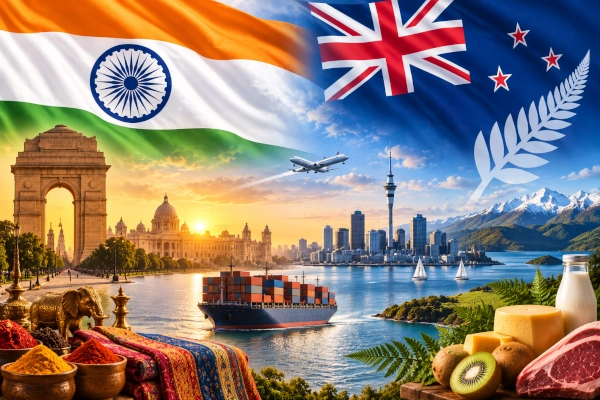
The India–New Zealand Free Trade Agreement will enter into force on October 20, 2026, marking a major expansion of economic ties between the two countries. The agreement will provide zero-duty access to 100% of Indian exports to New Zealand from the first day of implementation, while creating new opportunities in investment, services, technology, agriculture and professional mobility.
Union Commerce and Industry Minister Piyush Goyal and New Zealand Minister for Trade and Investment Todd McClay announced the implementation date during a virtual meeting on September 21 after both countries completed their respective internal procedures.
The agreement had been signed on April 27, 2026, at Bharat Mandapam in New Delhi. New Zealand completed a major part of its domestic ratification process when its Parliament passed the implementing legislation on September 16.
FTA Becomes Pillar of Wider Strategic Partnership
The implementation of the trade agreement comes amid a broader strengthening of India–New Zealand relations. Prime Minister Narendra Modi’s visit to New Zealand in July 2026 resulted in the announcement of a Strategic Partnership and the adoption of the India–New Zealand Strategic Partnership: Roadmap to 2030.
The roadmap sets an aspirational target of doubling bilateral trade in goods and services to NZ$7 billion, or approximately ₹35,000 crore, by 2030. The FTA is expected to become one of the principal economic instruments supporting that objective.
Goyal said the agreement would provide fresh momentum to bilateral ties by strengthening economic complementarities, creating economies of scale and improving the competitiveness of businesses in both countries.
New Zealand’s Todd McClay said the agreement offered greater certainty to businesses at a time when global trade was facing increasing uncertainty and tariff pressures. He also described the FTA as a foundation for expanding cooperation beyond trade into investment, culture, sports and wider people-to-people exchanges.
Zero Duty on All Indian Exports From Day One
One of the most significant provisions of the FTA is New Zealand’s commitment to eliminate tariffs on every tariff line covering Indian exports immediately after the agreement enters into force.
Indian products will therefore receive duty-free access comparable with that enjoyed by New Zealand’s other major trade partners.
Labour-intensive sectors such as textiles and apparel, leather products, footwear, gems and jewellery, engineering goods and processed foods are expected to benefit considerably. Existing New Zealand tariffs reaching as high as 10% on several such products will be removed.
The agreement could be particularly important for Indian MSMEs and manufacturers seeking to expand into the New Zealand market without the cost disadvantage previously created by import duties.
Cheaper Industrial Inputs for Indian Manufacturers
The agreement also provides tariff-free access to several important industrial inputs imported from New Zealand.
These include wooden logs, coking coal and metal scrap, which are used across manufacturing, construction, metals and related industries.
Lower input costs could improve the competitiveness of Indian manufacturers both within the domestic market and in export-oriented production.
Sensitive Agricultural Sectors Protected
India has retained tariff protection for several politically and economically sensitive agricultural sectors.
Products including dairy, most animal meat apart from sheep meat, selected agricultural commodities, sugar and edible oils have been kept outside India’s tariff concessions.
Market access for products such as New Zealand apples, kiwifruit and Manuka honey will instead be regulated through Tariff Rate Quotas, Minimum Import Prices and seasonal import windows.
These mechanisms are intended to provide controlled market access while limiting potential disruption to Indian farmers and domestic agricultural production.
Agriculture Productivity Partnership
The agreement goes beyond tariff concessions by establishing an Agriculture Productivity Partnership between India and New Zealand.
Dedicated cooperation programmes will focus on kiwifruit, apples and honey, with the objective of improving productivity, quality, farm incomes and post-harvest management in India.
Centres of Excellence are also expected to be established for orchard management, post-harvest technology, agricultural supply chains, food safety and sustainable beekeeping.
A Joint Agriculture Productivity Council will oversee the programme and monitor the implementation of New Zealand’s cooperation commitments alongside the market-access provisions of the FTA.
New Zealand to Facilitate $20 Billion Investment Into India
Investment forms another major pillar of the agreement.
New Zealand has committed to facilitate USD 20 billion in investment into India, with potential opportunities across agriculture, manufacturing, infrastructure and the startup ecosystem.
The investment provisions are expected to encourage closer collaboration between companies in both countries and deepen New Zealand’s participation in India’s expanding manufacturing and technology sectors.
Major Opening for India’s Services Sector
The FTA also provides wider access for India’s rapidly growing services industry.
Indian companies and professionals will gain opportunities across approximately 118 service sectors, including information technology, professional services, audiovisual services, construction and tourism.
India has also secured Most-Favoured Nation treatment across around 139 service sub-sectors, providing a mechanism for Indian service providers to benefit from certain future concessions that New Zealand may extend to other trading partners.
5,000 Skilled Employment Visas for Indians
Professional mobility forms an important component of the agreement.
New Zealand will provide a dedicated annual quota of 5,000 Temporary Employment Entry visas for skilled Indian workers.
The FTA also provides 1,000 Working Holiday visas annually for young Indians, expanding opportunities for temporary employment and international experience.
These provisions are expected to strengthen professional exchanges between the two economies, particularly in sectors where New Zealand requires specialised skills.
Expanded Opportunities for Indian Students
Indian students will also receive enhanced mobility provisions under the agreement.
Student mobility itself will remain uncapped, while eligible graduates will receive improved post-study employment opportunities.
Graduates in science, technology, engineering and mathematics disciplines will be able to access post-study work rights of up to three years, while doctoral scholars will be eligible for work rights extending to four years.
These provisions could further strengthen educational and research links between Indian and New Zealand institutions.
Faster Market Access for Indian Pharmaceuticals
Indian pharmaceutical and medical-device manufacturers are also expected to gain from changes to New Zealand’s regulatory procedures.
New Zealand will recognise inspection approvals issued by several internationally trusted regulatory authorities, including the United States Food and Drug Administration, European Medicines Agency, UK Medicines and Healthcare products Regulatory Agency and Health Canada.
Recognition of these approvals could reduce duplicative regulatory procedures and shorten the time required for eligible Indian pharmaceutical and medical-device products to reach the New Zealand market.
Bilateral Trade Positioned for Expansion
India–New Zealand merchandise trade stood at approximately USD 1.1 billion during 2025–26, leaving considerable room for expansion compared with India’s trade relationships with several other developed economies.
The removal of tariffs, combined with improved access for services, investment, professional mobility and agricultural cooperation, gives both countries a broader framework for increasing economic engagement.
For India, the agreement provides exporters with comprehensive duty-free entry into a developed market while retaining protection for sensitive agricultural sectors. For New Zealand, it creates greater access to one of the world’s largest and fastest-growing major economies.
With the agreement taking effect on October 20, 2026, the focus will now shift from negotiations and ratification to implementation, business utilisation and the conversion of tariff concessions into greater trade, investment and commercial partnerships.
References
Press Information Bureau, Government of India — India-New Zealand FTA to Enter into Force from 20 October 2026, September 21, 2026.
Department of Commerce, Government of India — India–New Zealand Free Trade Agreement Factsheet.
Department of Commerce, Government of India — Frequently Asked Questions: India–New Zealand Free Trade Agreement.
Press Information Bureau — India–New Zealand Free Trade Agreement Signing, April 27, 2026.
You may also like
-
India’s Economic Warfare Challenge: Strategic Autonomy, Energy Security and the Rise of a Global Power
-
India-US Trade Deal Stalemate: Why Washington’s Tariff Pressure Has Failed to Secure an Agreement
-
US Double Standards in Foreign Policy: 16 Recent Cases Involving India, Russia, China and Global Trade
-
India’s Arctic Energy Ambitions: Russian Oil, LNG and a New Sea Route to Indian Ports
-
India and Russia Explore Joint Icebreaker Construction as Maritime Industrial Cooperation Expands
