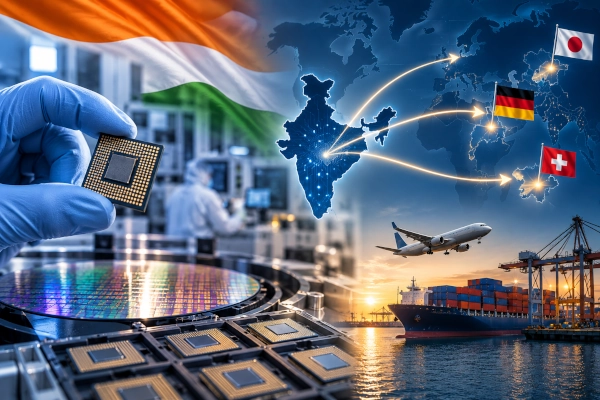
India’s semiconductor industry is beginning to move beyond domestic capacity creation into international markets, with semiconductor products made or designed in the country now reaching customers in Japan, Germany, Switzerland and other overseas markets. Electronics and Information Technology Minister Ashwini Vaishnaw highlighted the development at SEMICON India 2026 as evidence that India’s semiconductor ecosystem is progressing from assembly and packaging towards a broader combination of design, manufacturing and equipment localisation.
The development comes as India expands semiconductor activity across fabrication, assembly, testing, packaging and chip design. Multiple semiconductor units have entered production or advanced implementation stages, while government-supported design programmes are helping Indian companies and institutions develop proprietary semiconductor products.
The emergence of exports is important because the long-term viability of India’s semiconductor industry will depend on more than domestic demand. Fabrication and packaging facilities require large production volumes, consistent quality and access to international customers if they are to become globally competitive.
Semiconductor Products Begin Moving Into Export Markets
At SEMICON India 2026, Vaishnaw said semiconductor products made or designed in India are already reaching markets including Japan, Germany and Switzerland. The development reflects a gradual transition from semiconductor capacity creation towards commercial production with international customers.
India has traditionally played a major role in global semiconductor engineering and chip design, while much of the physical manufacturing and packaging of those designs took place overseas. The establishment of new manufacturing and packaging facilities is beginning to change that structure by allowing a larger share of the semiconductor value chain to operate within India.
Exports are particularly important because semiconductor plants depend on scale. Large fabs and packaging facilities cannot rely exclusively on domestic demand if they are to maintain high utilisation rates and competitive production economics. International customers therefore become an important part of sustaining the industry over the long term.
Sanand Production Already Has Global Markets in View
India’s export ambitions are already visible in semiconductor manufacturing projects entering production. Semiconductor facilities at Sanand in Gujarat are intended to serve both domestic customers and overseas markets, including customers in Japan, the United States and Europe.
The products manufactured and packaged at these facilities are expected to serve applications such as automobiles, electric vehicles, consumer electronics and industrial equipment. These sectors rely heavily on mature-node and specialised semiconductors that are produced in extremely large volumes and remain commercially important despite receiving less attention than cutting-edge processors.
This gives India an opportunity to compete in semiconductor categories where manufacturing reliability, cost, availability and supply-chain resilience are critical factors.
India Is Moving Beyond Assembly and Packaging
The significance of the current expansion lies in the growing range of semiconductor activities being established within India. Earlier electronics manufacturing growth was concentrated largely around final-product assembly, while semiconductor activity itself was dominated by engineering and design services.
The emerging ecosystem now extends into wafer fabrication, semiconductor assembly and testing, advanced packaging, semiconductor design, materials, equipment components, research and workforce development.
India has not created a fully domestic semiconductor supply chain, nor is that the immediate objective. Semiconductor production remains deeply global, and Indian facilities will continue to depend on international equipment, technology, materials and intellectual property.
The important change is that India is beginning to participate in more stages of the semiconductor value chain rather than remaining primarily a centre for design services and electronics assembly.
India’s Chip-Design Strength Becomes an Export Asset
Chip design remains one of India’s strongest semiconductor capabilities. The country already hosts a large semiconductor engineering workforce and substantial research and development operations belonging to major global technology companies.
Government programmes are now attempting to convert more of this engineering strength into Indian-owned semiconductor intellectual property and commercial products.
More than one lakh engineers across hundreds of organisations have been provided access to advanced semiconductor design tools under government-supported programmes. Academic institutions, startups and companies participating in these initiatives have developed hundreds of chip designs.
The next challenge is to convert more of these designs into qualified products capable of winning customers in India and overseas.
Indian-Owned Semiconductor Products Become a Policy Priority
One of the central aims of the next phase of India’s semiconductor strategy is to increase the number of companies that own their semiconductor architectures, intellectual property and commercial products.
Historically, a large share of semiconductor engineering carried out in India contributed to products owned by multinational companies. While this created deep technical expertise, much of the commercial value and intellectual property remained outside India.
A stronger domestic product ecosystem could allow Indian companies to design semiconductors for automotive electronics, industrial systems, telecommunications, defence, energy, artificial intelligence, digital infrastructure and consumer products.
If these devices secure international customers, India could begin exporting not only semiconductor manufacturing services but also Indian-owned chip products.
Semiconductor Equipment Localisation Begins to Deepen
Another important development highlighted at SEMICON India 2026 is the gradual localisation of semiconductor manufacturing equipment and associated components.
Vaishnaw referred to companies such as Lam Research while discussing the expansion of semiconductor manufacturing capabilities in India. The development is important because the equipment used inside semiconductor fabs is among the most complex industrial machinery produced anywhere in the world.
Modern fabs depend on deposition systems, etching tools, cleaning equipment, vacuum systems, gas-delivery infrastructure, precision robotics and sophisticated process-control technologies.
India is unlikely to reproduce every category of semiconductor equipment domestically in the near term, but localisation of selected components, subassemblies and support systems could create a substantial precision-manufacturing industry.
Lam Research Highlights a Wider Manufacturing Opportunity
Lam Research is one of the world’s major suppliers of wafer-fabrication equipment, particularly in deposition and etching technologies. Its growing engagement with India illustrates how the semiconductor programme can create opportunities beyond chip fabrication itself.
If Indian suppliers are able to manufacture components and subsystems to semiconductor-equipment standards, they could eventually enter global supply chains serving fabrication plants in multiple countries.
Such manufacturing requires exceptional precision, cleanliness, repeatability and quality assurance. These requirements create natural opportunities for Indian companies with existing capabilities in aerospace, defence, electronics and advanced engineering.
The semiconductor-equipment sector could therefore become an important bridge between India’s established precision-manufacturing industries and its emerging chip ecosystem.
Semiconductor Exports Demand Global Manufacturing Standards
Exporting semiconductor products places much greater pressure on manufacturers than producing only for a protected domestic market. International customers expect strict adherence to product specifications, reliability standards, qualification requirements and delivery schedules.
Automotive semiconductors, for example, must operate reliably for long periods across extreme temperatures and harsh operating conditions. Industrial, communications and energy-sector products have similarly demanding qualification requirements.
Indian companies must therefore compete on manufacturing yield, reliability, price and delivery performance rather than depending permanently on government incentives.
The fact that Indian-made or Indian-designed semiconductor products are beginning to reach overseas customers is significant because it indicates that at least part of the ecosystem is starting to engage with international qualification and supply requirements.
International Partnerships Remain Central to India’s Strategy
India’s semiconductor strategy combines domestic capability creation with international cooperation rather than pursuing an isolated national supply chain.
The country has developed semiconductor partnerships with the United States, Japan, the European Union, Singapore, Germany and the Netherlands, among others. These relationships provide access to equipment suppliers, manufacturing technology, specialised materials, research networks and potential customers.
This approach recognises the realities of the global semiconductor industry. No major semiconductor-producing country operates completely independently because equipment, materials, design tools and manufacturing technologies are distributed across multiple regions.
India’s objective is therefore to develop stronger domestic capability in strategically important areas while remaining integrated with international technology and manufacturing networks.
Semicon 2.0 Broadens the Industrial Base
The move into exports comes as India shifts from the first phase of its semiconductor programme towards Semicon 2.0.
The second phase significantly broadens the policy framework beyond fabs and assembly plants. It places greater emphasis on chip design, semiconductor equipment, materials, advanced packaging, research and development, precision manufacturing and talent.
This reflects the understanding that semiconductor manufacturing cannot be sustained by fabrication plants alone. Competitive fabs depend on equipment suppliers, materials companies, design firms, packaging facilities, research institutions and skilled workers.
The broader ecosystem is intended to support both domestic semiconductor demand and the development of products capable of competing internationally.
Artificial Intelligence Creates New Semiconductor Demand
India’s semiconductor expansion is also becoming increasingly connected with the rapid growth of artificial-intelligence infrastructure.
AI data centres require enormous quantities of processors, memory, networking equipment, power-management devices and communications components. Even where the most advanced processors continue to be imported, there are significant opportunities for Indian companies across the supporting semiconductor ecosystem.
Power electronics, connectivity devices, controllers, sensors and data-centre components represent areas where Indian semiconductor companies could potentially develop products for both domestic use and export.
The expansion of AI infrastructure could therefore create a large new domestic market while also helping Indian companies build manufacturing volumes required to compete internationally.
Dholera Will Add Large-Scale Front-End Fabrication
India’s semiconductor export potential is expected to increase further as major fabrication projects enter production.
Tata Electronics is developing a 300 mm semiconductor fabrication facility at Dholera in Gujarat with technology support from Taiwan’s Powerchip Semiconductor Manufacturing Corporation. The plant is intended to manufacture chips across mature and specialised process technologies for applications including automotive electronics, communications and industrial systems.
The Dholera project will give India front-end wafer-fabrication capacity at a scale substantially larger than its existing commercial semiconductor manufacturing base.
If the facility achieves competitive yields and production economics, it could eventually serve both domestic electronics companies and international semiconductor customers.
Exports Could Improve Manufacturing Scale
Access to overseas markets is particularly important for semiconductor manufacturing because fabs require high utilisation rates.
The fixed costs of constructing and operating semiconductor facilities are enormous. Cleanrooms, utilities and production equipment must operate at substantial volumes to keep manufacturing costs competitive.
India’s domestic electronics market can provide significant demand, but global customers can help fabs and packaging facilities achieve much larger production scale.
Export capability could therefore become one of the most important measures of whether India’s semiconductor plants evolve into globally competitive manufacturing centres.
From Global Design Centre to Semiconductor Producer
India has long been recognised as an important global semiconductor design centre. Engineers based in the country have contributed to semiconductor products developed by many of the world’s leading technology companies.
Historically, however, India captured a relatively small share of the physical manufacturing value chain.
That balance is beginning to change as new fabs, packaging facilities and Indian-owned semiconductor companies emerge.
Commercial production, expanding packaging capacity, indigenous chip-development programmes and the first overseas sales of Indian-made or Indian-designed semiconductor products indicate that India is gradually participating in more stages of the industry.
The transition will take years, and India remains far from matching the manufacturing scale of established semiconductor centres in East Asia. Nevertheless, the emergence of export activity represents an important commercial milestone.
Building an Export-Oriented Semiconductor Ecosystem
The ultimate test of India’s semiconductor programme will be whether domestic companies and manufacturing facilities can compete internationally without depending indefinitely on policy support.
International markets provide a demanding benchmark because customers can choose among suppliers operating across established semiconductor manufacturing regions.
Indian companies will therefore have to demonstrate competitive pricing, high manufacturing yields, reliable quality and consistent delivery performance if they are to build sustained export businesses.
The movement of Indian-made and Indian-designed semiconductor products into overseas markets suggests that the industry is beginning to progress beyond its initial investment phase.
References
- Financial Express — India-Made Chips Are Now Being Exported: Ashwini Vaishnaw, 18 September 2026
https://www.financialexpress.com/business/news/india-made-chips-are-now-being-exported-ashwini-vaishnaw/4342404/ - Press Information Bureau — India Building Semiconductor Future: Emerging Capabilities Across Design, Manufacturing, Packaging, Materials and Talent, 17 September 2026
https://www.pib.gov.in/PressReleasePage.aspx?PRID=2311220&lang=1 - Press Information Bureau, Ministry of Electronics & Information Technology — Semicon 2.0 to Deepen India’s Semiconductor Ecosystem With Focus on Design, Equipment, Fabs, Advanced Packaging, R&D and Talent, 17 September 2026
https://www.pib.gov.in/PressReleseDetailm.aspx?PRID=2311630 - Press Information Bureau — Prime Minister Inaugurates SEMICON India 2026 and Unveils Roadmap for Transition to Semicon 2.0, 17 September 2026
https://www.pib.gov.in/PressReleasePage.aspx?PRID=2311726&lang=1 - Press Information Bureau — Semiconductor Production at Sanand and Export Markets
https://www.pib.gov.in/PressReleasePage.aspx?PRID=2281149&lang=2 - Press Information Bureau — India’s Semiconductor Ecosystem and Semicon 2.0
https://www.pib.gov.in/PressNoteDetails.aspx?ModuleId=3&NoteId=160020&lang=1
You may also like
-
Nayan Technologies Selected by JSW MG Motor to Advance AI-Based Road Monitoring and Smart Mobility
-
From ‘We Will Coup Whoever We Want’ to Starlink in India: Elon Musk, Corporate Pressure and National Sovereignty
-
Indian Navy to Commission Indigenous Anti-Submarine Warfare Ship Mangrol on October 12
-
Starlink-Ukraine, Myanmar and Drug Smuggling: Why India Must Regulate Satellite Internet for National Security
-
Four ICAR-Developed Potato Varieties Account for Nearly 75% of India’s Cultivation Area
