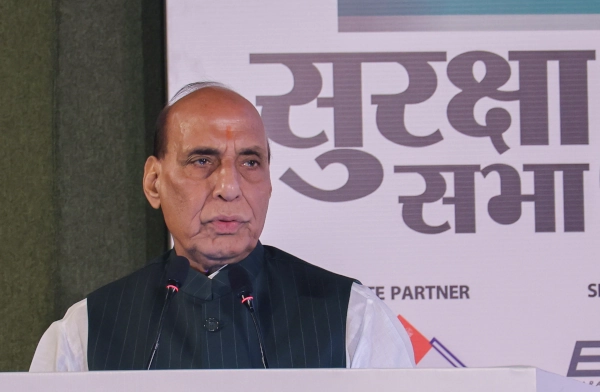
India has strengthened the operational freedom of its armed forces while accelerating efforts to build a more technologically advanced and self-reliant defence ecosystem, Defence Minister Rajnath Singh said in New Delhi on September 7, 2026.
Speaking at an event in the capital, Singh said the armed forces now have both the authority and the resources required to respond decisively to threats to national security. He stressed that India’s preference for peace should never be interpreted as an unwillingness to act when its security is challenged.
The Defence Minister said India had faced sustained attempts to weaken its security through terrorism, radicalisation, financial support for anti-India activities and efforts to create divisions within society. According to him, the government has responded through a combination of security operations, rehabilitation and de-radicalisation programmes, employment generation and initiatives intended to bring vulnerable youth back into the mainstream.
Referring to Jammu and Kashmir, Singh said the region had witnessed expanding economic and social opportunities following the abrogation of Article 370. He linked India’s broader counter-terrorism strategy with operations such as the Surgical Strikes, the Balakot air strike and Operation Sindoor, saying these demonstrated New Delhi’s willingness to act directly against terrorist infrastructure and those supporting it.
He also referred to India’s suspension of the Indus Waters Treaty as part of the wider response to terrorism, reiterating the government’s position that normal relations cannot continue alongside cross-border terrorist activity.
Singh said attempts to generate communal tensions within India had also failed. Referring to attacks on places of worship during Operation Sindoor, he said Indian society had resisted efforts to provoke internal divisions and had instead demonstrated social cohesion.
While reiterating that India neither seeks war nor territorial expansion, the Defence Minister drew a distinction between maintaining peace and displaying weakness. He said countries that support terrorism directed against India should not expect political dialogue in place of a security response.
A major part of Singh’s address focused on the changing character of warfare. He noted that modern military competition is no longer confined to land, sea and air, with space and cyberspace becoming increasingly important operational domains. Artificial intelligence, autonomous platforms, drones, precision-guided weapons and other advanced technologies are rapidly reshaping battlefield requirements.
Against this background, he said the government is attempting to make India’s defence strategy and national security architecture better prepared for future conflicts. The larger objective, he added, is to ensure that critical military technologies are increasingly designed and developed within India rather than sourced permanently from overseas suppliers.
Singh said India’s defence posture had also evolved from being primarily reactive to becoming more proactive. He cited India’s entry into the Missile Technology Control Regime in 2016 as an example of how diplomacy and strategic partnerships had supported the country’s defence capabilities.
According to the Defence Minister, MTCR membership helped create conditions for expanding the capabilities of systems such as the BrahMos cruise missile. He said BrahMos subsequently played an important operational role during Operation Sindoor.
Singh also highlighted the broader transformation of India’s defence-industrial base. He said government policy over the past several years had focused on strengthening border infrastructure, modernising the armed forces, expanding indigenous production and restructuring the former ordnance factory system.
India’s annual defence production, he said, has increased from roughly ₹40,000 crore before 2014 to around ₹1.80 lakh crore. Defence exports have expanded even faster, rising more than 50-fold to over ₹38,000 crore.
The Defence Minister pointed to a growing inventory of domestically developed weapons and platforms as evidence of this shift. He cited the Akashteer air-defence control system, the Akash family of surface-to-air missiles, the Pinaka rocket system, Astra air-to-air missiles, Prachand and Dhruv helicopters, the Tejas fighter, the Arjun main battle tank and a growing range of indigenous drone and counter-drone systems.
He also highlighted the induction of INS Vikrant, India’s first domestically built aircraft carrier, as a major milestone in indigenous naval capability.
Singh said India was simultaneously pursuing more advanced future technologies, including work related to next-generation combat aircraft. The government has set a target of raising annual defence exports to ₹50,000 crore by 2029.
The Defence Minister also underlined the financial turnaround of the defence public-sector ecosystem. According to him, all 16 Defence Public Sector Undertakings are currently operating without losses and are increasing their focus on research, development and international markets.
India’s defence budget, he said, has risen from around ₹2.5 lakh crore roughly 12 years ago to approximately ₹8 lakh crore. He maintained that increased expenditure was being directed toward improving military preparedness, modernisation and national security capabilities.
Singh placed India’s defence transformation within a wider national strategy that links military strength, economic resilience and strategic autonomy. A strong domestic economy, he said, is essential for sustaining advanced military capabilities without becoming excessively dependent on external suppliers.
He noted that India’s economy is currently expanding at around 7.8% despite international uncertainty. The government, he said, is seeking to strengthen supply chains, develop domestic manufacturing capacity and reduce vulnerabilities in strategically important sectors.
The emerging semiconductor ecosystem and Production Linked Incentive programmes were cited as examples of this effort to create greater economic and technological resilience.
Singh said strategic autonomy remained central to India’s foreign and security policy at a time when geopolitical competition was forcing many countries toward particular blocs. India, he argued, continues to pursue an independent foreign policy based on its own national priorities rather than automatic alignment with any major power grouping.
The growing participation of private companies and smaller manufacturers is also changing India’s defence-industrial landscape. Singh said more than 16,000 MSMEs are currently participating in the defence sector.
The Uttar Pradesh and Tamil Nadu Defence Industrial Corridors have together attracted investment proposals of approximately ₹70,000 crore, he said, with close to ₹10,000 crore already invested.
India’s defence-startup ecosystem has also expanded sharply. Singh said the number of defence startups had increased from only a few dozen in 2018 to more than 2,000, supported by innovation programmes including Innovations for Defence Excellence, or iDEX, and iDEX Prime.
He called on young Indians to participate more actively in defence innovation as entrepreneurs, researchers and technology developers, and said the Defence Ministry would continue supporting promising indigenous ideas.
Singh also praised DRDO’s effort to deepen cooperation with private industry, startups, universities and research institutions. He highlighted the successful testing of a scramjet combustor in May 2026 as an important technological milestone in India’s longer-term effort to develop hypersonic missile systems.
Another significant policy shift, he said, has been the transfer of DRDO-developed missile technologies to Indian industry. Allowing domestic private companies to manufacture such systems is intended to expand production capacity and improve the speed with which weapons can be supplied to the armed forces.
The Defence Minister said the ultimate objective is not merely to reduce imports, but to establish an integrated defence ecosystem capable of strengthening national security while also contributing to industrial growth, exports and technological development.
He expressed confidence that by 2047, India could emerge not only as a developed economy but also as a major global centre for advanced technology, defence manufacturing and strategic capability.
Source: PIB: https://www.pib.gov.in/PressReleaseDetail.aspx?PRID=2307663®=48&lang=1
You may also like
-
PRAHAAR: India’s First National Counter-Terrorism Policy and Strategy
-
Takshak Heavyweight Torpedo: How India’s Indigenous Submarine Weapon Compares With the World’s Leading Torpedoes
-
Embraer Builds Dual Aerospace Strategy in India Through C-390 Military and E175 Regional Aircraft Programmes
-
NextLeap Tests Indigenous Jet Engine for Long-Range Stryker Kamikaze UAV
-
Côte d’Ivoire Military Delegation Visits HAL, Shows Interest in India’s Indigenous Aerospace Platforms
