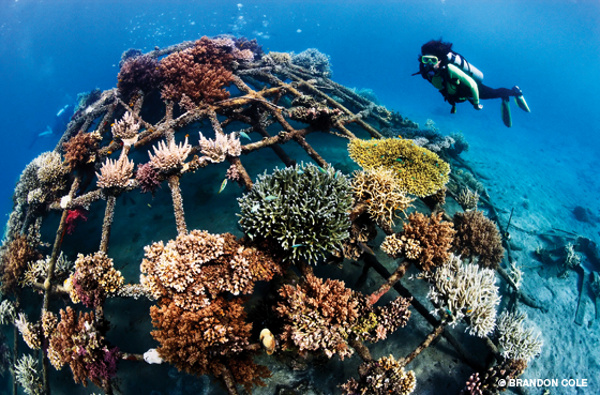
The Zoological Survey of India (ZSI), with help from Gujarat’s forest department, is attempting for the first time a process to restore coral reefs using biorock or mineral accretion technology. A biorock structure was installed one nautical mile off the Mithapur coast in the Gulf of Kachchh on January 19.
Biorock is the name given to the substance formed by electro accumulation of minerals dissolved in seawater on steel structures that are lowered onto the sea bed and are connected to a power source, in this case solar panels that float on the surface.
“The technology works by passing a small amount of electrical current through electrodes in the water,” Ch. Satyanarayana, a scientist at the Marine Biology Regional Centre of the ZSI, explained. “When a positively charged anode and negatively charged cathode are placed on the sea floor, with an electric current flowing between them, calcium ions combine with carbonate ions and adhere to the structure (cathode). This results in calcium carbonate formation. Coral larvae adhere to the CaCO3 and grow quickly,” he added.
Dr. Satyanarayana, a renowned coral expert, added that fragments of broken corals are tied to the biorock structure, where they are able to grow at least four to six times faster than their actual growth as they need not spend their energy in building their own calcium carbonate skeletons.
Along with scientists from the ZSI, Thomas Goreau, President of Global Reef Technology, U.S.A. had also provided inputs to the restoration project.
The location for installing the biorock had been chosen keeping in mind the high tidal amplitude in the Gulf of Kachchh. The low tide depth where the biorock has been installed is four metres, and at high tide it is about eight metres.
Shyamal Tikadar, Principal Chief Conservator of Forests (PCCF) (Wildlife), Gujarat, said that the biorock structure had been lowered and that calcification had started, making it an academic success.
“For us the real success will come when we find that the attached and new organisms (corals) grow faster and we are able to scale up the process,” Mr. Tikadar said. He added that a final determination on whether the biorock structure was giving the desired results or not would be made in the next three months.
Throwing light on the degradation of coral reefs across the world and also in India, Kailash Chandra, director of ZSI, said that threats were posed both by climate change induced acidification as well as by anthropogenic factors. Observing that coral reefs were the most diverse ecosystem on the earth, Dr. Chandra said India has four major coral reefs areas: Andaman and Nicobar Islands, Lakshadweep, Gulf of Mannar and the Gulf of Kachchh.
In 2015, the same group of ZSI scientists with the support of the Gujarat forest department had successfully restored branching coral species (staghorn corals) belonging to the family Acroporidae (Acropora formosa, Acropora humilis, Montipora digitata) that had gone extinct about 10,000 years ago to the Gulf of Kachchh. The researchers claimed that the specimens for regenerating these corals were brought from the Gulf of Mannar with the help of Tamil Nadu’s Forest Department.
Dr. Satyanarayana said that the ongoing initiative of coral restoration using biorock technology could potentially help to sustain the earlier successes. He added that the technology helps corals, including the highly sensitive branching corals, to counter the threats posed by global warming.
Source: The Hindu
Image Courtesy: Alert Diver
You may also like
-
PRAHAAR: India’s First National Counter-Terrorism Policy and Strategy
-
Jawahar Dweep Becomes India’s First Plastic-Free Oil Terminal at Mumbai Port
-
IIT Hyderabad Develops Lung-Derived Bioink for 3D Bioprinting and Regenerative Medicine
-
Indian Scientists Discover Molecular Switch That Can Regulate Cellular Autophagy
-
Scientists Map Earliest Glow of Hydrogen, Opening A New Window to the Universe
