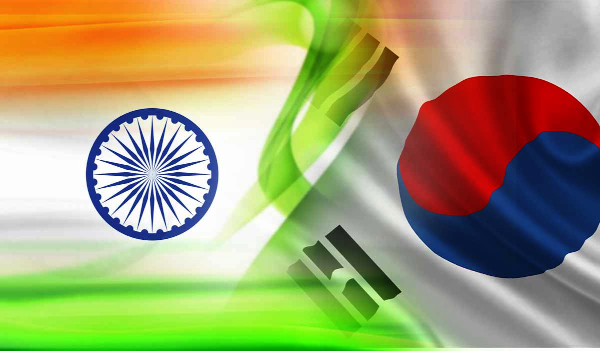
India and South Korea have taken another important step in strengthening their defence partnership, with both countries agreeing to expand cooperation in cyber defence, military education, peacekeeping, industrial collaboration and emerging technologies. The agreements were concluded during Defence Minister Rajnath Singh’s visit to Seoul, where he held comprehensive bilateral discussions with South Korea’s Minister of National Defence, Ahn Gyu-back.
The talks covered the full range of India–Republic of Korea defence cooperation, including defence industry, production, maritime security, emerging technologies, military exchanges, logistics and regional security. This broad agenda shows that the relationship is moving beyond routine military diplomacy and entering a more structured phase of strategic, technological and industrial partnership.
A major outcome of the meeting was the exchange of agreements in three key areas: Defence Cyber cooperation, training between India’s National Defence College and Korea National Defence University, and UN Peacekeeping Cooperation. These may look like separate tracks, but together they form a practical framework for a modern defence partnership. Cyber cooperation addresses the new digital battlefield, training builds institutional familiarity between future military leaders, and peacekeeping cooperation gives both countries a platform to work together in global security missions.
The cyber agreement is especially significant because modern military power is no longer measured only by tanks, ships, aircraft and missiles. Command networks, air-defence systems, logistics chains, intelligence platforms, satellites, radars and battlefield communications all depend on secure digital infrastructure. A cyber partnership between India and South Korea can help both sides exchange expertise, build resilience and prepare for threats that target military networks before a conventional conflict even begins.
The training agreement between India’s National Defence College and Korea National Defence University also has long-term value. Defence education creates strategic trust at the officer level. When military leaders study, train and exchange ideas together, they develop a better understanding of each other’s doctrines, security concerns and decision-making cultures. Over time, this can support smoother joint exercises, staff-level coordination, crisis communication and defence planning.
The UN peacekeeping agreement adds another meaningful layer. India has a long history of contribution to UN peacekeeping, while South Korea has also been expanding its international security role. Cooperation in this area can help both countries share lessons on stabilisation missions, humanitarian operations, rules of engagement, civilian protection and multinational military coordination.
The two ministers also reaffirmed their support for a free, open, inclusive and rule-based Indo-Pacific, linking the defence partnership to wider regional stability. PIB noted that both sides recognised the growing convergence between India’s Act East Policy and South Korea’s regional strategic vision. This is important because both countries depend heavily on secure sea lanes, stable trade routes and freedom of navigation across the Indo-Pacific.
The industrial dimension of the visit was equally important. Rajnath Singh met South Korea’s Minister for Defense Acquisition Program Administration, Lee Yong-chul, and both sides discussed ways to create avenues for joint development, joint production and joint exports. A roadmap for the India-Korea Defence Innovation Accelerator Ecosystem, known as KIND-X, was also discussed to connect the defence innovation ecosystems of both countries.
This matters because South Korea is already a serious defence-industrial power with strengths in artillery, armoured vehicles, naval platforms, missiles, electronics and advanced manufacturing. India, meanwhile, offers scale, engineering talent, a growing private defence sector, a large domestic requirement and an expanding export ambition. If these strengths are combined properly, the partnership can move from buyer-seller transactions to co-development, co-production and third-country exports.
The India–RoK Defence Industry Business Roundtable in Seoul brought together senior government officials and defence industry representatives from both countries. The discussion focused on new opportunities in defence manufacturing, co-development, co-production and supply-chain partnerships. During the event, two agreements between L&T India and Hanwa Co Ltd were also signed to promote defence innovation, technology cooperation and capacity building.
Rajnath Singh’s message to Korean industry was clear: India wants trusted technology partnerships that support indigenous manufacturing and global defence collaboration. He highlighted that modern defence ecosystems are now driven by advanced electronics, artificial intelligence, autonomous systems, cyber technologies, sensors, semiconductors, quantum technologies, advanced materials and space-based capabilities.
This is where the India–South Korea relationship can become strategically powerful. South Korea brings high-end industrial discipline, precision manufacturing and proven defence platforms. India brings a large operational military requirement, a fast-growing innovation base, start-ups, MSMEs, public-sector defence enterprises and private companies capable of system integration. Together, the two countries can build practical defence solutions rather than remaining limited to diplomatic statements.
There is also a strong historical and emotional background to the visit. Rajnath Singh began the South Korea leg of his tour by laying a wreath at the Korean War Cemetery in Seoul, paying tribute to soldiers who sacrificed their lives during the Korean War. India’s humanitarian and medical contribution during the Korean War remains an important part of the older India–Korea connection, and today’s defence partnership builds on that reservoir of goodwill.
The timing of the agreements is also important. The India–ROK Joint Strategic Vision issued earlier in 2026 had already highlighted both countries’ shared interest in a peaceful, free and prosperous Indo-Pacific, regular consultations on strategic and security issues, and new mechanisms such as a Joint Committee Meeting on Defence Industry Cooperation and a Defence and Foreign Affairs 2+2 Dialogue at Vice-Minister level.
From India’s perspective, the partnership supports three important goals. First, it strengthens defence diplomacy with a technologically advanced Asian partner. Second, it opens doors for collaboration in future military technologies. Third, it supports Atmanirbhar Bharat by encouraging joint production and industrial capacity-building inside India. The Ministry of Defence also stated that India’s defence production touched about ₹1.54 lakh crore and defence exports nearly ₹40,000 crore in FY2025-26, with exports expected to move towards ₹50,000 crore over the next one to two years.
Overall, the latest India–South Korea defence agreements show a relationship that is becoming more practical, more technological and more strategically relevant. Cyber defence, officer training, peacekeeping, innovation accelerators, industrial partnerships and Indo-Pacific security are all parts of the same larger picture. India and South Korea are not merely exchanging visits; they are building the architecture for a deeper defence partnership suited to the next generation of warfare.
You may also like
-
DRDO Opens Indigenous Thermal Tank Target Technology to Indian Defence Industry
-
China Reduced PLA Deployment Along LAC in 2025 as India Maintained Robust Border Posture: Defence Ministry
-
China Welcomes Modi’s Strategic Autonomy Message as India–China Ties Move Toward Wider Engagement
-
India–Canada CEPA Talks Enter Fourth Round as Both Sides Target Deal by End of 2026
-
Why Space Is Becoming the Fifth Domain of Modern Warfare
