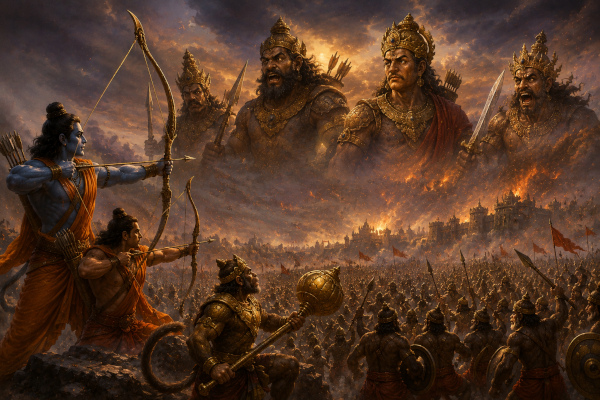
The Lanka campaign shows a clear military principle: an army begins to weaken when its commanders fall. Rama’s side repeatedly targets the great Rakshasa leaders who hold Ravana’s war machine together. Prahasta, Kumbhakarna, Indrajit and Ravana represent different layers of Lanka’s command strength. Each one carries authority, battlefield reputation and psychological weight. Their fall does more than reduce manpower. It shakes confidence, disturbs direction and breaks the rhythm of resistance.
Prahasta is one of Ravana’s principal commanders and a major pillar of Lanka’s field army. When he enters battle, he carries the confidence of a seasoned Rakshasa general. His presence gives structure to the troops around him. The soldiers look toward him for direction, courage and momentum. When Nila kills Prahasta, the effect spreads rapidly through the Rakshasa ranks. The army that moved forward under command begins to scatter in fear. This shows the value of commander targeting at the tactical level. The death of one leader changes the behaviour of many fighters.
A battlefield commander acts as the nervous centre of a formation. He reads the ground, directs movement, commits reserves, controls retreat and inspires soldiers during pressure. When that figure disappears, the unit loses its voice. Orders become unclear. Local officers hesitate. Soldiers begin to think about survival instead of victory. The Ramayana captures this reality through Prahasta’s fall. His death turns an organised advance into disorder, because the army loses the man who holds its immediate purpose together.
Kumbhakarna represents a different kind of target. He is less a normal commander and more a shock force in human form. His arrival gives Ravana’s side a sudden surge of morale. His size, strength and ferocity create terror among the Vanaras. He can crush formations, break confidence and change the emotional climate of the battle. Rama’s side understands that such a figure must be neutralised before he becomes the centre of a wider collapse. When Kumbhakarna falls, Lanka loses its great instrument of shock.
This is an important lesson in war. Some commanders lead through orders. Some lead through fear. Some lead through reputation. Kumbhakarna leads by presence. His appearance on the battlefield gives Rakshasa soldiers the feeling that Ravana still has unstoppable power. His death removes that illusion. The fall of such a warrior tells the defender that even the strongest reserve can be defeated. It tells the attacker that terror can be faced, broken and passed.
Indrajit stands at the strategic level of commander targeting. He is Ravana’s most dangerous battlefield mind. He uses deception, celestial weapons, concealment, ritual power and psychological pressure. His warfare is built on surprise and uncertainty. He injures Rama and Lakshmana, binds the Vanara army in fear and strikes from hidden advantage. His presence keeps Lanka’s hopes alive because he possesses the ability to disturb the enemy’s plan from beyond normal combat.
The campaign against Indrajit shows the role of intelligence in targeting commanders. Vibhishana’s knowledge becomes decisive because Indrajit draws strength from ritual preparation at Nikumbhila. Lakshmana, guided by this intelligence, strikes him before his full power can mature again. This is a classic intelligence-led targeting cycle. First comes identification of the enemy’s most dangerous asset. Then comes understanding of his method. Then comes timing. Then comes the strike. Indrajit’s death removes Lanka’s most sophisticated warfighter and breaks the enemy’s strategic confidence.
Modern warfare uses the same principle through high-value target prioritisation. Commanders, headquarters, communication nodes, radar centres, missile batteries, drone-control hubs and logistics coordinators are treated as priority targets because they multiply the strength of the troops around them. A modern army may have tanks, aircraft, missiles and artillery, yet those weapons require command, data, coordination and timing. When the leadership and control structure is damaged, the weapons remain physically present while their combined effect weakens.
India’s precision strikes on terror infrastructure across the border carry the same strategic logic in a modern counterterror framework. When India targeted launch pads, training spaces and command-linked facilities used by terror planners, the purpose extended beyond physical destruction. Such strikes attacked the enemy’s preparation cycle, disturbed the confidence of handlers, disrupted infiltration routes and showed that protected spaces used for planning violence could be reached with accuracy. In the Ramayana, Rama’s side targets Rakshasa commanders because they are the minds that direct Lanka’s war machine. In the modern context, terror planners, launch-pad coordinators, handlers and infrastructure managers perform a similar function for cross-border terrorism. Removing their safe space weakens morale, breaks operational rhythm and sends a clear message that the machinery behind terror will face direct consequences.
This idea is central to command-and-control warfare. The objective is to disturb the enemy’s ability to see, decide and act faster than the attacker. A commander who loses communication with forward units receives delayed information. A headquarters under pressure issues confused instructions. A formation that loses its leader becomes reactive. Modern precision warfare, electronic warfare, special forces raids and drone reconnaissance all support this goal: identify the enemy’s command structure and strike the points that give it direction.
The Ramayana expresses this principle through heroic combat rather than machines. Nila’s killing of Prahasta, Rama’s destruction of Kumbhakarna, Lakshmana’s slaying of Indrajit and Rama’s final battle with Ravana form a progressive dismantling of Lanka’s command system. Each commander removed from the field reduces the enemy’s ability to organise resistance. The campaign moves from outer commanders to elite champions, from elite champions to the heir, and from the heir to the king himself. The structure of Lanka is taken apart layer by layer.
Ravana is the final and highest command target. He is the ruler, supreme commander and moral centre of the Rakshasa cause. Every major decision flows from him. Every commander fights under his authority. His pride sustains the war even after repeated losses. As long as he stands, Lanka continues to resist. Rama’s final duel with Ravana is therefore more than a personal battle. It is the destruction of the enemy’s central will.
In military terms, Ravana represents the strategic command node of the entire war. His fall completes the collapse that began with the deaths of his commanders. Prahasta’s death shook the field army. Kumbhakarna’s death removed shock power. Indrajit’s death destroyed Lanka’s most dangerous strategic weapon. Ravana’s death ends the command chain itself. Once the supreme will is gone, the war loses its engine.
This layered targeting also reveals Rama’s clarity as a commander. He does not waste the strength of his army on blind destruction. The campaign identifies the figures who keep the enemy’s system alive and removes them through the right warriors. Nila faces Prahasta. Rama faces Kumbhakarna. Lakshmana faces Indrajit. Rama finally faces Ravana. Each engagement matches capability with mission. This is battlefield assignment with strategic intelligence.
The modern equivalent appears in the way armed forces build target lists during major operations. Enemy commanders, operational planners, air-defence controllers, artillery directors and logistics heads are studied because their influence extends across many units. Removing such figures can save lives, shorten battles and reduce the enemy’s ability to recover. The purpose is to break coordination rather than fight every soldier in isolation. The Ramayana presents the same wisdom through the fall of Lanka’s great warriors.
Morale is another key element. Soldiers draw strength from commanders who appear invincible. Prahasta gives confidence to the field ranks. Kumbhakarna gives faith in brute force. Indrajit gives hope through supernatural skill. Ravana gives identity to the entire cause. When these figures fall one after another, the Rakshasa army sees its own belief system collapsing. Fear enters the ranks before defeat becomes complete. This is why commander targeting affects the mind as deeply as the battlefield.
The Vanara side gains the opposite effect. Each fallen Rakshasa commander increases confidence among Rama’s forces. Fighters who once feared Lanka’s champions begin to believe in victory. The death of a major enemy leader becomes a signal that the siege is advancing. It gives momentum to the attacking army and strengthens trust in Rama’s leadership. Successful targeting therefore works in two directions: it weakens the defender and energises the attacker.
The episode also teaches that leadership carries both power and vulnerability. A commander gives direction to thousands, which makes him valuable. The same value makes him a decisive target. The greater his influence, the greater the shock caused by his fall. Lanka’s great commanders stand at the centre of their formations, and Rama’s side understands that the battle must reach those centres.
Targeting enemy commanders in the Ramayana is therefore a refined military concept. It combines intelligence, timing, morale assessment and battlefield matching. The campaign against Lanka succeeds because Rama’s side does more than push against walls and gates. It breaks the human pillars that hold the enemy army together. Each commander’s fall tears away one layer of Lanka’s strength.
In this lesson, the Ramayana speaks directly to modern war strategy. Armies are systems. Commanders are the minds of those systems. Strike the mind, and the body loses direction. Remove the leader, and the formation loses confidence. Break the command chain, and even a powerful army begins to move without unity. Rama’s campaign against Prahasta, Kumbhakarna, Indrajit and Ravana shows that victory comes through disciplined targeting of the enemy’s leadership core.
You may also like
-
Zen Technologies Introduces Indigenous Hyper-Strike Falcon AI-Guided Counter-Drone Interceptor
-
L&T and Germany’s SCHOTTEL Expand Partnership for Controllable Pitch Propeller Systems in Indian Shipbuilding
-
India to Train 60,000 Civil Defence Volunteers Across 12 States and UTs with Indian Army Support
-
Indian Army’s Northern Command Opens 75-Day Defence Technology Internship Programme for Young Innovators
-
India Emerges as Major Arms Supplier to Europe, Defence Secretary Highlights Surge in Ammunition Exports
