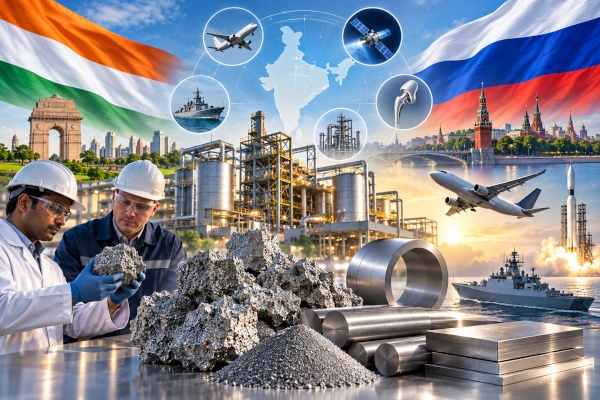
India and Russia are extending their industrial partnership into strategic materials, with Rosatom’s Giredmet Institute and Hyderabad-based ALT Metals Private Limited signing a contract to develop experimental titanium-sponge production capability in India.
The agreement was signed during INNOPROM India 2026 in New Delhi and was officially announced by Giredmet on September 11. It marks a significant new area of India–Russia cooperation because titanium sponge is a critical intermediate material used to produce titanium metal and alloys required by aerospace, space, shipbuilding, energy, chemical and medical industries.
Russian Technology to Be Transferred Into an Indian Pilot Programme
Under the agreement, Giredmet will work with ALT Metals on the deep processing of mineral raw materials and production of titanium sponge.
The Russian institute will first examine the Indian company’s proposed feedstock and conduct laboratory studies to determine how it performs within the production process.
Giredmet will then design, manufacture and supply a set of laboratory equipment required for titanium-sponge production. Russian specialists will also supervise installation and commissioning and provide training to Indian personnel.
The programme therefore extends beyond the straightforward sale of machinery. It brings Russian process expertise, equipment and training together with an Indian company that intends to develop domestic metallurgy and mineral-processing capabilities.
1,000-Tonne Industrial Plant Is the Longer-Term Objective
The project has a potentially much larger second stage.
Giredmet’s Andrei Golinei, head of the Chemical Technology Block of Rosatom Science, said the immediate work is intended to generate the technical input required for designing an industrial titanium-sponge plant with annual capacity of 1,000 tonnes.
The first stage will establish the necessary process data by examining ALT Metals’ feedstock, conducting laboratory work and operating the supplied equipment.
Giredmet says it is interested in subsequently scaling the technology to industrial level and integrating it into Indian industry.
This distinction is important. The agreement does not mean that a 1,000-tonne-per-year plant has already been ordered or is under construction. Instead, the experimental programme is intended to establish the technical basis from which such a commercial facility could later be developed.
Why Titanium Sponge Matters
Titanium sponge is the porous metallic material produced during the primary refining of titanium. It subsequently undergoes melting and processing to produce titanium ingots, alloys, forgings, sheets and components.
Its combination of high strength, relatively low weight, corrosion resistance and ability to withstand demanding operating environments makes titanium particularly valuable in aerospace and other strategic industries.
Giredmet specifically identifies potential applications in aviation and space technology, shipbuilding, chemical and oil-and-gas equipment and medicine.
For India, additional domestic titanium processing capacity could therefore support multiple high-technology supply chains rather than a single industry.
Aerospace and Space Industries Could Be Major Beneficiaries
Titanium is widely used in aircraft structures, engines and high-temperature components because it can provide considerable strength without the weight associated with many conventional steels.
It is similarly useful in launch vehicles, spacecraft structures and other space applications where reducing mass is particularly important.
India already has a growing aerospace manufacturing ecosystem built around organisations such as HAL, ISRO, DRDO and an expanding private supplier base. Increasing domestic availability of processed strategic metals can consequently have implications well beyond the metallurgy sector.
Shipbuilding is another potential beneficiary because titanium’s resistance to corrosion can make it useful for specialised marine applications.
ALT Metals Brings an Indian Mineral-Processing Partner
ALT Metals Private Limited is a relatively young Indian company.
According to Giredmet’s official announcement, the firm was established in 2023, is headquartered in Hyderabad, and specialises in developing projects involving metallurgy and mineral-feedstock processing.
The contract was signed by Golinei for the Rosatom side and ALT Metals founder and chief executive Anjani Shri Murthya Sunkavali for the Indian company.
This gives the project a clear industrial rather than purely research orientation, with the laboratory and pilot work intended to provide a route toward eventual commercial-scale production.
Part of a Much Broader Critical-Materials Push
The titanium agreement is taking place alongside broader India–Russia discussions on strategic metals.
At INNOPROM India, Rosatom’s metallurgy businesses identified titanium, zirconium, hafnium and calcium as areas where they see opportunities for cooperation with Indian industry.
Rosatom MetalTech also participated in discussions concerning rare-earth permanent magnets, aggregation of Indian demand for rare-earth products and investment in new production capacity.
These discussions are important, but they should be distinguished from the Giredmet–ALT Metals contract.
The signed agreement specifically concerns titanium sponge. Rare-earth magnets, zirconium, hafnium and calcium are currently part of a broader set of industrial cooperation discussions rather than components of the ALT Metals titanium contract.
Rare-Earth Magnets Are Becoming Strategically Important for India
The timing is particularly relevant because India is attempting to close a major gap in its domestic rare-earth value chain.
The Government of India says the country possesses rare-earth resources and can produce high-purity rare-earth oxides, but lacks sufficient industrial-scale capability for converting those oxides into metals, alloys and high-performance permanent magnets.
India therefore currently imports its entire requirement for sintered NdFeB rare-earth permanent magnets.
To address this, the government approved a ₹7,280-crore scheme to establish 6,000 tonnes per year of integrated rare-earth permanent-magnet manufacturing capacity in India.
Those magnets are essential for electric vehicles, wind turbines, high-end electronics and strategic aerospace and defence systems.
Russian discussions over rare-earth processing and magnet technologies therefore intersect with an area where India is actively seeking foreign technology, investment and domestic manufacturing capability.
India Has Significant Titanium Resources
India’s interest in processing technology is also supported by a substantial domestic mineral base.
The Department of Atomic Energy reported in January 2026 that the Atomic Minerals Directorate had established approximately 761.97 million tonnes of titanium-bearing mineral resources, including ilmenite, rutile and leucoxene, across Indian coastal and inland deposits.
The industrial challenge is therefore not simply locating titanium resources but developing competitive downstream processing technologies capable of turning mineral feedstock into high-value material.
The Giredmet–ALT Metals partnership directly addresses that middle part of the value chain.
Rosatom Brings Deep Strategic-Materials Expertise
Giredmet is one of Rosatom’s principal research organisations specialising in rare and strategic materials.
The institute works across the full technological chain, from beneficiation of ores containing rare and rare-earth metals to production of high-purity substances, single crystals and finished materials used in electronics, nuclear technology, aviation and space applications.
That experience makes its involvement particularly relevant if India intends eventually to scale the titanium project from laboratory production into an industrial plant.
India–Russia Partnership Moves Beyond Traditional Defence and Nuclear Ties
The agreement also illustrates how the India–Russia economic relationship is beginning to expand beyond its traditional pillars of defence equipment, hydrocarbons and nuclear power.
During INNOPROM India, Commerce and Industry Minister Piyush Goyal called for the two countries to move from agreements toward actual industrial production, while India and Russia reiterated their target of reaching $100 billion in bilateral trade by 2030.
Prime Minister Narendra Modi and Russian President Vladimir Putin also visited INNOPROM together on September 11 and highlighted its role in expanding industrial cooperation.
Titanium, rare-earth materials, industrial software, additive manufacturing and advanced nuclear technologies are now emerging alongside conventional trade as areas where Russian technology could combine with Indian manufacturing.
A Small Pilot With Potentially Strategic Consequences
The immediate Giredmet–ALT Metals programme is modest compared with India’s overall titanium requirements.
Its strategic significance lies instead in what it is designed to establish.
If the experimental stage succeeds, the partners intend to generate the engineering basis for a 1,000-tonne-per-year industrial titanium-sponge plant in India. That could create another domestic source of a material important to aerospace, space, shipbuilding and other high-technology sectors.
It also provides a practical example of the wider transformation both governments say they want in India–Russia economic ties—from buying and selling finished products toward technology transfer, local processing and industrial production inside India.
For India’s strategic-materials ambitions, the real milestone will therefore come if the laboratory programme progresses into the proposed industrial plant and begins converting Indian mineral resources into domestically produced titanium sponge at commercial scale.
You may also like
-
EON Space Labs and Dhruva Space Advance Indian Space Hardware on Transporter-18 Mission
-
SatLeo Labs’ TAPAS-1 Reaches Orbit, Advancing India’s Private Thermal-Imaging Capability
-
TakeMe2Space’s MOI-1A Reaches Space on Falcon 9 Transporter-18 Mission
-
Bank of Baroda Enters Pension Fund Management After PFRDA Appointment
-
SCI and India’s Push for a Larger Indigenous Maritime Fleet
