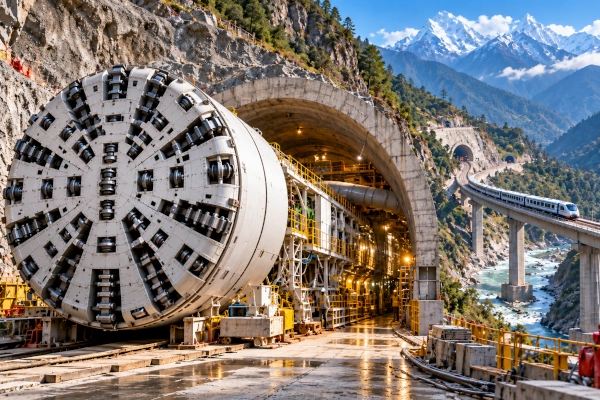
India is strengthening its domestic heavy-engineering capabilities by expanding the manufacture of advanced Tunnel Boring Machines (TBMs), reducing dependence on imported equipment for major railway, highway, metro and hydroelectric infrastructure projects. Union Railway Minister Ashwini Vaishnaw has announced that India is manufacturing tunnel boring machines with diameters of 8 metres and has begun producing larger systems measuring 15 metres, with plans to develop machines exceeding 16 metres.
The Railway Minister highlighted these developments on 22 October 2026 while discussing India’s efforts to establish a comprehensive domestic ecosystem for tunnelling technology. The initiative encompasses machine design, manufacturing, engineering modifications, operation and maintenance, reflecting the growing importance of specialised construction equipment in the country’s infrastructure expansion.
The announcement comes as work advances on the 125-kilometre Rishikesh–Karnaprayag railway project in Uttarakhand, one of India’s most demanding railway engineering undertakings. Approximately 83% of the alignment passes through tunnels, requiring specialised excavation techniques to overcome the complex geological conditions of the Himalayan mountains.
India’s growing tunnelling capabilities are particularly significant as international restrictions on specialised machinery create challenges for infrastructure projects dependent on foreign suppliers. The development of domestic manufacturing capacity can strengthen industrial resilience and support the country’s long-term infrastructure requirements.
India Begins Manufacturing Larger Tunnel Boring Machines
Railway Minister Ashwini Vaishnaw stated that India has made substantial progress in developing domestic manufacturing capabilities for tunnel boring machines. Equipment that previously depended heavily on international suppliers is increasingly being manufactured within the country.
According to the minister, 8-metre-diameter tunnel boring machines are being manufactured in India, while production of larger 15-metre machines has also commenced. He further announced plans to develop TBMs exceeding 16 metres in diameter, a capability that would expand India’s participation in the manufacture of exceptionally large tunnelling equipment.
The distinction between these stages is important. The minister described domestic manufacturing of 8-metre machines as an established activity and indicated that 15-metre production had begun. Machines exceeding 16 metres remain part of the country’s future development plans.
Vaishnaw also highlighted the presence of a tunnel boring machine manufacturing facility in Tamil Nadu. He explained that India is progressively developing the industrial capabilities needed to design, manufacture and maintain these complex machines domestically.
The initiative forms part of the government’s Aatmanirbhar Bharat programme, which seeks to strengthen domestic technological capabilities in strategically important manufacturing sectors.
Understanding the Technology Behind Tunnel Boring Machines
Tunnel Boring Machines are specialised mechanical systems designed to excavate underground passages through rock, soil and other geological formations. They are widely used in the construction of metro systems, railway tunnels, highways, water-transfer networks and hydroelectric infrastructure.
A typical TBM uses a rotating cutterhead equipped with cutting tools that break or remove material from the tunnel face. Powerful drive systems provide the torque and thrust required to advance the machine through the ground, while supporting mechanisms remove excavated material and assist with tunnel construction.
Depending on geological conditions and machine design, tunnelling equipment may also install precast concrete lining segments as excavation progresses. These segments help support the surrounding ground and create a durable tunnel structure.
The design of a TBM depends on several factors, including tunnel diameter, rock strength, groundwater conditions, geological instability and the intended use of the completed tunnel. A machine developed for relatively uniform rock formations may require significant modification before it can operate safely in fractured or unstable Himalayan geology.
Larger machines also present additional engineering challenges because their cutterheads, drive systems, bearings and structural components must withstand substantial mechanical loads.
Manufacturing such equipment therefore requires advanced metallurgy, precision engineering, hydraulic systems, specialised electrical equipment and sophisticated control technologies.
Domestic TBM Manufacturing Strengthens India’s Heavy-Engineering Industry
The expansion of indigenous tunnel boring machine manufacturing represents an important opportunity for India’s heavy-engineering sector. Large TBMs are complex industrial systems involving numerous specialised components. Their production requires cooperation among companies engaged in mechanical engineering, fabrication, precision machining, industrial electronics, hydraulic equipment and advanced materials.
Developing domestic capabilities across these areas can reduce dependence on imported machinery while providing opportunities for Indian manufacturers and engineering service providers.
A local manufacturing ecosystem can also improve access to technical support, replacement components and engineering modifications during construction. These requirements are particularly important for infrastructure projects operating under challenging geological conditions, where unexpected ground behaviour can necessitate changes to equipment or excavation methods.
Domestic production does not automatically establish that every component of a machine is manufactured in India. However, the development of capabilities in machine design, fabrication, assembly and maintenance represents progress towards greater industrial self-reliance.
The Railway Minister’s remarks emphasised the government’s intention to develop a complete tunnelling technology ecosystem rather than concentrating exclusively on the final assembly of imported equipment.
Rishikesh–Karnaprayag Railway Demonstrates India’s Himalayan Engineering Capabilities
The 125-kilometre Rishikesh–Karnaprayag railway project provides an important example of the technological challenges associated with infrastructure construction in the Himalayan region.
The railway is being developed through mountainous terrain characterised by complex geological formations, steep slopes and environmentally sensitive landscapes. According to the Railway Minister, approximately 104 kilometres of the alignment will pass through tunnels, representing nearly 83% of the entire route.
The project includes 16 main railway tunnels and 19 bridges along the alignment. Its tunnel-intensive design reflects the limited availability of suitable surface routes through the mountainous landscape.
The railway will connect several locations in Uttarakhand and improve access towards important destinations in the Garhwal region. Planned stations along the route include Shivpuri, Byasi, Devprayag, Janasu, Maletha, Srinagar, Dhari Devi, Tilani, Gholtir, Gauchar and Karnaprayag.
The project is also intended to improve connectivity towards major pilgrimage destinations, including Kedarnath and Badrinath. By providing an alternative transport corridor through the mountains, the railway could support regional mobility, tourism and economic activity.
Its construction requires a combination of advanced tunnelling techniques, geological investigation, ground stabilisation and continuous monitoring to address the challenges of building infrastructure in the young Himalayan mountain system.
Engineers Modify TBM Technology to Overcome Difficult Himalayan Geology
One of the major engineering challenges encountered during the Rishikesh–Karnaprayag project involves the variable and unstable geological conditions of the Himalayas.
The Himalayan mountain system contains regions of fractured rock, weak geological formations and materials that may deform under excavation pressure. Such conditions can create difficulties for conventional tunnelling methods and place considerable demands on mechanical excavation equipment.
Railway Minister Ashwini Vaishnaw explained that engineers undertook extensive investigations before deploying tunnel boring machines for the project. These studies helped identify the modifications needed to operate equipment under the region’s demanding geological conditions. According to the minister, engineers modified the cutterhead and shield assembly while introducing specialised changes to the drive system to provide additional torque and thrust.
These modifications were intended to improve the machine’s ability to excavate through difficult formations while supporting the tunnel structure during construction. The project demonstrates the importance of adapting tunnelling equipment to local geological requirements rather than relying exclusively on standard machine configurations.
Such engineering experience can contribute to India’s wider expertise in underground construction and help develop technical knowledge relevant to future infrastructure projects.
Tunnel T-8 Marks Major Achievement in Himalayan Railway Construction
The Rishikesh–Karnaprayag project achieved an important milestone with the breakthrough of Tunnel T-8, one of the longest railway tunnels in India. Larsen & Toubro announced the breakthrough of the approximately 14.57-kilometre tunnel in April 2025. The tunnel connects the Devprayag and Janasu sections of the railway alignment and represents a major engineering achievement in the Himalayan region.
The project used a specially adapted single-shield tunnel boring machine named Shakti, with a diameter of approximately 9.11 metres. According to Larsen & Toubro, the machine excavated around 10.4 kilometres of the tunnel, while the remaining section was constructed using the New Austrian Tunnelling Method.
The TBM achieved an average excavation rate of approximately 413 metres per month during its operation. The successful breakthrough demonstrated the effectiveness of combining specialised equipment with engineering adaptations suited to challenging geological conditions.
Tunnel T-8 is an operational tunnelling achievement associated with the railway project. It is separate from the Railway Minister’s October 2026 announcement concerning the expansion of domestic manufacturing towards 15-metre and larger TBMs.
Construction Progresses Across Rishikesh–Karnaprayag Railway Tunnels
The Railway Minister stated that construction has advanced across several sections of the Rishikesh–Karnaprayag railway project, with significant progress in tunnel excavation and supporting infrastructure.
He identified Tunnel T-1 as one of the most demanding sections of the alignment. The approximately 11-kilometre tunnel passes through difficult geological formations and areas where nearby human settlements create additional engineering and safety considerations.Specialised ground stabilisation techniques, including the use of micropiles, are being employed to address these challenges. Micropiles are small-diameter structural elements installed into the ground to improve stability and support construction in difficult soil or rock conditions.
Vaishnaw also highlighted continuing work on Tunnel T-5, indicating that construction activities were progressing across the remaining challenging sections. The project requires careful coordination between tunnel excavation, bridge construction, track installation and supporting systems. The extensive underground alignment makes geological monitoring and construction safety particularly important throughout the implementation process.
The progress achieved so far reflects the application of advanced engineering techniques to one of India’s most demanding mountain railway projects.
Indigenous Tunnelling Equipment Can Support Multiple Infrastructure Sectors
The development of domestic tunnel boring machine manufacturing has applications extending well beyond railway construction.
India’s expanding metro rail network requires specialised tunnelling equipment to construct underground stations and transport corridors beneath densely populated urban areas. Such projects frequently encounter complex combinations of soil, groundwater, existing foundations and underground utilities. Highway and road tunnel projects also require advanced excavation technologies, particularly in mountainous regions where conventional surface routes may involve difficult terrain and long travel distances.
Hydroelectric projects depend on tunnels for water conveyance and other infrastructure requirements. The availability of specialised equipment can therefore support the development of power generation and water-management facilities.
Manufacturing TBMs domestically could improve the availability of equipment suited to different project requirements while strengthening local technical support and maintenance capabilities.The Railway Minister’s announcement indicates that India intends to build manufacturing capacity across multiple machine sizes, enabling the domestic industry to address an increasingly diverse range of underground construction requirements.
International Supply Restrictions Highlight Importance of Indigenous Technology
India’s efforts to expand domestic tunnel boring machine production have gained additional relevance amid reported restrictions affecting international supplies of specialised tunnelling equipment. Recent reports have referred to tighter Chinese controls on the export of tunnel boring machines, raising concerns about equipment availability for infrastructure projects dependent on overseas manufacturers.
China is an important producer of large tunnelling machines, while several other countries also possess established expertise in designing and manufacturing specialised TBM systems. The availability of equipment, components and technical services can influence project planning and construction schedules, particularly for large underground infrastructure programmes.
Developing domestic manufacturing capabilities provides an opportunity to diversify equipment sources and strengthen India’s ability to maintain critical construction activities. The country’s efforts to produce larger TBMs also reflect the importance of investing in industrial capabilities that support long-term infrastructure development.
By strengthening domestic design, manufacturing and maintenance expertise, India can reduce exposure to external supply disruptions while creating opportunities for its engineering industry.
Larger Tunnel Boring Machines Represent the Next Manufacturing Objective
The Railway Minister’s announcement that India intends to manufacture machines exceeding 16 metres in diameter points towards the next stage of development in domestic tunnelling technology.
Machines of this size require exceptionally large cutterheads, powerful drive mechanisms and specialised structural components capable of operating under demanding geological conditions. Their development also involves considerable challenges in transportation, assembly, testing and maintenance. Large TBMs are often transported in sections and assembled near project sites because of their substantial dimensions and weight.
Establishing domestic manufacturing capabilities for such equipment would require sustained investment in advanced fabrication, industrial infrastructure and engineering expertise. The minister’s statement identifies larger TBMs as a future manufacturing objective. It does not establish that machines exceeding 16 metres have already entered domestic production or completed operational testing.
Nevertheless, the progression from smaller machines towards larger configurations indicates India’s intention to expand its participation in the global heavy-engineering industry.
Indigenous TBM Manufacturing Advances India’s Infrastructure Self-Reliance
India’s expanding tunnel boring machine manufacturing capabilities represent an important development in the country’s heavy-engineering and infrastructure sectors. The domestic production of 8-metre machines, the commencement of 15-metre manufacturing and the ambition to develop systems exceeding 16 metres demonstrate a progressive approach towards strengthening specialised industrial capabilities.
At the same time, the Rishikesh–Karnaprayag railway project illustrates the practical importance of advanced tunnelling equipment in constructing infrastructure through difficult terrain. The engineering experience gained from adapting TBMs to Himalayan geological conditions can contribute to future projects requiring sophisticated underground excavation technologies.
Developing a comprehensive domestic ecosystem for machine design, manufacturing, operation and maintenance also creates opportunities for Indian engineering companies, component manufacturers and specialised technology providers. As India continues expanding its railways, highways, metro networks and power infrastructure, the availability of advanced tunnelling equipment will remain an important requirement.
The country’s progress towards indigenous TBM manufacturing strengthens the industrial foundation needed to undertake increasingly complex infrastructure projects and supports the broader objective of building advanced engineering capabilities within India.
References
- Union Minister for Railways Ashwini Vaishnaw. Public statements on indigenous tunnel boring machine manufacturing and the Rishikesh–Karnaprayag railway project, 22 October 2026. Reported by The Economic Times on 23 October 2026.
https://m.economictimes.com/industry/transportation/railways/china-banned-tbm-exports-but-india-is-building-its-own-tunnel-boring-machines-ashwini-vaishnaw-shares-progress-status-of-125-km-rishikesh-karnaprayag-railway-line-with-16-tunnels/articleshow/135139108.cms - DD India / Prasar Bharati. Rishikesh–Karnaprayag Rail Line Is Uttarakhand’s Lifeline to Future: Ashwini Vaishnaw. Published 23 October 2026.
https://ddindia.co.in/2026/10/rishikesh-karnaprayag-rail-line-is-uttarakhands-lifeline-to-future-ashwini-vaishnaw/ - Ministry of Railways, Press Information Bureau, Government of India. Parliamentary reply concerning railway infrastructure projects in Uttarakhand and progress on the Rishikesh–Karnaprayag railway project. Published 29 July 2026.
https://www.pib.gov.in/PressReleasePage.aspx?PRID=2291217&lang=1®=46 - Ministry of Information and Broadcasting, Press Information Bureau. Rishikesh–Karnaprayag New Rail Line Project Tunnels. Official background material on major railway tunnelling projects in India.
https://www.pib.gov.in/PressNoteDetails.aspx?ModuleId=3&NoteId=156935&lang=13®=22 - Larsen & Toubro. L&T Achieves Breakthrough in India’s Longest Rail Tunnel on Rishikesh–Karnaprayag Rail Line. Official company announcement, 21 April 2025.
https://www.larsentoubro.com/pressreleases/2025-04-21-lt-achieves-breakthrough-in-india-s-longest-rail-tunnel-on-rishikesh-karnaprayag-rail-line
You may also like
-
BHEL–Coal India Joint Venture Begins Construction of ₹25,016 Crore Indigenous Coal Gasification Project in Odisha
-
Zen Technologies Introduces Indigenous Hyper-Strike Falcon AI-Guided Counter-Drone Interceptor
-
L&T and Germany’s SCHOTTEL Expand Partnership for Controllable Pitch Propeller Systems in Indian Shipbuilding
-
PM Modi to Inaugurate RBI’s Tier IV Data Centre and Cybersecurity Training Institute in Bhubaneswar
-
India Creates 11 Crore Digital Farmer IDs Five Months Ahead of Target, Strengthening AgriStack Infrastructure
