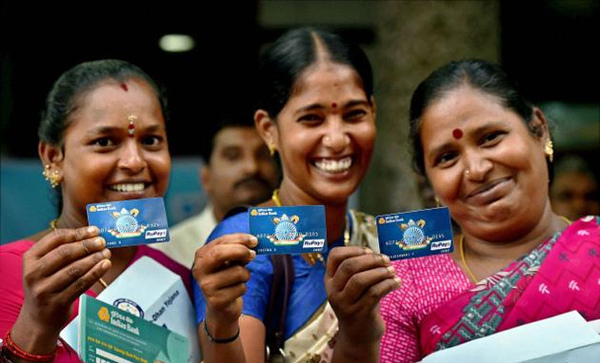
India has brought formal banking services within reach of almost every inhabited village in the country, marking a major advance in financial inclusion and rural connectivity.
As of July 17, 2026, 6,00,868 of India’s 6,01,328 inhabited villages—around 99.92 per cent—had access to a banking outlet within a five-kilometre radius. These outlets include conventional bank branches, Business Correspondents and India Post Payments Bank centres.
The figures, based on information uploaded by banks to the Jan Dhan Darshak application, indicate that only a small number of inhabited villages remain outside the targeted coverage area.
The expansion has been supported by a nationwide network of more than 1.81 lakh bank branches, 17.36 lakh Business Correspondents and 1.65 lakh India Post Payments Bank centres.
Banking Services Reach Rural and Remote Communities
The Government’s financial-inclusion strategy aims to ensure that every inhabited village has access to a banking outlet within five kilometres.
This does not necessarily require the establishment of a full bank branch in every village. Banking access may instead be provided through a Business Correspondent or an India Post Payments Bank outlet, allowing residents to use essential services closer to their homes.
Business Correspondents act as local banking representatives and help customers perform transactions such as cash deposits, withdrawals, balance enquiries, fund transfers and account-related services.
This model has proved particularly useful in remote regions where opening and operating a conventional bank branch may be difficult or commercially unviable.
India Post Payments Bank has also used the extensive postal network to take banking and payment services to rural households and geographically isolated communities.
Liberalised Branch-Opening Rules Support Expansion
The Reserve Bank of India has permitted commercial banks, Small Finance Banks, Payments Banks, Local Area Banks and Regional Rural Banks to open branches anywhere in India without obtaining prior approval.
However, banks are required to ensure that 25 per cent of their new branches are opened in unbanked rural centres.
The policy gives financial institutions greater operational flexibility while directing a portion of expansion towards underserved areas.
The identification and coverage of remaining unbanked locations is a continuous process. State Level Bankers’ Committees and Union Territory Level Bankers’ Committees coordinate with state governments, Union Territory administrations, banks and other stakeholders to examine local requirements.
Banks consider proposals for new outlets according to RBI guidelines, their business strategies and the commercial viability of the proposed locations.
Jan Dhan Accounts Cross 58.77 Crore
The Pradhan Mantri Jan Dhan Yojana continues to form the foundation of India’s financial-inclusion programme.
As of July 17, 2026, the country had 58.77 crore Jan Dhan accounts with a combined balance of ₹3,12,414 crore.
The programme was created to provide basic banking access to households and individuals who had previously remained outside the formal financial system.
Jan Dhan accounts allow beneficiaries to receive government payments directly, use digital-payment services and build a formal financial record. They also provide an entry point for accessing insurance, pensions, credit and other financial products.
The substantial balance held in these accounts indicates that they are increasingly being used as active financial instruments rather than merely as channels for receiving government benefits.
Direct Transfers Become More Efficient
The expansion of bank accounts and banking outlets has strengthened India’s Direct Benefit Transfer system.
Government subsidies, pensions, scholarships, wages and welfare benefits can be deposited directly into the verified bank accounts of eligible beneficiaries.
Direct transfers reduce the number of intermediaries involved in the distribution of public funds. They can also improve transparency, limit delays and reduce the risk of diversion or duplication.
Near-universal village coverage is particularly important because the benefits of direct transfers depend on customers being able to access their accounts conveniently.
A bank account may have limited practical value when the account holder must travel a long distance to withdraw funds or resolve service-related issues. The five-kilometre coverage objective seeks to address this challenge.
Digital Platforms Strengthen Access to Government-Backed Credit
The Government has introduced several digital platforms intended to make institutional credit more transparent and accessible.
The Jan Samarth Portal functions as a single digital platform linking government-sponsored credit and subsidy programmes.
Applicants can use the portal to identify suitable schemes, submit loan applications and undergo digital evaluation. The system is intended to improve processing speed and support the timely sanction of eligible loans.
By bringing multiple schemes onto a common platform, Jan Samarth also reduces the need for applicants to visit several departments or financial institutions separately.
Agricultural Credit Moves Towards Digital Delivery
A series of digital initiatives has been introduced to streamline agricultural lending and improve the identification of eligible farmers.
NABARD has developed an electronic Know Your Customer application, while the Department of Agriculture and Farmers Welfare has introduced KRISHIKA.
Banks are also developing their own digital applications to support beneficiary identification, farmer outreach, application processing and loan monitoring.
These tools can reduce paperwork, improve data verification and make it easier for banks to process applications in rural areas.
Digital monitoring can also help lenders track the progress of loan applications and identify delays in credit delivery.
Kisan Rin Portal Accelerates Interest-Subvention Claims
The Department of Agriculture and Farmers Welfare launched the Kisan Rin Portal in September 2023.
The platform supports Aadhaar-based verification of beneficiaries and enables faster digital settlement of claims under the Modified Interest Subvention Scheme.
The scheme applies to eligible agricultural loans taken through the Kisan Credit Card framework.
By digitising beneficiary verification and claim processing, the portal is intended to ensure that interest-related benefits reach eligible farmers more quickly and transparently.
The integration of agricultural databases, bank information and identity verification can also reduce errors and prevent duplicate or ineligible claims.
Cybersecurity Becomes Central to Digital Banking Expansion
The rapid growth of digital payments has increased the importance of cybersecurity and fraud prevention.
As more people use mobile banking, internet banking, payment cards and instant digital-payment services, financial institutions face growing threats from phishing, identity theft, malicious applications, fraudulent links and money-mule networks.
The Government and RBI have introduced several measures to improve the security of digital transactions and protect citizens from financial fraud.
These measures combine regulatory requirements, artificial intelligence, fraud-intelligence sharing, cybercrime reporting and public-awareness programmes.
Digital Payment Intelligence Corporation to Share Fraud Alerts
The Government, in consultation with the Reserve Bank of India, has established the India Digital Payment Intelligence Corporation.
The organisation is intended to share real-time fraud intelligence and alerts with banks and financial institutions.
It will use technologies such as artificial intelligence, machine learning and big-data analytics to identify suspicious patterns and emerging threats.
Real-time information sharing can help banks block fraudulent transactions more quickly and prevent the same method from being used repeatedly across several institutions.
A centralised intelligence mechanism can also improve coordination between banks, payment companies, regulators and law-enforcement agencies.
RBI Sets Minimum Digital Security Standards
The Reserve Bank of India issued Master Directions on Digital Payment Security Controls in February 2021.
The directions require banks to establish common minimum security controls across payment channels, including internet banking, mobile banking and card-based transactions.
The framework is intended to strengthen application security, authentication, customer protection, fraud monitoring and incident response.
Standardised security requirements are important because the safety of the financial system depends on all participating institutions maintaining adequate safeguards.
A vulnerability in one bank or service provider can be exploited to affect a large number of customers and interconnected payment systems.
MuleHunter Targets Fraudulent Accounts
The RBI has introduced an artificial intelligence-based tool called MuleHunter to identify suspected money-mule accounts.
Money mules are individuals or accounts used to receive, transfer or withdraw funds obtained through fraud.
Such accounts often act as intermediaries between victims and the final beneficiaries of cybercrime. Rapid identification is therefore essential for tracing transactions and preventing stolen money from being moved across multiple accounts.
Banks and financial institutions have been advised to use the tool to strengthen their fraud-detection systems.
Artificial intelligence can examine transaction patterns, account behaviour and connections between accounts that may be difficult to identify through manual monitoring alone.
Citizens Can Report Fraud Through Helpline 1930
The Indian Cyber Crime Coordination Centre under the Ministry of Home Affairs has been analysing digital-lending applications, including potentially fake or illegal loan apps.
Citizens can report cyber incidents through the National Cybercrime Reporting Portal.
The national cybercrime helpline number 1930 is also available for reporting financial fraud.
Prompt reporting is especially important in digital-payment fraud because rapid action may allow banks and authorities to freeze suspicious accounts before the money is withdrawn or transferred further.
Public awareness of the reporting system is therefore an essential part of the country’s fraud-prevention framework.
Awareness Campaigns Promote Safer Banking
The RBI and banks are conducting awareness campaigns through text messages, radio programmes and public communication initiatives.
These campaigns warn customers against sharing passwords, personal identification numbers, one-time passwords and other sensitive financial information.
The RBI also conducts electronic banking awareness and training programmes known as e-BAAT.
These programmes focus on common types of fraud, digital-banking risks and precautions customers can take while using financial services.
Awareness remains important because many cybercrimes rely on social engineering rather than technical attacks. Fraudsters may impersonate bank officials, government representatives or customer-support agents to persuade victims to reveal confidential information.
Reference
Press Information Bureau, Government of India. “India achieves near-universal banking coverage, with 99.92% of inhabited villages now served by a banking outlet.” Ministry of Finance, published on 3 August 2026 at 4:25 PM, PIB Delhi.
You may also like
-
India’s Economic Warfare Challenge: Strategic Autonomy, Energy Security and the Rise of a Global Power
-
India-US Trade Deal Stalemate: Why Washington’s Tariff Pressure Has Failed to Secure an Agreement
-
US Double Standards in Foreign Policy: 16 Recent Cases Involving India, Russia, China and Global Trade
-
India’s Arctic Energy Ambitions: Russian Oil, LNG and a New Sea Route to Indian Ports
-
India and Russia Explore Joint Icebreaker Construction as Maritime Industrial Cooperation Expands
