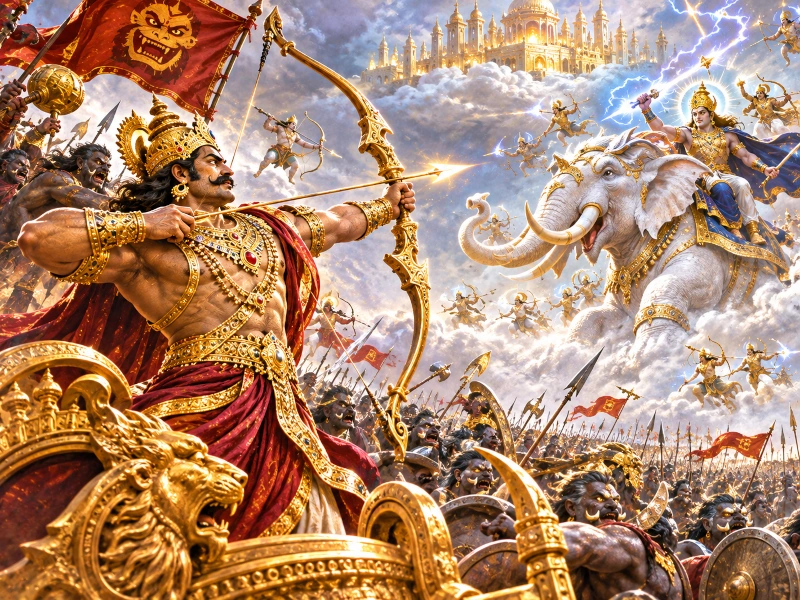
Ancient Warfare Strategies from the Purāṇas | Śrīmad Bhāgavata Purāṇa | Skandha 8, Chapters 10, 11 and 15
Introduction: The Asura Commander Who Challenged the Kingdom of Indra
The Śrīmad Bhāgavata Purāṇa contains several remarkable accounts of warfare between the Devas and Asuras, illustrating the importance of military leadership, strategic preparation, battlefield innovation and the ability to recover from defeat. Among these narratives, the campaigns of Mahābali, the powerful Daitya ruler and grandson of Prahlāda, offer a particularly significant examination of military command and the conquest of a strategically important kingdom.
Bali emerged as one of the foremost commanders of the Asuras during their prolonged struggle against the celestial forces led by Indra. His military career included direct battlefield confrontation, the employment of extraordinary weapons, the mobilisation of powerful commanders and a remarkable recovery following defeat. His subsequent campaign against Svarga culminated in the withdrawal of Indra and the occupation of the celestial capital by the Asura forces.
The Bhāgavata Purāṇa presents these developments across separate but interconnected episodes. Chapters 10 and 11 describe the great battle following the distribution of Amṛta, during which Bali directly confronts Indra and suffers defeat. Chapter 15 recounts Bali’s restoration, renewed military preparations and successful advance against Indra’s celestial kingdom.
The central military significance of Bali’s campaigns lies in the relationship between leadership, force regeneration, strategic preparation and the exploitation of an adversary’s inability to resist an overwhelming military threat.
Equally important is the response of Indra, who ultimately accepts the advice of Bṛhaspati to abandon Svarga temporarily rather than engage an opponent whose strength has become exceptionally formidable. The episode therefore provides lessons not only in offensive military strategy but also in defensive restraint and the preservation of forces.
The Strategic Background: Competition for Celestial Supremacy
The conflict between the Devas and Asuras intensified following the Samudra Manthana, the churning of the Ocean of Milk. Both groups had participated in the undertaking to obtain Amṛta, the nectar of immortality, but the eventual distribution of the nectar favoured the Devas through the intervention of Lord Viṣṇu in the form of Mohinī.
The Asuras regarded the outcome as a major setback. Having contributed to the immense effort required to obtain Amṛta, they found themselves deprived of the resource that would significantly strengthen their position in the struggle for supremacy.
The resulting confrontation developed into a large-scale battle involving powerful commanders, diverse weapons and extensive forces on both sides. Bali, the son of Virocana and grandson of Prahlāda, assumed command of the Asura army against the celestial forces led by Indra.
The Bhāgavata Purāṇa describes the armies assembling with chariots, elephants, cavalry, infantry and numerous extraordinary mounts. The battlefield became the scene of simultaneous engagements between prominent warriors from the opposing sides.
The military importance of this confrontation lies in its representation of a major struggle for strategic supremacy, in which control over extraordinary resources and military power determined the balance between rival kingdoms.
For Bali, the campaign represented an opportunity to challenge Indra’s dominance and establish the Asuras as the superior military force. For Indra, the conflict concerned the defence of the celestial order and the preservation of the kingdom under his authority.
Bali’s Command Structure: Leadership of a Powerful Asura Coalition
In Skandha 8, Chapter 10, the Bhāgavata Purāṇa identifies Bali as the commander-in-chief of the Asura forces. He appears at the centre of an extensive military formation supported by numerous powerful commanders, including Namuci, Śambara, Bāṇa, Vipracitti, Praheti, Heti, Tāraka, Jambha and several other formidable warriors.
Bali’s command position was distinguished by his extraordinary aerial vehicle, Vaihāyasa, which had been constructed by Maya. The vehicle possessed remarkable capabilities and is described as sometimes visible and sometimes invisible. Equipped for battle and surrounded by senior commanders, Bali occupied an elevated position from which he participated in the great confrontation.
The aerial vehicle symbolised the technological and supernatural capabilities attributed to the Asura forces within the Purāṇic narrative. More importantly, its presence placed Bali in a distinctive command position above the conventional battlefield.
From a military perspective, Bali’s position aboard Vaihāyasa illustrates the strategic advantage of an elevated and mobile command platform capable of supporting battlefield observation, movement and combat operations.
The surrounding Asura commanders represented a formidable concentration of military strength. Their presence demonstrates that Bali’s authority extended beyond personal combat abilities to the leadership of a large coalition of powerful warriors.
A commander responsible for such a force must maintain coordination among different formations, sustain morale and ensure that the capabilities of subordinate leaders contribute towards the larger military objective.
The essential principle of command demonstrated in the narrative is that military effectiveness depends not merely upon the strength of individual warriors but upon their organisation under a recognised and capable leadership structure.
The Battle Against Indra: Direct Confrontation Between Rival Commanders
As the opposing armies engaged, Bali confronted Indra, who entered the battlefield mounted upon Airāvata, his magnificent celestial elephant.
The Bhāgavata Purāṇa describes a series of direct engagements between prominent Deva and Asura warriors. Bali’s confrontation with Indra formed the central contest between the respective commanders of the opposing forces.
During the battle, Bali launched a coordinated attack against Indra and the immediate elements supporting his battlefield position. According to Chapter 10, Verse 41, he directed ten arrows against Indra, three against Airāvata, four against the guards protecting the elephant and one against its driver.
This sequence provides one of the most interesting tactical details in the Purāṇic account.
Bali did not concentrate all his missiles exclusively upon Indra. Instead, he distributed his attack across the commander, his mount, his protective personnel and the individual responsible for controlling the elephant.
The military significance of this attack lies in the attempt to disrupt the enemy commander’s entire fighting system rather than targeting the commander alone.
Indra’s effectiveness on the battlefield depended upon several interconnected elements. Airāvata provided mobility and an elevated fighting position, the guards contributed protection, and the driver maintained control over the mount. By attacking these components simultaneously, Bali attempted to weaken the commander’s operational effectiveness.
This resembles the broader military principle of attacking the supporting elements that enable an adversary’s principal combat capability.
However, the narrative also records Indra’s exceptional defensive skill. He intercepted Bali’s arrows before they reached their intended targets and subsequently neutralised several other weapons employed by the Asura commander.
The episode demonstrates that disrupting an enemy’s command system can be an effective tactical objective, but its success depends upon overcoming the adversary’s defensive capabilities and battlefield adaptability.
Bali’s Use of Māyā: Battlefield Deception and Psychological Warfare
When his conventional weapons failed to overcome Indra, Bali adopted an entirely different form of warfare. The Bhāgavata Purāṇa describes him employing Māyā, or extraordinary illusion, to create terrifying conditions across the battlefield.
Through this power, an immense illusory mountain appeared above the Deva forces. Burning trees, sharp stones, dangerous animals and other destructive manifestations descended upon the soldiers. The account further describes violent winds, threatening clouds, fire and overwhelming waters appearing in succession.
These extraordinary phenomena belong to the supernatural framework of the Purāṇic narrative and should not be confused with historical military technologies. Nevertheless, they provide a useful basis for examining the psychological effects of unfamiliar and unpredictable threats upon organised forces.
The Devas found themselves confronting dangers that did not resemble the conventional weapons previously employed in the battle. Their formations were subjected to confusion and distress as the environment itself appeared to become hostile.
The strategic principle illustrated by Bali’s use of Māyā is that disrupting an enemy’s understanding of the battlefield can weaken morale, interfere with coordinated action and create uncertainty about the nature and direction of the threat.
Bali’s employment of illusion also demonstrated an important feature of tactical adaptation. When conventional weapons failed, he shifted to an unconventional method intended to overwhelm the adversary’s ability to respond.
The Bhāgavata Purāṇa subsequently describes Lord Viṣṇu appearing upon Garuḍa and dispelling the illusions. The intervention restored the Devas’ ability to confront the battlefield without the distortions created by the Asura forces.
The enduring military lesson is that unconventional methods can temporarily undermine a stronger opponent, but their effectiveness depends upon whether the adversary possesses the means to recognise, withstand and neutralise the disruption.
The Defeat of Bali: When the Commander Falls
Despite Bali’s formidable abilities and the extraordinary methods employed by the Asuras, the battle did not conclude in his favour.
In Chapter 11, the confrontation between Bali and Indra continues with an exchange that reveals the confidence and determination of both commanders. Bali displays considerable composure and speaks about the influence of time upon victory, defeat, fame and death.
Indra eventually strikes Bali with his Vajra, the celestial thunderbolt. The Asura commander falls upon the battlefield, suffering a decisive defeat.
The loss of such a prominent commander represented a major setback for the Asura forces. Bali had occupied a central position in their command structure, and his defeat demonstrated that even the most formidable leader remained vulnerable during direct confrontation.
The military significance of Bali’s fall lies in the vulnerability created when a powerful army depends heavily upon the survival and effectiveness of its principal commander.
The defeat also demonstrates that tactical innovation and personal courage do not guarantee victory against an adversary possessing superior defensive skill or a decisive weapon.
Yet Bali’s military career did not end with this defeat. The subsequent restoration of the Asura ruler became the foundation for one of the most significant strategic reversals described in the Bhāgavata Purāṇa.
Strategic Recovery: The Restoration of Bali’s Military Power
Chapter 15 begins by recounting how Bali was restored to life by the descendants of Bhṛgu, including Śukrācārya and his followers.
Following his restoration, Bali placed himself under their guidance and demonstrated his gratitude and devotion. The Bhṛgu priests, pleased with him, conducted the Viśvajit sacrifice to support his ambition of conquering the celestial kingdom.
The narrative describes extraordinary military resources emerging through this ritual. These included a magnificent chariot adorned with a lion-emblazoned banner, a golden bow, inexhaustible quivers of arrows and celestial armour. Bali also received a garland from Prahlāda and a conch from Śukrācārya.
Within the religious framework of the Bhāgavata Purāṇa, these developments represent the spiritual power and blessings associated with Bali’s advisers. From the perspective of military analysis, they also illustrate the importance of restoring combat capability before undertaking a renewed offensive.
Bali did not immediately return to the battlefield following his earlier defeat. His recovery was accompanied by renewed preparation, the acquisition of powerful equipment and the consolidation of support from influential advisers.
The strategic significance of Bali’s recovery lies in the principle of force regeneration: a defeated army can regain offensive capability when leadership, resources, equipment and institutional support are successfully restored.
The episode also demonstrates the importance of relationships between political leadership and experienced advisers. Śukrācārya and the Bhṛgu priests provided the spiritual and institutional foundation for Bali’s renewed strength.
A capable commander recognises that victory depends not only upon personal courage but also upon the resources, preparation and guidance required to sustain a prolonged military campaign.
The March on Svarga: Concentration of Military Power
After completing his preparations, Bali assembled his forces and advanced towards the celestial capital of Indra.
The Bhāgavata Purāṇa describes the Asura ruler mounting his magnificent chariot, equipped with armour, bow, sword and arrows. He was surrounded by powerful Daitya commanders and a vast army whose movement was portrayed as shaking the heavens and the earth.
The description emphasises the scale and impressive appearance of the advancing force. Bali’s campaign was no longer an isolated battlefield engagement between individual warriors. It had developed into a major offensive directed against the political and strategic centre of the Devas.
The objective was the seizure of Indra’s capital and the establishment of Asura supremacy over Svarga.
The fundamental military principle demonstrated by Bali’s advance is the concentration of superior forces against a strategically decisive objective.
Rather than dissipating his strength across unrelated engagements, Bali directed his army towards the centre of his adversary’s authority.
The celestial capital represented more than a fortified location. It was the seat of Indra’s political power and the symbolic centre of Deva supremacy. Its occupation would therefore carry consequences far beyond the immediate possession of territory.
By advancing directly against the enemy’s political centre, Bali transformed military pressure into a challenge to the entire structure of celestial authority.
The campaign also demonstrated the psychological effect of overwhelming force. The size and apparent invincibility of Bali’s army became important factors in shaping Indra’s response even before a decisive battle occurred.
The Siege of Indra’s Capital: Military Pressure Without Decisive Combat
The Bhāgavata Purāṇa describes Bali reaching Indra’s magnificent capital, surrounded by its extraordinary gardens, palaces and fortifications. The city represented the wealth, stability and authority of the celestial kingdom.
Bali’s forces surrounded the city, and the Asura ruler sounded his conch, creating fear among its inhabitants.
The military situation had changed dramatically from the earlier conflict in which Indra had defeated Bali. The Asura commander now possessed immense strength derived from his restoration and the blessings of his spiritual advisers.
Indra recognised the seriousness of the threat and sought the counsel of Bṛhaspati, the spiritual preceptor of the Devas.
This decision became the turning point of the campaign.
Rather than immediately confronting the advancing Asura army, Indra requested an assessment of Bali’s extraordinary power and the possibility of resisting him.
The episode illustrates that the defence of a strategic centre requires an accurate evaluation of the attacking force before committing available military resources to a potentially decisive engagement.
The presence of a powerful army outside the capital did not automatically make a defensive battle the best available course of action.
Indra’s willingness to consult Bṛhaspati demonstrated the importance of understanding the balance of power before deciding whether to fight.
Bṛhaspati’s Strategic Assessment: Knowing When Not to Fight
Bṛhaspati explained that Bali’s extraordinary power originated from the blessings and support of the Bhṛgu priests. Under the prevailing circumstances, the Asura ruler possessed strength that the Devas could not successfully overcome.
The assessment was unambiguous. Bṛhaspati advised Indra and the other Devas to abandon the celestial kingdom temporarily and remain concealed until the circumstances responsible for Bali’s superiority changed.
This advice was not a declaration that Svarga had ceased to possess strategic importance. Rather, it recognised that defending the capital through immediate battle could result in an even greater disaster.
Bṛhaspati understood that the relative balance of power had shifted and that the Devas lacked the means to defeat Bali at that particular moment.
The central strategic lesson of Bṛhaspati’s advice is that a commander must distinguish between the importance of an objective and the wisdom of attempting to defend it under unfavourable conditions.
A strategically important city or territory may be worth defending, but the decision must consider the likely consequences for the army responsible for its protection.
Bṛhaspati’s recommendation effectively prioritised the survival of the Devas over the immediate possession of their capital.
The preservation of combat capability may be more important than retaining territory when continued resistance would expose the defending force to destruction without a realistic prospect of success.
Indra accepted this assessment, demonstrating the practical value of informed strategic consultation.
The contrast with rulers who reject inconvenient advice is particularly significant. Indra possessed authority over the Devas, yet he recognised that his position did not eliminate the need for expert judgment.
The Withdrawal of the Devas: Strategic Retreat as a Military Decision
Following Bṛhaspati’s advice, Indra and the Devas withdrew from Svarga.
The Bhāgavata Purāṇa states that they departed from the celestial kingdom and concealed themselves, leaving Bali free to occupy the capital.
This withdrawal represents one of the most important military aspects of the narrative because it prevented the campaign from developing into a potentially disastrous defensive battle.
Indra recognised that the immediate balance of power favoured Bali and accepted the temporary loss of territory rather than risk the destruction of his forces.
The military principle illustrated by this decision is that strategic withdrawal can preserve an army’s capacity for future operations when the conditions for successful defence no longer exist.
A retreat undertaken after careful assessment differs fundamentally from an uncontrolled collapse. In the former, the commander deliberately preserves resources and avoids unnecessary losses. In the latter, the defending force loses the ability to maintain cohesion or organise an effective response.
The Bhāgavata Purāṇa does not provide a detailed account of withdrawal routes, rear guards or logistical arrangements. Its emphasis is upon the decision itself and the acceptance of Bṛhaspati’s assessment.
Nevertheless, the strategic reasoning remains clear. Indra chose survival and the possibility of future recovery over immediate confrontation with a superior opponent.
The ability to withdraw at the appropriate moment is an essential element of military judgment, particularly when preserving forces offers greater long-term value than fighting for an objective that cannot presently be held.
Bali Occupies Svarga: Victory Through Overwhelming Strategic Superiority
With the Devas having withdrawn, Bali entered and occupied the celestial capital.
The Bhāgavata Purāṇa records that the son of Virocana took possession of Indra’s city and established his authority over the heavenly realm.
The conquest represented the culmination of Bali’s recovery from defeat, the restoration of his military resources and his successful concentration of power against a decisive strategic objective.
Importantly, the final conquest was not achieved through the destruction of Indra’s army in a decisive battle. Instead, Bali’s superior strength compelled the defending leadership to abandon its position.
The central military significance of Bali’s conquest is that overwhelming superiority can achieve strategic objectives by making continued resistance unacceptable to the adversary.
Military success does not always require the physical annihilation of enemy forces. The ability to create a situation in which an opponent chooses withdrawal can produce the same immediate territorial result.
Bali’s occupation of Svarga demonstrated the effectiveness of combining concentrated military strength, capable leadership and a clearly defined strategic objective.
Yet the narrative also reveals the distinction between acquiring power and maintaining it.
The subsequent chapters describe how Bali’s extraordinary position eventually becomes connected with the appearance of Lord Viṣṇu as Vāmana. The larger narrative therefore places Bali’s conquest within a continuing examination of power, duty, generosity and the limits of worldly sovereignty.
The conquest of a strategic centre represents a major achievement, but the durability of that achievement depends upon the wider political, moral and institutional conditions supporting the victor’s authority.
Modern Military Parallel: Strategic Withdrawal and the Preservation of Forces
A useful modern comparison can be found in the evacuation of Allied forces from Dunkirk during the Second World War in 1940.
Following the rapid German advance through Western Europe, substantial British and Allied forces became trapped near the French coast. The military situation had deteriorated to the point where continued resistance in the existing positions threatened the destruction or capture of a large portion of the Allied army.
Operation Dynamo, conducted between 26 May and 4 June 1940, evacuated more than 338,000 Allied personnel from Dunkirk and nearby beaches.
The evacuation required the abandonment of considerable military equipment and did not prevent the subsequent defeat of France. Nevertheless, it preserved a substantial body of experienced personnel who remained available for the continuation of Britain’s war effort.
The parallel with Indra’s withdrawal from Svarga is strategic rather than historical or operational. Dunkirk involved modern mechanised warfare, air attacks, naval evacuation and complex logistical operations, while the Bhāgavata Purāṇa describes a supernatural conflict between celestial forces.
However, both episodes illustrate the importance of preserving military capabilities when the immediate tactical or territorial situation becomes untenable.
The shared military principle is that a temporary loss of territory need not constitute permanent strategic defeat if the withdrawal preserves the forces required to continue the struggle.
Indra’s decision to accept Bṛhaspati’s advice reflects this principle within the Purāṇic narrative. Rather than risk destruction in defence of Svarga, he withdrew and retained the possibility of future recovery.
The comparison also demonstrates that military leadership must distinguish between political prestige and strategic necessity. The refusal to abandon a threatened position may appear determined, but continued resistance becomes counterproductive when it destroys the resources necessary for eventual recovery.
Military Lessons from Bali’s Campaigns
Bali’s campaigns illustrate several important principles of military leadership and strategic planning. His earlier battlefield defeat demonstrates the vulnerability of even the most formidable commander when confronted by an adversary possessing superior combat effectiveness. His subsequent restoration shows how military strength can be regenerated through renewed preparation, equipment and institutional support.
The first lesson is that defeat in battle does not necessarily eliminate a commander’s ability to recover, reorganise and conduct a successful future campaign. Bali’s restoration and renewed preparations transformed an earlier military setback into the foundation for a major strategic offensive.
A second lesson concerns command organisation. Bali led a formidable coalition of Asura warriors supported by experienced commanders and extraordinary military capabilities. His leadership demonstrates the importance of concentrating diverse resources under a coherent command structure. The effectiveness of a powerful army depends upon the ability of its commander to organise subordinate forces and direct their capabilities towards a common strategic objective.
The third lesson emerges from Bali’s attempt to attack Indra, Airāvata, the elephant’s guards and its driver during their earlier confrontation. This episode demonstrates an understanding of the supporting components that enable a principal combatant to operate effectively. Disrupting an adversary’s mobility, protection and command support can be as important as attacking the principal combatant directly.
The fourth lesson concerns unconventional warfare. Bali’s employment of Māyā temporarily created extraordinary confusion among the Deva forces. Although these manifestations belong to the supernatural setting of the Purāṇa, they illustrate the potential effect of surprise and unfamiliar threats. The ability to disrupt an enemy’s perception of the battlefield can weaken morale and interfere with coordinated military action.
The fifth lesson concerns the concentration of military power. Bali’s later campaign directed his restored army towards Indra’s capital, the centre of celestial authority. By threatening this decisive objective with overwhelming strength, he created conditions in which the defenders chose withdrawal. A military campaign becomes strategically effective when its operations are directed towards objectives whose loss significantly changes the adversary’s political and military position.
The sixth lesson emerges from Bṛhaspati’s advice. His assessment prevented Indra from engaging in a battle under exceptionally unfavourable circumstances. Sound military leadership requires the courage to reject battle when the preservation of forces offers a greater strategic advantage than immediate confrontation.
Finally, the narrative emphasises the relationship between military power and informed counsel. Bali benefited from the guidance of Śukrācārya and the Bhṛgu priests, while Indra relied upon Bṛhaspati’s assessment before withdrawing from Svarga. The enduring lesson is that military strength becomes most effective when commanders combine operational capability with experienced strategic advice.
Conclusion: The Commander Who Turned Defeat into Conquest
Mahābali’s rise from battlefield defeat to the conquest of Svarga stands among the significant military narratives of the Śrīmad Bhāgavata Purāṇa.
His earlier confrontation with Indra demonstrated courage, tactical initiative and the employment of extraordinary combat methods, but it ultimately ended in defeat. His subsequent restoration under the guidance of Śukrācārya and the Bhṛgu priests allowed him to rebuild his strength and undertake a new campaign against the celestial kingdom.
The later offensive revealed a different dimension of military success. Bali did not need to destroy Indra’s army in battle to occupy Svarga. His overwhelming strength and determined advance compelled the Devas to withdraw after Bṛhaspati concluded that resistance would be futile under the prevailing circumstances.
The greatest strategic achievement of Bali’s campaign was his ability to transform renewed military strength into political control over a decisive objective without requiring a final battle against Indra’s forces.
At the same time, Indra’s withdrawal demonstrated the wisdom of preserving military capabilities when the enemy possesses overwhelming superiority. The contrasting decisions of Bali and Indra illustrate how offensive concentration and defensive restraint can both represent sound strategic choices under different circumstances.
The episode therefore offers an important understanding of warfare that extends beyond the simple distinction between victory and defeat. Military success depends upon preparation, leadership, resources, timing, intelligence and the ability to recognise when circumstances favour attack or withdrawal.
The enduring principle of warfare preserved in Bali’s conquest is that a successful commander must know how to recover from defeat, concentrate strength against decisive objectives and exploit opportunities, while a wise defender must recognise when preserving an army is more important than holding territory.
Through the campaigns of Bali and the strategic counsel of Bṛhaspati, the Bhāgavata Purāṇa demonstrates that the outcome of war is shaped not merely by courage and weapons but by the quality of military judgment governing their employment.
True strategic mastery lies in knowing when to fight, when to advance, when to withdraw and how to preserve the strength necessary for the next decisive engagement.
Scriptural References: Śrīmad Bhāgavata Purāṇa, Skandha 8, Chapter 10, particularly Verses 16–24 and 41–55; Chapter 11, concerning Bali’s confrontation and defeat by Indra; and Chapter 15, Verses 3–36, concerning Bali’s restoration, military preparations, march against Svarga, Bṛhaspati’s strategic advice and the occupation of Indra’s celestial capital.
You may also like
-
The Saptāṅga Theory: Why Kauṭilya Considered the State a System of Seven Interdependent Elements
-
Over 1,500 Megalithic Burial Structures and Rare Female Stone Figures Identified in Telangana
-
Rāhu Infiltrates the Devas: Deception, Enemy Penetration and the Sudarśana Chakra
-
Mārīca’s Warning to Rāvaṇa: When Strategic Advice Is Ignored by Political Leadership
-
From Enemy Prince to Allied King: Vibhīṣaṇa and the Politics of Strategic Realignment
