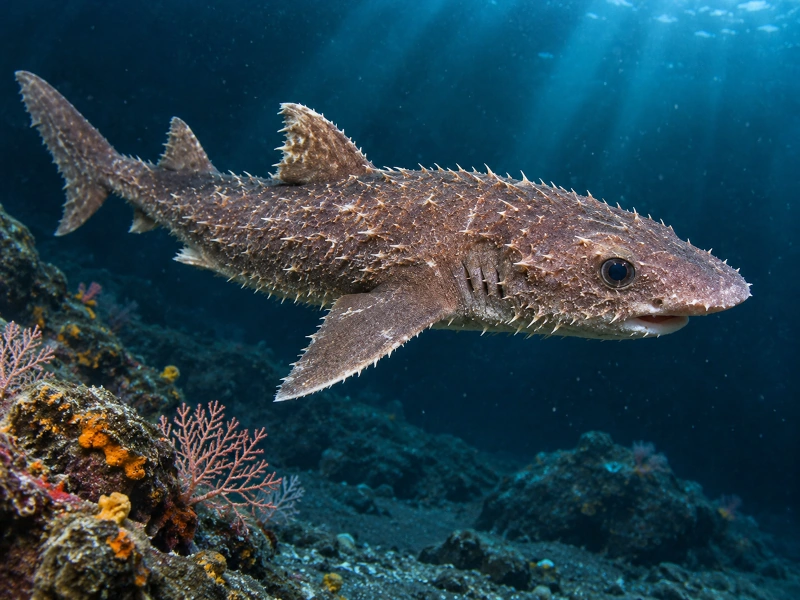
Indian scientists have identified a previously unrecognised species of deep-sea shark in the Indian Ocean, resolving a decades-old scientific misidentification and expanding the documented marine biodiversity of India’s surrounding waters. The newly described species, named Echinorhinus roinee, or the Indian Bramble Shark, was identified through collaborative research conducted by the Zoological Survey of India (ZSI) and the ICAR-Central Marine Fisheries Research Institute (ICAR-CMFRI).
The discovery was officially announced by the Ministry of Environment, Forest and Climate Change on November 11, 2026. The shark, which inhabits deep waters off India’s southwestern coast, had previously been classified as the Atlantic Bramble Shark despite belonging to a genetically distinct Indian Ocean lineage. The findings have been published in Records of the Zoological Survey of India, Volume 126, Special Issue 1, 2026.
Discovery Linked to Deep-Sea Fishing Operations in Kerala
The specimens examined during the investigation were collected from Sakthikulangara Fishing Harbour in Kollam district, Kerala, where they had been landed as incidental catches by deep-sea shrimp trawlers.
Sakthikulangara is an important fishing harbour along India’s southwestern coastline, supporting commercial fishing operations that extend into deeper offshore waters. These activities occasionally bring poorly documented marine organisms to the surface, providing researchers with opportunities to examine species that are otherwise difficult to observe in their natural habitats.
The Indian Bramble Shark inhabits continental slope waters at depths ranging from approximately 350 to 450 metres, where sunlight penetration is limited and environmental conditions differ considerably from those found in shallower coastal ecosystems.
The newly described species can attain a length of approximately three metres, making it a substantial deep-water predator.
The discovery demonstrates how systematic examination of specimens obtained through commercial fisheries can reveal previously unrecognised marine species, even when those animals have been recorded in scientific and fisheries literature for decades.
A Deep-Sea Shark Distinguished by Thorn-Like Skin Structures
The Indian Bramble Shark possesses several distinctive physical characteristics that distinguish it from other sharks.
Its body is predominantly dark brown to blackish and is covered with prominent thorn-like structures known as dermal denticles. These specialised skin structures are particularly characteristic of sharks belonging to the genus Echinorhinus.
As the shark matures, the denticles develop into larger, multi-pointed plates, producing the rough and heavily armoured appearance associated with bramble sharks.
The researchers identified several anatomical characteristics that differentiate Echinorhinus roinee from its closest relatives.
These include relatively larger eyes, larger pelvic fins and an elongated region extending from the snout to the gill openings.
The combination of these structural features provided important evidence that the Indian Ocean specimens did not belong to the Atlantic species under which they had previously been classified.
The identification of distinctive anatomical characteristics, supported by genetic evidence, established that the Indian Bramble Shark represents a separate species rather than a geographical population of the Atlantic Bramble Shark.
DNA Analysis Resolves Decades of Scientific Misidentification
For several decades, bramble sharks recorded from Indian waters were considered members of Echinorhinus brucus, a species associated with the Atlantic Ocean and other regions.
However, detailed examination of the Indian specimens revealed morphological differences that prompted researchers to investigate their evolutionary relationships.
The scientific team employed mitochondrial DNA barcode analysis to compare genetic material from the Indian Ocean specimens with that of related bramble sharks.
The investigation confirmed that Echinorhinus roinee represents a genetically distinct lineage, separate from both the Atlantic Bramble Shark (Echinorhinus brucus) and the Pacific Prickly Shark (Echinorhinus cookei).
Mitochondrial DNA analysis is an established technique in modern taxonomy, allowing researchers to compare genetic sequences and investigate evolutionary differences between closely related organisms.
The results provided independent genetic evidence supporting the anatomical observations.
The findings resolved a longstanding taxonomic uncertainty and established the Indian Bramble Shark as a distinct member of the genus Echinorhinus.
Distribution May Extend Beyond Indian Waters
Although the specimens used in the scientific investigation were obtained from Kerala, genetic evidence suggests that the species may have a wider geographical distribution across parts of the Indian Ocean and adjoining waters.
Researchers identified genetically similar records associated with waters near Oman, Sri Lanka and Thailand.
These findings suggest that the Indian Bramble Shark may occur across a broader marine region than the southwestern coast of India.
However, the precise geographical distribution, population structure and abundance of the species have not yet been established.
Additional specimen examinations and genetic comparisons will be necessary to determine its distribution across the Indian Ocean.
The discovery also raises the possibility that historical records attributed to the Atlantic Bramble Shark in the region may require re-examination.
Discovery Has Important Implications for Deep-Sea Fisheries Research
The identification of Echinorhinus roinee carries implications for the accuracy of fisheries records and assessments of deep-sea biodiversity.
Bramble sharks are occasionally captured as incidental catches in deep-sea trawl and longline fisheries operating along India’s southwestern coast.
Previously, specimens belonging to the newly recognised Indian Ocean species were recorded under the scientific name of the Atlantic Bramble Shark.
Such misidentification can affect the accuracy of information used to investigate species distribution, fishing pressure and population trends.
Accurate identification allows researchers to distinguish between species that may have different ecological characteristics, population sizes and conservation requirements.
Recognising Echinorhinus roinee as a separate species provides an improved scientific basis for documenting deep-sea shark catches and assessing the conservation needs of this previously overlooked Indian Ocean lineage.
The discovery also highlights the importance of cooperation between marine fisheries researchers and taxonomic institutions in identifying species encountered during commercial fishing operations.
Scientific Research Supported Under India’s Deep Ocean Mission
The investigation was conducted by a team of scientists from the Zoological Survey of India and ICAR-Central Marine Fisheries Research Institute.
The research team included Praveen Rozario, Bineesh K. K., Sweta Beura, Anil Kasinath and Dhriti Banerjee from the Zoological Survey of India, along with Akhilesh K. V. from ICAR-CMFRI.
The work received financial support from the Ministry of Earth Sciences under India’s Deep Ocean Mission, which supports scientific investigations of deep-ocean environments and marine resources.
The researchers combined detailed morphological examination, anatomical measurements and molecular genetic analysis to establish the species’ identity.
The scientific description has been published in Records of the Zoological Survey of India, providing the formal taxonomic documentation required for its recognition.
The type specimens have been deposited in the National Zoological Collections at the Marine Biology Regional Centre of the Zoological Survey of India in Chennai.
These preserved specimens serve as permanent scientific references, allowing future researchers to examine the species and compare newly collected material with the original description.
New Species Named in Honour of Roinee
The newly identified shark has been assigned the scientific name Echinorhinus roinee.
According to the Zoological Survey of India, the specific name roinee honours Roinee, the daughter of Dr. Dhriti Banerjee, Director of the Zoological Survey of India and a member of the research team.
Scientific naming follows established international taxonomic conventions, with newly described species receiving formal names that are subsequently used in research literature and biodiversity databases.
The naming of the Indian Bramble Shark provides a distinct scientific identity for a species that had previously been grouped with its Atlantic relative.
Importance of the Discovery for Marine Conservation
The recognition of the Indian Bramble Shark as a distinct species has important implications for marine biodiversity documentation and conservation research.
Deep-sea ecosystems are comparatively difficult to investigate because of their depth, limited accessibility and the specialised equipment required for direct observation.
Consequently, scientists continue to identify previously undocumented organisms and revise the classification of species inhabiting these environments.
Accurate taxonomy is essential for conservation because population assessments and fisheries management depend upon identifying the organisms being studied.
The discovery of Echinorhinus roinee also highlights the need for careful documentation of deep-sea bycatch, particularly in fisheries operating along continental slopes.
Although the species has now been formally recognised, its population size, reproductive biology, geographical distribution and conservation status remain insufficiently understood.
Further research will be required to establish these characteristics and assess whether the species faces significant threats from fishing activities or environmental changes.
A Significant Addition to India’s Marine Biodiversity
The identification of the Indian Bramble Shark represents an important contribution to the scientific understanding of marine life in the Indian Ocean.
By combining traditional morphological taxonomy with modern molecular techniques, Indian researchers have distinguished a previously overlooked species from closely related sharks inhabiting other ocean regions.
The discovery also demonstrates the scientific value of specimens obtained from fishing harbours and the importance of preserving zoological collections for future research.
India’s surrounding seas encompass diverse marine environments, including continental slopes and deeper ocean habitats that remain comparatively less studied than coastal ecosystems.
The discovery of Echinorhinus roinee off Kerala establishes a new species in India’s documented marine fauna and demonstrates that the Indian Ocean continues to contain biological diversity that has not yet been fully recognised or scientifically understood.
You may also like
-
IIT Madras Identifies Unique Microbial Signature in Chennai Metro, Reveals New Insights into Urban Microbiology
-
IIT Hyderabad Researchers Develop Zinc-Based Biomolecular Material with Enhanced Strength and Adhesive Properties
-
BITS Pilani Develops ₹2,500 System to Convert Food Waste into Animal Feed
-
IIT Madras and Gauhati University Develop New Climate Network Method to Identify Monsoon Onset Across India
-
India Advances MATSYA-6000 Deep Ocean Mission
