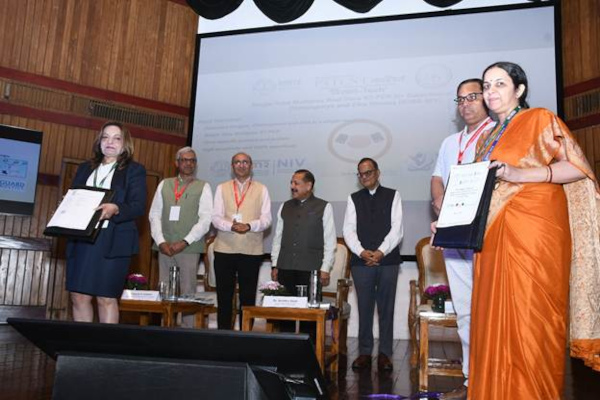
India’s medical innovation ecosystem received a fresh push on May 11, 2026, as the Indian Council of Medical Research transferred three indigenous medical technologies to industry partners during the National Technology Day programme ‘विज्ञान–Tech’ held at BRIC–National Institute of Immunology, New Delhi. The event was organised to showcase India’s scientific strength and technological progress, bringing together 14 scientific Ministries and Departments under a Whole-of-Government approach.
The programme was coordinated by the Office of the Principal Scientific Adviser in collaboration with the Department of Biotechnology. Union Minister of State for Science and Technology Dr. Jitendra Singh inaugurated the national technology exhibition and interacted with innovators and exhibitors. Principal Scientific Adviser Prof. Ajay Kumar Sood and Dr. Rajiv Behl, Secretary, Department of Health Research and Director General of ICMR, were also present.
A major highlight of the event was the transfer of three ICMR-developed technologies to industry through licensing agreements under ICMR’s Medical Innovations Patent Mitra initiative. The first technology, a cost-effective PSP94 ELISA designed to help guide prostate biopsy decisions in patients with PSA levels below 20 ng/ml, was developed at ICMR–National Institute for Research in Women’s Health by Dr. Dhanashree Jagtap, Dr. Smita Mahale and Dr. Bhakti Pathak. It was licensed to Krishgen Labs Pvt. Ltd.
The second technology was a Factor VIII Inhibitor and coagulation disorder point-of-care diagnostic developed by Dr. Rucha Patil at ICMR–National Institute for Research on Blood and Immune Disorders. This technology was licensed to Meril Life Sciences. The third technology, a single-tube multiplex real-time RT-PCR test for detecting dengue, chikungunya and Zika viruses, was developed by Dr. Alagarasu K at ICMR–National Institute of Virology and licensed to Vanguard Life Sciences.
ICMR also showcased six high-impact indigenous technologies across the biopharma, health, bioindustrial and green chemicals sectors. These included Covaxin, the COVID Kavach ELISA Kit, a CRISPR-Cas-based TB detection system, the Nipah point-of-care assay, a diagnostic ELISA kit for dengue detection and a biolarvicide for mosquito control. In addition, 25 promising technologies and innovations developed by various ICMR institutes were featured in the official compendium released during the programme.
The technology transfers are significant because they represent the movement of publicly funded medical research from laboratory development toward industry-scale application. By licensing these technologies to private partners, ICMR is seeking to strengthen India’s medical innovation value chain, promote indigenous manufacturing and support the larger Make in Bharat vision in healthcare.
The ‘विज्ञान–Tech’ programme also served as a platform for closer collaboration between government, academia and industry. For India’s healthcare sector, the event underlined the importance of converting domestic research into usable diagnostics, medical devices and public health tools. As the country works toward a more self-reliant healthcare ecosystem, such technology transfers could play an important role in making Indian medical innovation more accessible, scalable and industry-ready.
Reference: PIB
You may also like
-
Ayurveda on Cold Foods and Iced Drinks: Why Food Temperature Matters for Digestion
-
Serum Institute of India-Manufactured Ebola Vaccine Enters Clinical Trial in Uganda
-
Ayurveda and Hydration: How Much Water Should We Really Drink?
-
Warm Water in Ayurveda: When and Why It Is Recommended
-
Women Make Up 43% of India’s Ayush Workforce as Sector Supports 17.6 Lakh Livelihoods
