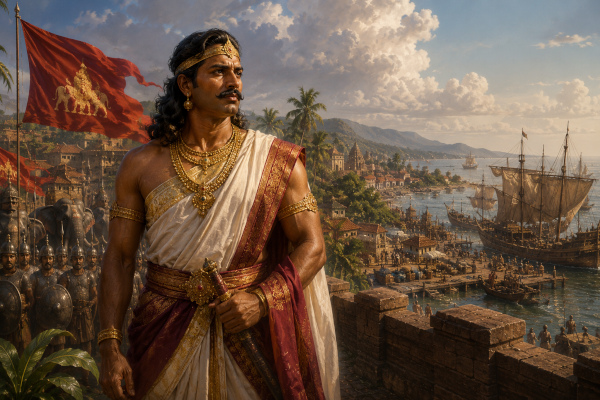
Nedum Cheralathan, often identified in Sangam literature as “Imayavaramban Nedum Cheralathan,” stands among the most celebrated rulers of the early Chera dynasty of South India. Remembered through ancient Tamil Sangam poems for his military power, royal generosity, maritime influence, and ambitious campaigns, he occupies a legendary position in early South Indian history. His reign belongs to the Sangam Age — the early historic period of Tamilakam that roughly spanned from around the last centuries BCE to the early centuries CE. During this era, the Cheras, Cholas, and Pandyas competed for influence across southern India while simultaneously participating in one of the ancient world’s most vibrant maritime trade networks.
Nedum Cheralathan is particularly remembered for expanding Chera prestige beyond Kerala’s western coast and projecting military influence deep into Tamilakam. Sangam poets describe him as a ruler whose authority extended up to the Himalayas, giving rise to the title “Imayavaramban,” meaning “the one whose boundary reached the Himalayas.” While such descriptions likely contain poetic exaggeration typical of royal eulogies, they indicate the immense prestige and martial reputation associated with the king in classical Tamil memory.
Lineage and the Early Chera Dynasty
Nedum Cheralathan belonged to the ancient Chera dynasty, one of the three great crowned Tamil dynasties of Sangam literature alongside the Cholas and Pandyas. The Cheras primarily ruled regions corresponding to present-day Kerala and parts of western Tamil Nadu. Their territories included rich spice-producing zones, forest resources, elephant trade routes, and important ports connected to Roman, Arab, Egyptian, and Mediterranean trade networks.
According to Sangam texts, Nedum Cheralathan was the son of Uthiyan Cheralathan, another important early Chera ruler remembered in Tamil tradition. Uthiyan Cheralathan himself is associated with military expansion and royal patronage, and Sangam literature portrays him as a king who strengthened the foundations of Chera authority in western Tamilakam.
The Chera lineage during this period was not merely a regional ruling house but part of a wider Indian Ocean commercial civilisation. The Cheras controlled access to highly valuable commodities including black pepper, cardamom, ivory, pearls, sandalwood, teak, and forest products that attracted merchants from Rome and West Asia.
The Meaning of “Imayavaramban”
The title “Imayavaramban” attached to Nedum Cheralathan is one of the most fascinating aspects of his legacy. “Imaya” refers to the Himalayas, while “varamban” implies boundary or frontier. Sangam poets therefore portrayed him as a ruler whose fame or authority symbolically extended from the southern tip of India to the Himalayas.
Some historians interpret this as a poetic metaphor for prestige and military ambition rather than literal territorial control. Others believe it may reflect northern expeditions, alliances, or participation in wider pan-Indian political traditions that connected southern rulers with northern sacred geography.
The title also reveals how Sangam kings increasingly projected themselves not merely as local chieftains but as universal monarchs with civilisational legitimacy.
Military Campaigns and Expansion
Nedum Cheralathan’s fame in Sangam literature rests heavily on his military achievements. Ancient Tamil poems portray him as a fierce warrior king who conducted numerous campaigns against rival Tamil rulers and external enemies.
The Cheras during this period competed intensely with the Cholas and Pandyas for trade routes, agricultural wealth, and political prestige. Warfare between the Tamil dynasties appears frequently in Sangam literature, and Nedum Cheralathan is depicted as a dominant military figure in these conflicts.
One of the most famous traditions associated with him concerns a naval campaign against sea raiders or foreign maritime groups. Sangam poems suggest that he defeated hostile forces operating in the Arabian Sea and secured maritime trade routes important to Chera commerce. This has led some historians to view the Cheras as one of the earliest South Indian powers with organised naval capability linked to trade protection.
His military campaigns likely helped strengthen Chera influence over western coastal ports and interior hill trade routes connecting Kerala with Tamil Nadu and Karnataka.
Relations with the Yavanas
An especially intriguing aspect of Sangam references to Nedum Cheralathan involves the “Yavanas,” a term generally used in ancient Indian texts for Greeks, Romans, or western foreigners associated with Mediterranean trade.
Some Sangam poems suggest that Nedum Cheralathan captured or subdued Yavana traders or groups connected to maritime commerce. Historians debate the exact meaning of these references. They may indicate conflict with foreign merchants, piracy suppression, political symbolism, or attempts by Chera rulers to control lucrative overseas trade.
The Chera kingdom during this era was deeply connected to Indo-Roman trade. Roman coins, amphorae, ceramics, and Mediterranean artefacts discovered in Kerala and Tamil Nadu indicate intensive commercial exchange. Ports associated with the Cheras, especially Muziris, became globally significant trading centres.
Nedum Cheralathan’s reign likely coincided with the height of this maritime prosperity.
Royal Generosity and Patronage
Like many Sangam rulers, Nedum Cheralathan was celebrated not only as a warrior but also as a generous patron. Sangam poets repeatedly praised kings for rewarding bards, scholars, warriors, and guests with gold, food, elephants, ornaments, and land.
Tamil literary culture during the Sangam age depended heavily on royal patronage. Poets travelled between courts composing verses that immortalised rulers and battles. Nedum Cheralathan appears in several such poetic traditions as an ideal king embodying valour, generosity, and honour.
The Chera court likely supported religious institutions, local assemblies, Brahmanical traditions, and temple-related activities, though large stone temples characteristic of later Kerala architecture had not yet fully emerged during this early historic period.
Architecture and Urban Culture
Direct architectural remains specifically attributable to Nedum Cheralathan are scarce due to the antiquity of the Sangam age and Kerala’s tropical climate, which caused heavy deterioration of early wooden structures. However, literary and archaeological evidence allows historians to reconstruct aspects of the urban and architectural culture associated with early Chera rule.
The Cheras likely ruled from fortified urban centres connected to ports, river valleys, and hill trade routes. Sangam literature describes palaces, assembly halls, warehouses, military camps, market towns, and bustling ports filled with foreign ships.
Architecture during this period heavily used wood, brick, laterite, and thatch rather than massive stone construction. Kerala’s abundant forests encouraged sophisticated timber architecture traditions that would later evolve into the classical Kerala temple style.
The port city of Muziris — often associated with Chera authority — was one of the most important trading centres in the ancient Indian Ocean world. Greek, Roman, Arab, and Indian merchants exchanged spices, gemstones, ivory, textiles, and luxury goods through these coastal hubs.
Although Nedum Cheralathan is not directly linked to surviving monuments, his reign almost certainly contributed to the economic prosperity that enabled the growth of early urbanisation and trade infrastructure in the Chera realm.
Sangam Literature and Historical Sources
Most knowledge about Nedum Cheralathan comes from Sangam texts such as:
- Purananuru
- Akananuru
- Pathitrupathu
Among these, the Pathitrupathu (“Ten Tens”) is particularly important for Chera history because it contains dedicated poetic decades praising Chera rulers.
These works blend historical memory with poetic imagination. While exact chronology remains debated, historians use literary cross-references, Roman trade evidence, archaeology, and comparative analysis to reconstruct the political world of the early Cheras.
The Sangam poems portray Nedum Cheralathan as a king who combined martial strength with cultural prestige and maritime prosperity.
The Battle with the Cholas
One of the most dramatic episodes associated with Nedum Cheralathan concerns his conflict with the Chola ruler known as Verpahradakkai Perunarkilli. Sangam traditions suggest that both kings fought a fierce battle in which they suffered fatal injuries.
Tamil heroic culture highly valued battlefield honour, and kings were expected to personally participate in warfare. The story of Nedum Cheralathan’s death reflects this martial ethos.
Some accounts indicate that even while mortally wounded, the king displayed extraordinary dignity and generosity. Sangam poetry often transforms such deaths into heroic moral narratives emphasising honour over mere survival.
Death and Legacy
The exact date of Nedum Cheralathan’s death remains uncertain, but historians generally place him within the early centuries CE during the flourishing period of the Sangam age.
His death in battle became part of his enduring heroic image. Sangam literature remembers him not as a defeated ruler but as a king who embodied the ideals of courage, kingship, generosity, and martial honour.
Nedum Cheralathan’s larger legacy lies in how he symbolised the rise of the early Chera state as a major power in South India. Under rulers like him, the Cheras became central participants in Indian Ocean trade, Tamil literary culture, and early state formation in Kerala and western Tamilakam.
His memory survived for centuries because Sangam poets transformed historical rulers into civilisational icons. Through their verses, Nedum Cheralathan emerged not merely as a regional monarch but as a legendary emperor whose fame stretched from the spice-rich forests of the Western Ghats to the distant Himalayas themselves.
Even today, he remains one of the most important figures in the historical imagination of early Kerala and Tamilakam — a ruler standing at the intersection of war, poetry, commerce, and the ancient maritime world of the Indian Ocean.
You may also like
-
Sindhu: The Indus Kingdom of Jayadratha in the Mahabharata
-
Kuninda or Kulinda: The Himalayan Realm of the Mahabharata in Uttarakhand and Himachal Pradesh
-
Durga versus Mahishasura: Weapons, Battlefield Tactics and the Triumph of Shakti
-
Kuluta: The Kullu Valley Kingdom of the Mahabharata
-
Israel to Honour Indian Pilot Smit Machchhar with Highest Civilian Bravery Award for Saving Flydubai Flight
