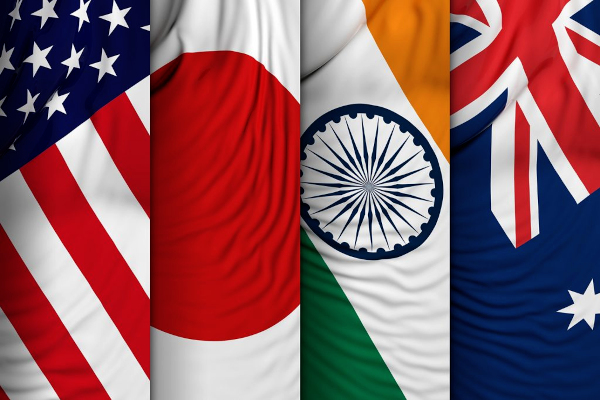
The leaders of India, the United States, Japan and Australia announced a series of initiatives to strengthen maritime security, artificial intelligence cooperation, cybersecurity, critical infrastructure connectivity and economic partnerships during the seventh Quad Leaders’ Summit held in Manila, Philippines, on 17 November 2026.
Prime Minister Narendra Modi, US President Donald Trump, Japanese Prime Minister Sanae Takaichi and Australian Prime Minister Anthony Albanese participated in the summit, reaffirming their commitment to a free, open, stable and prosperous Indo-Pacific.
The four leaders emphasised the importance of protecting freedom of navigation and overflight, strengthening critical supply chains and maintaining secure maritime transit corridors. They also expressed opposition to unilateral attempts to change the regional status quo through force or coercion and raised concerns about economic coercion, including arbitrary export restrictions.
The announcements mark an expansion of practical cooperation among the Quad countries, particularly in maritime surveillance, emerging technologies, digital infrastructure and regional economic security.
Quad Announces New Indo-Pacific Maritime Surveillance Collaboration
One of the principal outcomes of the summit was the announcement of the Indo-Pacific Maritime Surveillance Collaboration, a new initiative intended to strengthen maritime information-sharing and improve maritime domain awareness among the four countries.
Under the initiative, maritime patrol aircraft from the Quad countries are scheduled to participate in a joint maritime exercise in 2027. The exercise will involve P-8 and P-3C maritime patrol aircraft and will represent the first such aviation exercise conducted within a Quad framework.
The initiative is designed to strengthen coordination in monitoring maritime activities, improving information exchange and enhancing awareness of developments across the Indo-Pacific’s extensive maritime regions.
Maritime domain awareness is particularly important for identifying unusual vessel movements, monitoring commercial shipping routes and responding to activities that could threaten maritime security.
For India, the collaboration is relevant to its responsibilities in the Indian Ocean Region, where major international shipping routes connect energy-producing countries in West Asia with the economies of South Asia, Southeast Asia and East Asia.
Improved maritime information-sharing among the Quad partners can complement India’s existing maritime surveillance capabilities and regional security partnerships.
Artificial Intelligence Cooperation Through New Technology Accelerator
The Quad leaders reaffirmed their support for the Super Intelligence Accelerator, previously announced by the grouping’s foreign ministers in Atlanta.
The initiative is intended to coordinate financial support, technical assistance and technology deployment to improve access to trusted artificial intelligence systems across the Indo-Pacific.
The summit’s joint statement clarified that the term Super Intelligence, as used in the initiative, refers to artificial intelligence in Australia, India and Japan.
The programme is designed to encourage cooperation in the development and deployment of advanced AI technologies while supporting regional access to reliable technological capabilities.
Artificial intelligence has increasingly important applications in maritime surveillance, disaster response, industrial operations, logistics, scientific research and digital infrastructure management.
For India, participation in such initiatives complements its growing artificial intelligence ecosystem and provides another framework for cooperation with technologically advanced partner countries.
Quad Expands Cybersecurity Cooperation
The leaders also announced Enhanced Quad Cybersecurity Cooperation in response to the increasing frequency and scale of cyber incidents across the Indo-Pacific.
The initiative seeks to strengthen cooperation among the four countries in maintaining an open and secure cyberspace.
Cybersecurity has become an important component of national and economic security as governments, financial institutions, transportation systems, communication networks and critical infrastructure become increasingly dependent on interconnected digital systems.
Strengthening international cybersecurity cooperation can support the exchange of technical expertise, improve institutional coordination and contribute to the protection of essential digital services.
The initiative is particularly relevant to India, where the expansion of digital public infrastructure, electronic financial transactions and technology-driven services has increased the importance of reliable cybersecurity systems.
Undersea Cables and Critical Infrastructure Connectivity
The summit also reviewed progress under the Quad Partnership for Cable Connectivity and Resilience, an initiative aimed at strengthening secure and reliable communications infrastructure across the Indo-Pacific.
The leaders welcomed an expansion of Australia’s contribution to the partnership, extending its focus to electricity cables and regional energy connectivity.
They also welcomed upcoming undersea cable projects in the Indian Ocean intended to improve communications connectivity and infrastructure resilience.
Submarine communication cables carry a substantial proportion of international digital traffic and are essential for global telecommunications, financial transactions and internet connectivity.
Their protection and resilience have become increasingly important as countries seek to reduce vulnerabilities in critical communications infrastructure.
For India, the development of resilient undersea communications networks is relevant to its expanding digital economy, international connectivity requirements and strategic position in the Indian Ocean.
India to Host Quad Business Leaders’ Forum in 2027
The Quad leaders announced the establishment of an inaugural Quad Business Leaders’ Forum, scheduled to take place in early 2027.
The forum will bring together business representatives, government officials and policy experts from the four countries to strengthen private-sector cooperation and encourage commercial partnerships.
India is expected to host the inaugural forum in Mumbai.
The initiative is intended to support stronger economic engagement among the Quad countries, particularly in sectors connected with technology, infrastructure and critical supply chains.
The proposed forum provides a platform for Indian companies to engage with businesses from the United States, Japan and Australia in areas of shared economic and technological interest.
Critical Supply Chains and Economic Security
The leaders also emphasised the importance of strengthening critical supply chains and reducing vulnerabilities arising from excessive dependence on concentrated sources of essential materials and technologies.
Discussions included critical minerals, energy security and technologies that support industrial and economic resilience.
Critical minerals are essential for several advanced manufacturing industries, including electronics, renewable energy equipment, electric vehicles and defence technologies.
The Quad countries have increasingly recognised the importance of cooperation in these areas as global manufacturing becomes more dependent on specialised materials and advanced technological components.
For India, these discussions complement ongoing efforts to strengthen domestic manufacturing, develop critical mineral supply chains and expand participation in international technology partnerships.
Counterterrorism and Regional Security Cooperation
The Quad leaders unequivocally condemned terrorism and violent extremism in all forms, including cross-border terrorism, and committed themselves to strengthening existing counterterrorism cooperation.
The declaration is relevant to India’s longstanding emphasis on international cooperation against terrorism and the importance of coordinated responses to transnational security threats.
The leaders also reaffirmed their support for ASEAN centrality and unity, recognising Southeast Asian countries as important partners in maintaining regional peace, stability and prosperity.
The summit highlighted the Quad’s intention to work with regional partners through practical initiatives covering maritime security, economic development, emerging technologies and humanitarian assistance.
Strategic Significance for India
The Manila summit reflects the expanding scope of the Quad beyond traditional diplomatic consultations into practical cooperation involving maritime surveillance, technological development, cybersecurity and critical infrastructure.
For India, maritime security remains particularly significant because of its geographical position in the Indian Ocean and the importance of international shipping routes passing through the region.
The planned maritime patrol aircraft exercise provides an additional opportunity for operational coordination and information-sharing among the four participating countries.
Similarly, cooperation in artificial intelligence and cybersecurity aligns with India’s growing emphasis on technological capability, digital infrastructure and secure communications.
The development of resilient undersea cable networks and stronger critical supply chains also supports India’s wider economic and connectivity interests.
The proposed Quad Business Leaders’ Forum in Mumbai adds an economic dimension to the partnership by encouraging direct engagement between industries and technology companies.
The seventh Quad Leaders’ Summit therefore represents another stage in the evolution of the grouping as a platform for cooperation across security, technology and economic development.
For India, the initiatives provide opportunities to strengthen maritime partnerships, expand technological cooperation and contribute to the development of a secure, connected and economically resilient Indo-Pacific.
You may also like
-
From Enemy Prince to Allied King: Vibhīṣaṇa and the Politics of Strategic Realignment
-
India Joins US and Eight Nations in Declaration to Secure AI Supply Chains
-
India and Belarus Strengthen Economic Cooperation at 12th Inter-Governmental Commission Meeting
-
India and Thailand Review Trade Cooperation as Bilateral Trade Reaches $21.49 Billion
-
Vibhīṣaṇa’s Counsel to Rāvaṇa: The Importance of Dissent in Foreign Policy
