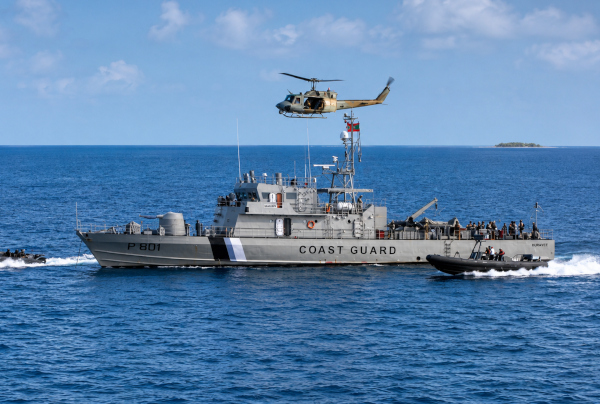
India’s maritime security network contains an important and comparatively little-known technological link with New Zealand. HamiltonJet waterjet propulsion systems, designed and manufactured by the Christchurch-based company C.W.F. Hamilton & Co., power a significant group of Indian naval fast attack craft and coastal-security boats.
The partnership represents a successful combination of Indian ship design and construction with specialised New Zealand propulsion technology. Indian shipyards built the vessels, integrated their weapons and sensors, and adapted them for domestic operational requirements, while HamiltonJet supplied the waterjet systems that provide speed, acceleration, shallow-water mobility and exceptional manoeuvrability.
This combination has strengthened India’s capability to intercept hostile craft, conduct coastal patrols, protect offshore assets and respond rapidly to incidents across littoral waters.
New Zealand’s Pioneering Waterjet Technology
HamiltonJet traces its origins to 1939 and the engineering work of New Zealand inventor Sir William Hamilton. During the 1950s, Hamilton and his team developed practical marine waterjet systems that allowed boats to operate at speed through the shallow and fast-flowing rivers of New Zealand.
The company subsequently evolved into a specialist manufacturer of waterjets, control systems and integrated propulsion solutions. Its present range supports power inputs from approximately 150 kilowatts to 5,500 kilowatts and can be installed on vessels measuring up to around 80 metres. The company serves military patrol boats, search-and-rescue craft, pilot vessels, ferries, offshore boats and specialised maritime platforms.
HamiltonJet’s military portfolio covers littoral vessels, coastal interceptors and riverine patrol craft. Its propulsion and control systems can also interface with remote-control and autonomous technologies, opening possibilities for future unmanned and optionally crewed maritime platforms.
How Waterjet Propulsion Works
A conventional marine propulsion system transfers engine power to an external shaft and propeller beneath the hull. A waterjet system uses an engine-driven impeller housed largely inside the vessel.
Water enters through an intake fitted flush with the bottom of the hull. The impeller accelerates the water and expels it through a nozzle at the stern. The reaction created by this high-velocity flow drives the vessel forward.
Steering is achieved by directing the jet stream. A reverse bucket redirects the flow to produce astern thrust, rapid deceleration and precise low-speed control. Multiple waterjets can work together to turn the vessel within a very small area, move it sideways and maintain position during boarding, interception or rescue operations.
HamiltonJet states that its split-duct reverse-bucket arrangement provides precise steering across the speed range, power braking and 360-degree thrusting capability in suitable multi-jet installations.
Why Waterjets Suit Fast Attack Craft
Fast attack craft operate in a demanding zone between major warships and small patrol boats. They require sufficient speed to intercept suspicious vessels, enough endurance to patrol an exclusive economic zone and enough agility to operate near ports, islands, offshore installations and congested shipping routes.
Waterjet propulsion supports these missions through several operational advantages.
High speed and acceleration
HamiltonJet systems are especially suited to high-speed planing vessels operating in the 20-to-50-plus-knot range. Strong low-speed thrust and rapid acceleration allow an interceptor to close the distance with a fast-moving surface target.
Exceptional manoeuvrability
The directional nozzle controls the thrust stream directly, allowing rapid turns and precise course changes. Such agility becomes valuable when shadowing an unidentified craft, approaching a vessel for boarding or manoeuvring through a crowded harbour.
Power braking
The reverse bucket can redirect thrust while the engine continues producing power. This enables rapid deceleration and gives the crew greater control during interception.
Shallow-water operation
The flush-mounted intake and absence of an exposed propeller or shaft permit operation in relatively shallow waters. This feature supports patrols near beaches, river mouths, islands and coastal approaches.
Reduced vulnerability to underwater impact
Most major propulsion components remain within the vessel. The arrangement reduces exposure to floating debris, submerged obstacles and accidental grounding during littoral operations.
Safety during boarding and rescue
The absence of an exposed rotating propeller improves safety around personnel in the water. This becomes important during search-and-rescue missions, swimmer recovery and close-quarter boarding operations.
HamiltonJet in the Indian Navy
The most important Indian military application is the Water Jet Fast Attack Craft fleet built by Garden Reach Shipbuilders and Engineers in Kolkata.
HamiltonJet’s Indian representative states that 14 Indian Navy attack craft commissioned between 2007 and 2017 were equipped with Hamilton waterjet propulsion systems. The publicly available construction record points to the original Car Nicobar-class vessels and four improved follow-on Water Jet Fast Attack Craft.
The four follow-on vessels were:
- INS Tarmugli
- INS Tihayu
- INS Tillanchang
- INS Tarasa
They represented an upgraded version of the earlier Car Nicobar-class design. INS Tarasa, the fourth and final follow-on vessel, entered service in September 2017. The Ministry of Defence described the craft as possessing good endurance, low draught, high speed and manoeuvrability, making it suitable for extended coastal surveillance and offshore patrol.
Indian-Built Warships with New Zealand Propulsion
The Water Jet Fast Attack Craft programme remains fundamentally an Indian shipbuilding achievement.
GRSE designed and constructed the vessels in India. Indian organisations supplied major elements of their weapons, sensors, communications and onboard systems. HamiltonJet provided a specialised propulsion component integrated into this wider indigenous platform.
GRSE lists the principal characteristics of its Water Jet Fast Attack Craft as:
| Characteristic | Specification |
|---|---|
| Length | 48.9 metres |
| Breadth | 7.5 metres |
| Displacement | Approximately 321 tonnes |
| Maximum speed | 35 knots |
| Endurance | Approximately 2,000 nautical miles at 12–14 knots |
| Main propulsion power | Three engines of 2,720 kilowatts each |
| Propulsion | Hamilton waterjets |
| Complement | Six officers and 23 sailors |
GRSE describes these vessels as suited for intercepting fast-moving surface craft, anti-smuggling patrols, fisheries protection and search-and-rescue missions.
INS Tarasa and its sister ships use three waterjets and can exceed 35 knots, equivalent to about 65 kilometres per hour. They carry an indigenous 30 mm main gun together with light, medium and heavy machine guns for coastal-defence duties.
Operational Role of the Water Jet Fast Attack Craft
These vessels provide the Indian Navy with responsive combat power in coastal and offshore waters.
Interception of hostile surface craft
Fast boats can be used for infiltration, sabotage, smuggling or attacks against ports and offshore infrastructure. A Water Jet Fast Attack Craft can rapidly reach such a contact, identify it and conduct interception or engagement.
Coastal surveillance
India has a coastline extending thousands of kilometres, major commercial ports, naval bases, island territories and densely trafficked sea lanes. Fast attack craft provide persistent local presence while larger warships remain available for broader oceanic missions.
Exclusive Economic Zone patrol
The vessels can monitor fishing activity, investigate suspicious movement and support law-enforcement operations within India’s maritime zones.
Protection of offshore assets
Oil platforms, offshore terminals and energy infrastructure require patrol coverage against asymmetric threats. Fast, armed and highly manoeuvrable craft are well suited to this protective role.
Search and rescue
Speed, shallow draught and close-control manoeuvrability allow these vessels to respond to maritime emergencies. The design can support survivor recovery, medical evacuation and assistance to vessels in distress.
Humanitarian assistance
Waterjet craft can reach coastal areas and island communities during natural disasters, especially where damaged jetties or shallow approaches limit access by larger ships.
Coastal Security After the Mumbai Attacks
The role of HamiltonJet technology extends into India’s coastal-policing architecture.
Following the November 2008 Mumbai terrorist attacks, the Ministry of Home Affairs initiated the acquisition of coastal-security police boats for deployment by maritime police units. According to HamiltonJet’s Indian representative, 120 of these boats were equipped with twin Hamilton waterjets.
These craft belong to the coastal-security and law-enforcement network rather than the combat fleet of the armed forces. Their mission supports the wider maritime-security grid by patrolling near-shore areas, monitoring landing points and strengthening the ability of state agencies to respond to suspicious movement.
The integration of the same broad propulsion technology across naval and police craft also creates opportunities for common training, maintenance practices and technical support.
Indian Army Patrol-Boat Requirement
HamiltonJet’s involvement in India also reaches inland and high-altitude waters.
The company’s Indian representative reports a contract to supply 24 waterjets for 12 Indian Army fast-patrol boats. These boats are intended for surveillance and patrol duties on large water bodies, including high-altitude areas. The publicly available source confirms the contract while providing limited information regarding delivery status, boat design and deployment.
Waterjet propulsion offers practical advantages for such environments. Shallow draught supports operations near irregular shorelines, while strong manoeuvrability helps crews conduct patrols in confined waters. The protected internal impeller arrangement also reduces exposure to underwater obstacles.
High-altitude operation presents additional engineering challenges because reduced air density can affect engine performance. The complete boat, engine and jet combination therefore requires careful matching for the intended elevation, payload and environmental conditions.
A Small Component with Major Tactical Value
Propulsion systems rarely receive the public attention given to missiles, guns and radars. Their operational importance remains fundamental.
A warship reaches its weapons range, intercepts its target, evades hazards and maintains tactical position through its propulsion and control systems. On a fast attack craft, propulsion directly influences acceleration, turning radius, stopping distance, shallow-water access and survivability.
HamiltonJet waterjets therefore act as a force multiplier for India’s littoral vessels. Their value comes through the ability to convert engine power into responsive movement during the most demanding phases of a patrol or interception.
Scope for Indian Production and Technology Partnership
India’s future requirement for coastal interceptors, unmanned surface vessels, riverine craft and high-speed patrol boats creates considerable scope for deeper industrial cooperation.
A future India–New Zealand programme could include:
- Licensed manufacture of selected waterjet components in India
- Local assembly and testing of propulsion modules
- Indian production of control-system hardware
- Joint development of waterjets optimised for tropical and high-altitude conditions
- Integration with Indian engines, navigation systems and remote weapon stations
- Propulsion packages for unmanned surface vessels
- Predictive maintenance and digital fleet-management systems
- Hybrid-electric propulsion for patrol and harbour-security craft
HamiltonJet already combines propulsion with electronic controls, dynamic-positioning interfaces and autonomous-control technology. Its JETlink system provides an interface for remote and autonomous vessel control, while JETanchor supports automated station-keeping and precision manoeuvring.
India possesses strong capabilities in shipbuilding, marine electronics, command systems, artificial intelligence and unmanned platforms. A cooperative programme could combine these strengths with New Zealand’s specialised propulsion engineering.
Strategic Relevance for India–New Zealand Defence Relations
India and New Zealand are maritime nations with an interest in a stable and secure Indo-Pacific. Their 2025 joint statement supported stronger defence engagement, exchanges, training and cooperation between the armed forces. The leaders also highlighted maritime security, freedom of navigation and the peaceful use of the seas.
HamiltonJet represents an existing industrial foundation on which a wider defence partnership could be constructed. The technology has already passed through Indian shipbuilding, integration and operational cycles. This practical experience can support future collaboration in coastal-security vessels, search-and-rescue platforms and autonomous maritime systems.
A Proven India–New Zealand Defence Link
HamiltonJet’s role in India demonstrates how a specialised foreign subsystem can strengthen an indigenously designed military platform.
India retained control of ship construction, weapons integration and operational configuration. New Zealand supplied a propulsion technology suited to the demanding speed and manoeuvrability requirements of littoral warfare.
The result is visible in the Indian Navy’s Water Jet Fast Attack Craft fleet, the coastal-security police network and the Army’s fast-patrol-boat requirement.
As India expands its maritime-security architecture, the next stage can move from equipment supply towards co-development, local production and integration with Indian autonomous systems. HamiltonJet waterjet technology already provides the foundation for such a partnership—one built around speed, agility and decisive control in the waters closest to India’s shores.
References
- HamiltonJet. “About Us: The HamiltonJet Waterjet Story.”
https://www.hamiltonjet.com/about-us - HamiltonJet. “Why Waterjets: Performance, Control and Lifecycle Advantages.”
https://www.hamiltonjet.com/why-waterjets - HamiltonJet. “Patrol and Military Waterjet Propulsion Systems.”
https://www.hamiltonjet.com/patrol-boats - HamiltonJet. “Waterjet Propulsion Systems.”
https://www.hamiltonjet.com/waterjets - HamiltonJet. “JETlink: Autonomous and Remote-Control Interface.”
https://www.hamiltonjet.com/autonomy/jetlink - HamiltonJet. “JETanchor: Vessel Positioning and Station-Keeping System.”
https://www.hamiltonjet.com/autonomy/jetanchor - Garden Reach Shipbuilders and Engineers Limited. “Water Jet Fast Attack Craft.”
https://grse.in/fast-attack-craft/index.php - Garden Reach Shipbuilders and Engineers Limited. “Water Jet Fast Attack Craft — Product Brochure.”
https://grse.in/ship-building/files/WJFAC.pdf - Department of Defence Production, Ministry of Defence, Government of India. “Water Jet Fast Attack Craft.”
https://www.ddpmod.gov.in/hi/node/7488 - Press Information Bureau, Ministry of Defence, Government of India. “Indian Navy Commissions Water Jet Fast Attack Craft INS Tarasa.” 26 September 2017.
https://www.pib.gov.in/PressReleasePage.aspx?PRID=1504043 - Press Information Bureau, Ministry of Defence, Government of India. “Major Achievements of the Ministry of Defence from May 2014 to May 2018.”
https://archive.pib.gov.in/4YearsOfNDA/Comprehensive-Materials/defence.pdf - Varya Tech Private Limited. “HamiltonJet Waterjet Propulsion Systems in India.”
https://varyatech.com/maritime-sector/hamiltonjet/ - HamiltonJet. “AVX Controls and Dynamic-Positioning Integration.”
https://www.hamiltonjet.com/controls/avx - HamiltonJet. “JETlink Autonomous and Remote-Control Interface — Product Brochure.”
https://www.hamiltonjet.com/assets/main/jetlink-digital.pdf - Ministry of External Affairs, Government of India. “India–New Zealand Joint Statement.” 17 March 2025.
https://www.mea.gov.in/bilateral-documents.htm?dtl/39197/India__New_Zealand_Joint_Statement_March_17_2025 - Ministry of External Affairs, Government of India. “List of Outcomes: Official Visit of the Prime Minister of New Zealand to India.” 17 March 2025.
https://www.mea.gov.in/bilateral-documents.htm?dtl/39196/List_of_Outcomes_Official_Visit_of_Prime_Minister_of_New_Zealand_Rt_Hon_Christopher_Luxon_to_India_March_1620_2025
All online sources were reference on 10 July 2026.
You may also like
-
PRAHAAR: India’s First National Counter-Terrorism Policy and Strategy
-
Takshak Heavyweight Torpedo: How India’s Indigenous Submarine Weapon Compares With the World’s Leading Torpedoes
-
Embraer Builds Dual Aerospace Strategy in India Through C-390 Military and E175 Regional Aircraft Programmes
-
NextLeap Tests Indigenous Jet Engine for Long-Range Stryker Kamikaze UAV
-
Côte d’Ivoire Military Delegation Visits HAL, Shows Interest in India’s Indigenous Aerospace Platforms
