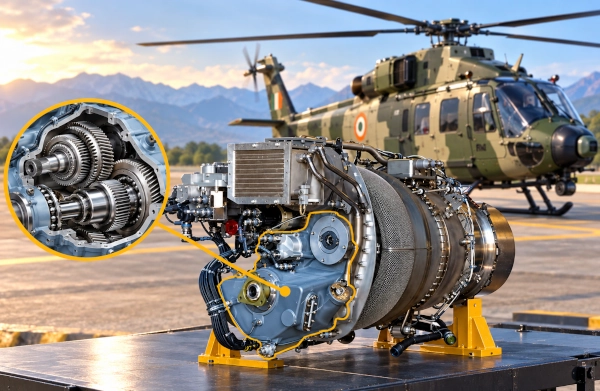
Hindustan Aeronautics Limited is moving to deepen the Indian manufacturing content of the Shakti helicopter engine by seeking domestic industry partners capable of manufacturing detail parts, assembling them and supplying complete Reduction Gear Modules for the turboshaft engine used across some of India’s most important military helicopter programmes.
The scope makes the programme considerably more significant than a conventional procurement of individual spare parts. HAL is looking for industry capability extending from manufacture of individual components through module assembly to delivery of a completed reduction gear unit, potentially allowing qualified Indian companies to assume responsibility for a larger section of the Shakti engine manufacturing chain.
The Shakti, also known as the Ardiden 1H1, was co-developed by HAL and Safran Helicopter Engines and has become one of the central powerplants supporting India’s indigenous military helicopter fleet. HAL officially lists the engine on the Dhruv Mk III and Mk IV, while the weaponised Rudra is powered by two Shakti engines. The Light Combat Helicopter, now known as LCH Prachand, also uses twin Shakti engines producing about 1,032 kW each.
Safran likewise describes the Shakti as the Indian production version of the Ardiden 1H1 and confirms that it was co-developed with HAL. The engine was specifically developed for demanding operating conditions and forms part of the long-running Indo-French helicopter propulsion partnership.
The reduction gear module performs a crucial function within a helicopter turboshaft powerplant. Turbine machinery operates at very high rotational speeds, whereas the helicopter transmission requires usable mechanical power at substantially different rotational characteristics. The reduction system converts the engine’s high-speed output into the speed and torque characteristics required by the drivetrain while maintaining reliability under continuously changing loads.
Manufacturing such equipment places demanding requirements on precision engineering. Gear geometry, shafts, bearings, housings, surface treatment, heat treatment, lubrication arrangements and dimensional tolerances must all meet stringent aerospace standards because the module operates under high rotational speeds, mechanical loads and temperatures.
HAL’s decision to seek Indian manufacturing participation therefore creates an opportunity for domestic aerospace companies to move beyond simple build-to-print components and into higher-value rotating assemblies associated with helicopter propulsion.
This approach fits with HAL’s wider outsourcing strategy, under which Indian suppliers can progressively move from manufacturing individual detail parts toward complex assemblies and complete modules. HAL has previously described its supplier development model as a tiered structure intended to encourage companies to acquire greater manufacturing, tooling and engineering responsibility.
The Shakti programme offers a particularly attractive base for such localisation because the engine is already tied to a substantial and expanding fleet of HAL-built helicopters. Dhruv serves across the Indian Armed Forces and other government agencies, while Rudra provides an armed reconnaissance and fire-support capability. Prachand has been developed specifically for combat operations, including demanding high-altitude environments.
HAL is simultaneously expanding LCH Prachand production following large orders for the helicopter, increasing the importance of a resilient domestic supply chain capable of supporting higher output over the coming years.
Greater localisation of engine modules can provide benefits beyond production capacity. Establishing qualified Indian suppliers for precision propulsion assemblies can reduce exposure to international supply-chain disruptions, shorten manufacturing lead times and create a domestic capability for lifecycle support, repair and future production increases.
The programme can also help Indian companies acquire expertise relevant to other aero-engines. Precision gear systems and rotating assemblies are used across helicopter engines, aircraft transmissions, auxiliary power systems and other advanced aerospace equipment, meaning manufacturing knowledge developed through the Shakti programme could have wider applications.
India has historically faced greater technological dependence in aero-engines than in many other areas of defence manufacturing. Aircraft structures, avionics, weapons and increasingly complex subsystems are now produced domestically, but propulsion remains one of the most technologically demanding parts of the aviation ecosystem.
Building a larger domestic industrial base around existing engines such as Shakti therefore provides one route toward developing the specialist capabilities required for more ambitious indigenous propulsion programmes in the future.
The initiative also comes as HAL and Safran expand their cooperation into a new generation of helicopter engines. The two companies are working together on a new turboshaft intended initially for India’s proposed Indian Multi-Role Helicopter and Deck-Based Multi-Role Helicopter programmes, creating another potential long-term requirement for Indian propulsion manufacturing expertise.
Experience gained by domestic suppliers through Shakti manufacturing could consequently strengthen the broader supplier ecosystem available for future helicopter engines.
HAL and Safran have already demonstrated considerable localisation through the Shakti programme. Safran has stated that more than 500 Shakti engines had been produced in India as the partnership matured, establishing a sizeable installed base and manufacturing foundation for the powerplant.
The latest EoI represents an opportunity to push that localisation deeper into the engine’s internal module-level supply chain.
Rather than limiting Indian companies to ancillary hardware or relatively simple components, the proposed arrangement calls for manufacturing, assembly and supply of the reduction gear module itself. Successful participation would therefore add another layer of specialised private-sector capability beneath HAL’s helicopter production programmes.
For India’s defence aerospace industry, this kind of localisation is important because genuine self-reliance depends not simply on assembling complete helicopters within the country but on building domestic competence in the precision components and critical modules from which those aircraft are made.
By bringing Indian manufacturers into major projects, HAL is creating another pathway for domestic industry to move into high-value helicopter propulsion manufacturing while strengthening the industrial base behind Dhruv, Rudra and LCH Prachand.
You may also like
-
EON Space Labs and Dhruva Space Advance Indian Space Hardware on Transporter-18 Mission
-
SatLeo Labs’ TAPAS-1 Reaches Orbit, Advancing India’s Private Thermal-Imaging Capability
-
TakeMe2Space’s MOI-1A Reaches Space on Falcon 9 Transporter-18 Mission
-
PRAHAAR: India’s First National Counter-Terrorism Policy and Strategy
-
SCI and India’s Push for a Larger Indigenous Maritime Fleet
