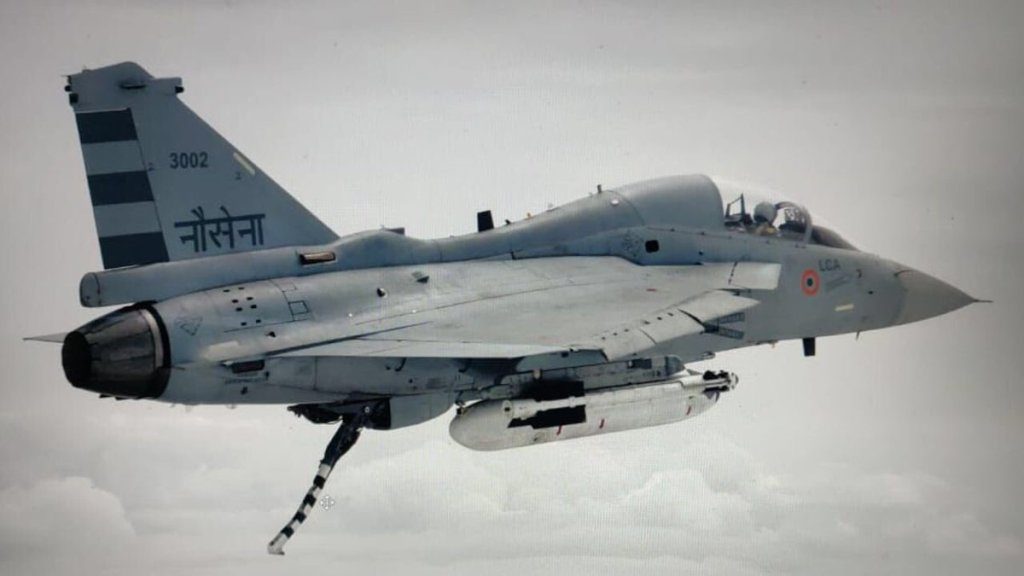
Hindustan Aeronautics Limited has reported progress on two of India’s most important indigenous fighter-aircraft programmes, with the company confirming that technical issues surrounding the proposed production of GE Aerospace’s F414 fighter engine in India have been resolved. At the same time, HAL is working to begin deliveries of the delayed Tejas Mk1A to the Indian Air Force, with around 10 aircraft targeted for delivery by March 2027.
HAL Chairman and Managing Director Ravi K said on 18 September 2026 that discussions with GE Aerospace over the proposed production of the F414-GE-INS6 engine in India have moved beyond the technical stage. HAL is now awaiting a commercial proposal from GE Aerospace, following which the two companies are expected to negotiate the commercial and contractual framework for the programme.
The development is significant because the F414 is intended to power the Tejas Mk2, while progress on the separate F404-IN20 engine supply is directly affecting the pace at which HAL can deliver the Tejas Mk1A. Although both engines are supplied by GE Aerospace, they belong to two different fighter programmes and serve different operational requirements.
Technical Issues Resolved on F414 Programme
The proposed F414 manufacturing arrangement is central to the Tejas Mk2 programme. The larger Mk2 requires substantially more thrust than the Tejas Mk1 and Mk1A, which are powered by the GE F404-IN20.
According to HAL, the major technical issues connected with the proposed F414 co-production arrangement have now been resolved. The programme has therefore moved closer to the commercial negotiation stage, during which the two sides will have to finalise pricing, contractual conditions, production responsibilities and the structure of the proposed technology transfer.
The development should not, however, be interpreted as confirmation that the final F414 production agreement has already been signed. The technical framework has advanced, but commercial negotiations and the necessary approvals must still be completed before large-scale production can begin.
F414 to Power the Tejas Mk2
GE Aerospace and HAL signed a Memorandum of Understanding in June 2023 covering the potential production of F414 fighter engines in India for the Tejas Mk2 programme.
The agreement represented a major expansion of the long-standing relationship between HAL and GE Aerospace. GE stated at the time that the proposed arrangement would involve production of the F414 in India and would support the development and future serial manufacture of the Tejas Mk2.
The F414-GE-INS6 is a higher-thrust afterburning turbofan derived from GE Aerospace’s F414 family. It provides significantly greater thrust than the F404-IN20 and is intended to support the Mk2’s increased size, fuel capacity, payload and expanded mission systems.
GE Aerospace had earlier confirmed that India selected 99 F414 engines for the Tejas Mk2 programme. Initial engines are being supplied for development activities, while subsequent production is expected to involve manufacturing in India under the proposed technology-transfer arrangement.
Major Technology-Transfer Programme
The F414 manufacturing proposal is particularly important because of the depth of technology transfer envisaged under the programme.
The proposed arrangement has been described as involving technology transfer of around 80 per cent, although the precise industrial workshare will ultimately depend on the final agreement between HAL and GE Aerospace.
The objective is expected to extend well beyond assembling imported engine kits. Indian industry is envisaged to participate in a broader range of manufacturing, assembly, inspection and production processes connected with the engine.
Producing a modern fighter turbofan involves complex metallurgy, precision manufacturing, high-temperature materials, specialised coatings, turbine components and extremely tight production tolerances. The F414 programme could therefore contribute to India’s broader effort to develop a stronger domestic ecosystem for advanced military aero-engines.
It would not make India fully independent in fighter-engine technology, but it could provide important manufacturing experience and industrial capability that could support future indigenous propulsion programmes.
Tejas Mk2 Development Moves Forward
Progress on the engine negotiations comes as HAL and the Aeronautical Development Agency continue work on the first Tejas Mk2 prototype.
GE Aerospace has already supplied F414 engines for the development phase of the programme. In its 2023 announcement, the company said that eight F414 engines had already been delivered as part of the existing development effort.
The availability of these engines means that prototype development and flight testing do not have to wait for the final Indian production agreement to be concluded.
The Tejas Mk2 is designed as a larger and more capable aircraft than the Mk1A. The new fighter is expected to carry more fuel and weapons while incorporating advanced avionics, sensors and electronic-warfare capabilities. The greater thrust available from the F414 is therefore central to the aircraft’s planned performance.
HAL has indicated that structural assembly of the prototype is progressing, with the front, centre and rear fuselage sections brought together as the programme advances towards ground testing and eventual first flight.
HAL Has 27 Tejas Mk1A Airframes Ready
While work on the Tejas Mk2 continues, HAL is simultaneously attempting to clear the delivery backlog affecting the Tejas Mk1A.
HAL CMD Ravi K said that the company has completed 27 Tejas Mk1A airframes. These aircraft form part of the large production programme ordered by the Indian Air Force, although formal deliveries have been delayed by a combination of engine-supply problems and remaining integration and certification work.
The aircraft are at an advanced stage of readiness, but several final tasks associated with radar, weapons and software integration must be completed before they can be accepted by the IAF.
HAL has described the outstanding work as being in its final stages, with the company estimating that around 90 to 95 per cent of the remaining integration effort has been completed.
Ten F404 Engines Now Available
Another major constraint affecting the Tejas Mk1A programme has been the delayed supply of GE F404-IN20 engines.
HAL now has 10 F404-IN20 engines available, following additional deliveries from GE Aerospace during 2026. This provides sufficient powerplants for an initial batch of Mk1A aircraft once the remaining certification and integration requirements are completed.
The improvement in engine availability marks an important change for the programme because HAL had continued manufacturing airframes even while engine deliveries remained behind schedule.
Once engines are available and integration work is completed, these finished airframes can progress towards ground testing, flight testing and eventual delivery rather than waiting for production to restart from the beginning.
F404 and F414 Serve Different Tejas Variants
The two GE engine programmes should be clearly distinguished.
The F404-IN20 powers the Tejas Mk1 and Tejas Mk1A. It is already established on the Tejas platform and remains essential to HAL’s ability to deliver the large Mk1A fleet ordered by the Indian Air Force.
The F414-GE-INS6, by comparison, is intended for the larger and heavier Tejas Mk2. It provides significantly greater thrust and is part of a separate development and future production programme.
The immediate challenge for HAL is therefore securing a predictable supply of F404 engines for Mk1A production while simultaneously completing negotiations for domestic F414 manufacturing to support the Mk2 programme.
F404 Supply Chain Gradually Recovering
GE Aerospace restarted production of the F404-IN20 after HAL placed an order for 99 additional engines in 2021 for the Tejas Mk1A programme.
Restarting the production line proved more difficult than originally expected because GE had previously concluded production of the Indian variant and had to rebuild parts of the associated supplier network.
The process was further complicated by disruptions in the global aerospace supply chain following the COVID-19 pandemic. Suppliers had to be requalified, production capacity restored and specialised components brought back into regular manufacture.
GE delivered the first F404-IN20 from the restarted production line in March 2025 and has gradually increased deliveries since then.
The recovery of the engine supply chain is crucial because sustained Tejas Mk1A production will require a regular flow of engines rather than occasional batches.
HAL Targets 10 Mk1A Deliveries by March 2027
HAL is targeting the delivery of approximately 10 Tejas Mk1A aircraft by the end of the current financial year in March 2027.
The company has indicated that deliveries could begin earlier if the remaining radar, weapons-integration and certification work is successfully completed within the expected timeframe.
The availability of 10 F404 engines means that engine supply is no longer the sole immediate obstacle for the first batch. Attention is now increasingly focused on completing the final integration and acceptance requirements.
The Indian Air Force has placed orders for a total of 180 Tejas Mk1A fighters through two major contracts. The first order covered 83 aircraft, while a subsequent order expanded the programme by another 97 aircraft.
The scale of these orders makes the Mk1A programme one of the largest fighter-production commitments currently being undertaken by India’s aerospace industry.
HAL Builds Capacity for Higher Tejas Production
HAL has been expanding production infrastructure to support the growing Tejas order book.
The company has established multiple production lines and is working towards an annual manufacturing capacity capable of supporting substantially higher fighter deliveries once engine supplies and other critical components stabilise.
This production capacity will be important because the Mk1A programme involves not merely completing the initial batch but sustaining deliveries across a fleet of 180 aircraft.
A stable production rate will also require coordination across a large network of Indian private-sector suppliers responsible for structures, assemblies, avionics, components and other systems.
The programme therefore represents an important test of India’s ability to move from relatively limited fighter-aircraft production towards sustained industrial-scale manufacturing.
Tejas Mk1A Remains Central to IAF Modernisation
The Tejas Mk1A is an extensively improved version of the earlier Tejas Mk1 and is intended to become an important component of the Indian Air Force’s fighter fleet.
The aircraft incorporates an AESA radar, improved electronic-warfare systems, enhanced maintainability, air-to-air refuelling capability and support for a wider range of weapons.
Its induction is particularly important as the IAF continues to retire older fighter types while attempting to maintain adequate squadron strength.
The Mk1A also serves as an industrial bridge between the original Tejas programme and the more ambitious Tejas Mk2, allowing HAL, ADA and the wider aerospace supply chain to expand production experience before moving towards the next generation of indigenous combat aircraft.
Two Fighter Programmes Enter a Critical Phase
The latest developments place both the Tejas Mk1A and Tejas Mk2 at important transition points.
For the Mk1A, HAL must convert its inventory of completed airframes into operational fighters by completing the remaining radar, weapons and certification work while ensuring that GE Aerospace maintains a steady flow of F404 engines.
For the Mk2, progress now depends partly on finalising the commercial and contractual structure of the F414 production arrangement while prototype development continues with engines already available for testing.
The two programmes are therefore advancing along different but closely connected tracks. The Mk1A is moving towards large-scale squadron induction, while the Mk2 is establishing the technological and industrial foundations required for India’s next major indigenous fighter programme.
References
- Hindustan Times — HAL Chairman Ravi K interview on Tejas Mk1A deliveries, F414 negotiations and Tejas Mk2 progress, 18 September 2026
https://www.hindustantimes.com/india-news/hal-eyes-beginning-delivery-of-lca-mk-1a-to-air-force-by-year-end-light-combat-aircraft-exclusive-ravi-k-chairman-101789697459900.html - GE Aerospace — GE Aerospace Signs MoU with Hindustan Aeronautics Limited to Produce Fighter Jet Engines for Indian Air Force, 22 June 2023
https://www.geaerospace.com/news/press-releases/ge-aerospace-signs-mou-hindustan-aeronautics-limited-produce-fighter-jet-engines - GE Aerospace — F414 Engines Selected to Power India Light Combat Aircraft Program
https://www.geaerospace.com/news/press-releases/defense-engines/ge-f414-engines-selected-power-india-light-combat-aircraft-program - GE Aerospace — Delivering for India Today and Into the Future, 26 March 2025
https://www.geaerospace.com/news/articles/delivering-india-today-and-future
You may also like
-
Nayan Technologies Selected by JSW MG Motor to Advance AI-Based Road Monitoring and Smart Mobility
-
Indian Navy to Commission Indigenous Anti-Submarine Warfare Ship Mangrol on October 12
-
JSW Steel’s Crude Steel Production Rises 5% to 7.27 Million Tonnes in Q2 FY2027
-
Kabra Extrusiontechnik’s GEON Commissions 20 MWh Battery Storage Project in Rajasthan
-
OBSC Perfection Secures ₹8.9 Crore Israeli Defence Order for Precision Fuze Components
