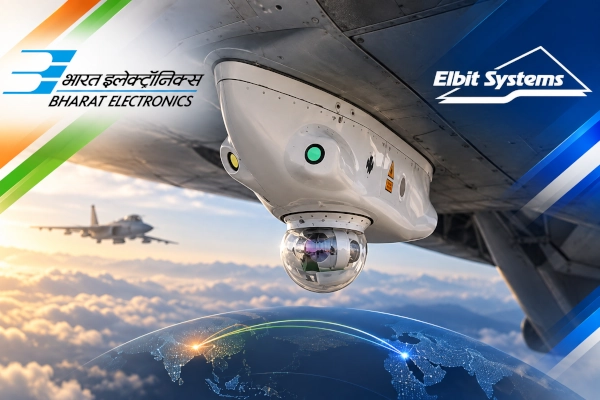
Bharat Electronics Limited has strengthened its position in the international aerospace and electronic-warfare supply chain with a major export purchase order from Elbit Systems Electro-Optics ELOP Ltd for the production and supply of sub-assemblies used in Directed Infrared Countermeasure systems.
The agreement was signed on 16 September 2026 in Bengaluru by Rajnish Sharma, Director, Bengaluru Complex, BEL, and Shai Cohen, Senior Vice President, Elbit Systems. Senior officials from both companies were present, including representatives responsible for electronic warfare, international marketing and Elbit’s DIRCM business.
BEL to Manufacture DIRCM Sub-Assemblies
Under the agreement, BEL will manufacture and supply specialised sub-assemblies that will be incorporated into Elbit Systems’ DIRCM solutions.
The significance of the order lies in BEL participating not merely as a domestic integrator but as a manufacturing supplier to an international airborne self-protection programme. The specific sub-assemblies covered by the agreement and the financial value of the export order have not been publicly disclosed.
BEL already lists Israel among the countries to which it exports defence equipment and components, while its export portfolio includes electronic assemblies, TR modules, mechanical parts and missile-system sub-assemblies.
What Is a DIRCM System?
A Directed Infrared Countermeasure system is an aircraft self-protection technology designed primarily to defeat infrared-guided surface-to-air missiles, particularly man-portable air-defence systems, or MANPADS.
When an incoming missile is detected and tracked, the DIRCM system directs precisely controlled laser energy towards the missile’s infrared seeker. The energy interferes with the seeker’s ability to remain locked on to the aircraft, causing it to lose or divert from its intended target.
BEL describes its DIRCM system as a laser-based countermeasure capable of automatically engaging heat-seeking missiles without requiring flight-crew intervention. It is intended to protect aircraft during vulnerable phases including take-off, cruise and landing.
Elbit’s MUSIC Family Forms a Major Global DIRCM Portfolio
Elbit Systems is one of the established international suppliers of airborne DIRCM equipment through its MUSIC family of self-protection systems.
Elbit says its DIRCM architecture combines fiber-laser technology, a high-frame-rate thermal camera and a rapidly moving mirror turret to detect, track and counter infrared-guided threats. The open architecture allows the technology to be adapted to different fixed-wing and rotary-wing aircraft.
Variants of Elbit’s DIRCM technology have been selected for platforms including the C-27J, C-130J, AW101 and KC-390, as well as commercial and VIP aircraft fleets.
The company continues to secure major international orders for the technology. In January 2026, Elbit announced approximately $275 million in contracts to equip an Asia-Pacific country’s helicopter fleet with an airborne electronic-warfare suite incorporating its Mini-MUSIC DIRCM system.
Earlier the same month, Elbit announced approximately $150 million in additional DIRCM contracts for European customers, demonstrating the scale of the international market for aircraft laser-based self-protection systems.
India Enters a High-Value Aerospace Supply Chain
The BEL–Elbit agreement is important because DIRCM equipment sits within one of the more technologically demanding areas of airborne electronic warfare.
Manufacturing sub-assemblies for such systems requires capabilities in precision electronics, electro-optics, high-reliability manufacturing, testing and aerospace-quality assurance. Supplying these components for export therefore gives BEL exposure to an international production chain rather than restricting its manufacturing base to Indian military programmes.
The arrangement also reflects the gradual evolution of India’s defence manufacturing sector from producing complete systems primarily for domestic customers towards becoming a supplier of components, modules and sub-systems for global defence manufacturers.
BEL Expands Electronic-Warfare Business
Electronic warfare and avionics are already major areas of BEL’s business. The company’s portfolio spans radar warning equipment, communications, jammers, airborne systems, seekers and electro-optical technologies.
BEL’s own product catalogue includes DIRCM as an airborne protection technology and describes capabilities such as dual-band laser operation, multiple-threat handling, automatic engagement and integration with different missile-warning systems.
The Elbit export order therefore builds on an existing technological base within BEL rather than representing an entirely new manufacturing activity.
Separate ₹648-Crore Order Inflow Includes Laser-Based IR Jammers
BEL has separately disclosed that it received ₹648 crore in additional orders since its previous disclosure of 26 August 2026. The latest orders include laser-based IR jammers, communications equipment, cybersecurity solutions, thermal imagers, transducers, AI-based software, TR modules, upgrades, spares and services.
However, BEL has not published a customer-wise breakdown of the ₹648-crore figure. It would therefore be inaccurate to assume that the value represents the Elbit DIRCM export agreement or to assign any portion of it to that contract without a separate disclosure.
Growing Defence Export Footprint
For BEL, the agreement adds another specialised product stream to a steadily expanding export portfolio. For India, it illustrates how domestic defence companies are increasingly participating in the international aerospace industry at the sub-system and component level, where long-term production contracts can create sustained manufacturing relationships.
The DIRCM order is particularly notable because it involves equipment intended for advanced airborne survivability systems rather than relatively conventional defence hardware.
By manufacturing DIRCM sub-assemblies for Elbit Systems, BEL is positioning itself deeper within the global supply chain for sophisticated electronic-warfare and aircraft self-protection technologies, while further broadening the export dimension of India’s defence-electronics industry.
Reference
You may also like
-
Nayan Technologies Selected by JSW MG Motor to Advance AI-Based Road Monitoring and Smart Mobility
-
Indian Navy to Commission Indigenous Anti-Submarine Warfare Ship Mangrol on October 12
-
JSW Steel’s Crude Steel Production Rises 5% to 7.27 Million Tonnes in Q2 FY2027
-
Kabra Extrusiontechnik’s GEON Commissions 20 MWh Battery Storage Project in Rajasthan
-
OBSC Perfection Secures ₹8.9 Crore Israeli Defence Order for Precision Fuze Components
