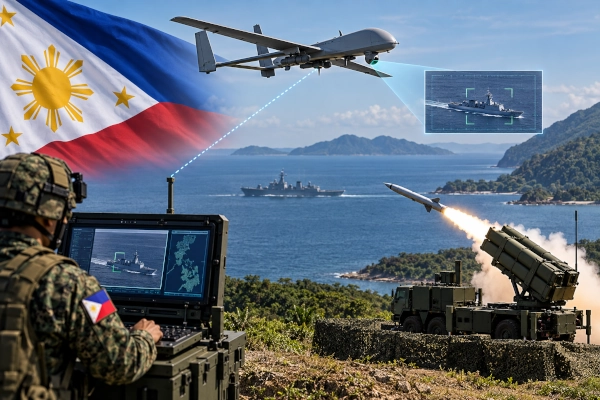
The Philippines has taken another step towards building an integrated coastal-strike network by rehearsing the use of Philippine Air Force Hermes unmanned aerial vehicles to locate and track ships for simulated engagement by the Philippine Marine Corps’ BrahMos shore-based anti-ship missile batteries.
The exercise was conducted in northern Luzon as part of Archipelagic Coastal Defense Continuum 26.4, a continuing series of bilateral training activities between the Philippine Marine Corps and the United States Marine Corps. During the drill, Philippine and American personnel worked through the process of detecting maritime targets, maintaining surveillance on them, developing targeting information and preparing a BrahMos strike solution.
No BrahMos missile was fired during the event. The importance of the exercise lay instead in rehearsing the sequence that must occur before a long-range coastal missile can be employed effectively against a moving ship at sea.
Hermes UAVs Become the Eyes of the Coastal Missile Force
During the maritime-strike training conducted near Bojeador in northern Luzon on 25 August 2026, planners incorporated Philippine Air Force Hermes UAVs into the targeting scenario. The aircraft were used notionally to track a maritime surface action group while Philippine Marine Corps personnel developed the information required for a simulated BrahMos engagement.
This represents the fundamental sensor-to-shooter problem faced by any long-range anti-ship missile force. A coastal missile battery may possess the range to engage a warship hundreds of kilometres from shore, but the missile crew still requires reliable information about where the target is, where it is moving and whether the track corresponds to the intended vessel.
A long-range missile battery therefore becomes substantially more useful when connected to surveillance assets capable of searching beyond the visual and radar horizon of the launcher itself. In an archipelagic environment such as the Philippines, unmanned aircraft offer one method of maintaining surveillance over maritime approaches while keeping the missile battery concealed at a separate location.
The Hermes UAV consequently performs a role that is just as important as the missile launcher itself. It extends the sensing network over the sea and provides the information from which a firing unit can begin constructing a valid targeting solution.
A Simulated BrahMos Strike Against a Surface Action Group
The exercise scenario did not use generic unidentified targets. According to information released in connection with the training, the simulated opposing naval force represented a surface action group consisting of two Type 052D guided-missile destroyers, one Type 054A frigate and a Type 901 fast combat support ship.
These ship classes are operated by China’s People’s Liberation Army Navy, giving the exercise a realistic force-composition model based on vessels that could operate in waters surrounding the Philippine archipelago.
The Hermes-supported surveillance picture was used by planners to practise target identification and maritime fire planning. Philippine Marine Corps personnel from the Coastal Defense Regiment worked alongside U.S. Marines specialising in fire support and maritime strike coordination to develop the procedures required to turn surveillance information into a usable engagement plan.
The training therefore concentrated on the stages preceding weapons release rather than on the missile flight itself. Detecting a ship is only the beginning of the process. Its identity must be established, its location must be continually updated and its movement must be assessed so that the missile battery receives information accurate enough to conduct an engagement.
From Detection to a Firing Solution
The phrase sensor-to-shooter kill chain describes the sequence connecting the platform that finds a target with the weapon system capable of attacking it. For the Philippine coastal-defence force, the August exercise explored how a remotely piloted surveillance aircraft could contribute to that sequence.
In its simplest form, the process begins when the UAV establishes a maritime contact. The contact must then be tracked and classified while information about its position, course and speed is passed into the command-and-control structure. Fire-control personnel use that information to build the engagement solution before the missile unit is authorised to prepare or execute a strike.
The challenge becomes more demanding when the target is a moving warship. Unlike a fixed installation, the vessel may change course or speed after its initial detection. Surveillance must therefore be sufficiently persistent and the reporting chain sufficiently rapid to keep the targeting picture relevant.
This is why the Philippine exercise is more significant than merely placing a drone and a missile system in the same training scenario. It represents an effort to develop the doctrine, communications procedures and fire-planning methods needed to make independently acquired systems function as components of a wider maritime strike network.
BrahMos Gives the Philippines a New Coastal Strike Capability
The Philippines became the first foreign customer for the Indo-Russian BrahMos supersonic cruise missile after signing a contract with BrahMos Aerospace in January 2022. The agreement was valued at approximately US$375 million and covered three shore-based anti-ship missile batteries together with operator training, maintenance training and associated logistics support.
The first BrahMos systems were delivered to the Philippines in April 2024 and are operated by the Philippine Marine Corps’ Coastal Defense Regiment. The regiment was established to provide the country with a land-based capability for defending maritime approaches, straits, coastal areas and strategically important islands.
BrahMos travels at approximately Mach 2.8 and combines high speed with a sea-skimming anti-ship attack profile. Its speed reduces the reaction time available to the target once the missile approaches the defended area, while its mobile land-based launchers allow batteries to move between firing positions rather than remaining tied to permanent coastal installations.
The Philippine requirement has always extended beyond simply possessing the missile. A mobile anti-ship weapon becomes most effective when it can receive targeting information from aircraft, UAVs, ships, coastal radars and other surveillance systems operating across a much larger area.
The Hermes exercise directly addresses that requirement.
Building an Archipelagic Coastal Defence Network
The training forms part of a much wider Philippine effort to develop what its Marine Corps calls an Archipelagic Coastal Defense Concept. The geography of the country makes such an approach particularly relevant. More than 7,000 islands are spread across strategically important waters connecting the South China Sea, Philippine Sea, Sulu Sea and the approaches to the Luzon Strait.
Rather than attempting to defend every stretch of coastline with permanently deployed forces, Philippine planners are developing units that can move between islands and coastal positions while drawing targeting information from a distributed network of sensors.
BrahMos batteries can provide the long-range strike component of such a network, while UAVs and other surveillance systems provide the maritime picture required to employ them. Command-and-control systems must then connect those elements across considerable geographical distances.
The Archipelagic Coastal Defense Continuum has increasingly concentrated on precisely these areas. U.S. Marine Corps descriptions of the programme identify maritime-domain awareness, unmanned systems, command and control and fires integration as recurring elements of the training.
US Marines Bring Their Own Littoral Warfare Experience
The United States Marine Corps has been developing a similar approach under its own transformation towards distributed maritime operations. Marine Littoral Regiment formations are designed to operate from dispersed positions across islands and coastlines while using sensors, communications networks and long-range anti-ship weapons to influence surrounding maritime areas.
That makes cooperation with the Philippine Coastal Defense Regiment particularly relevant. Both forces are examining how relatively small, mobile units can locate naval targets, exchange information and employ long-range weapons without depending on large fixed bases.
During the August exercise, U.S. Marines did not simply provide a missile system for the Philippines to observe. Instead, fire-support specialists worked with Philippine personnel on the procedures involved in target identification and strike planning.
This distinction matters because the Philippine Marine Corps must ultimately develop its own operational methods around BrahMos. The missile is an Indian-designed weapon system operated by Philippine personnel within a national coastal-defence structure, while the exercise with the United States provides experience in integrating that weapon into a wider distributed fires architecture.
Wider Sensors Are Being Added to the Exercise Network
The Hermes-BrahMos rehearsal also took place within a broader series of exercises examining how additional sensors could support Philippine coastal defence.
Earlier in August, U.S. Marines deployed and tested the mobility of the AN/TPS-80 Ground/Air Task-Oriented Radar, commonly known as G/ATOR, in the Philippines. The radar can provide 360-degree surveillance and contribute targeting information to other systems while supporting command-and-control functions.
The U.S. Marine Corps stated that the activity was intended to improve fires integration and support the Philippine Marine Corps’ Archipelagic Coastal Defense Concept. Taken together with the Hermes-supported maritime strike rehearsal, the training shows growing emphasis on the network connecting sensors, command posts and weapons rather than treating each platform as an isolated capability.
For the Philippines, this networking problem will become increasingly important as new UAVs, coastal radars, missiles and maritime-surveillance systems enter service.
The Exercise Did Not Demonstrate a Permanent Digital Link
The August drill should not be interpreted as evidence that a fully automated digital datalink now permanently connects Philippine Hermes UAVs directly to BrahMos launch vehicles.
Publicly available information confirms that Hermes UAV tracks were incorporated into the maritime-strike planning process and used to support a simulated BrahMos engagement. It does not establish that targeting information passed directly from the UAV into the BrahMos fire-control system without intermediate command-and-control processing.
This distinction is technically important. A genuine sensor-to-shooter network can take several forms. In one architecture, information may move directly between compatible digital systems. In another, UAV data may enter a command centre where personnel validate the target before passing coordinates and track information to the missile unit through a separate network.
Both can support long-range maritime strike operations, but they represent different levels of automation and integration.
The Philippine exercise demonstrates that the armed forces are practising the operational chain linking aerial surveillance with BrahMos strike planning. The exact communications architecture used to move targeting data through that chain has not been publicly disclosed.
The Next Challenge Is a Moving Maritime Target
A shore-based anti-ship missile battery ultimately depends on the quality of the maritime targeting picture available to it. A warship hundreds of kilometres away can move several kilometres while targeting information is being processed, and sophisticated naval forces may attempt to disrupt the surveillance and communications network feeding the missile battery.
Future exercises will therefore need to test the Philippine system against increasingly demanding conditions, including rapidly manoeuvring targets, communications disruption, electronic warfare and the requirement to transfer target tracks between different sensors.
The ability to maintain a continuous track after one surveillance asset leaves the area will also be important. A mature coastal-strike network cannot depend on a single UAV. It must be capable of combining information from several aircraft, ships, coastal sensors and potentially allied intelligence sources while maintaining a common operating picture.
This is the direction in which the Philippine coastal-defence force appears to be moving.
BrahMos Is Becoming Part of a Larger Maritime System
The most important feature of the August exercise was therefore not the BrahMos launcher itself. The Philippines has possessed the missile system since 2024, and its personnel have already undergone operator and maintenance training.
What is now developing is the network around the weapon.
By using Hermes UAV surveillance to support simulated BrahMos fire planning, Philippine and U.S. Marines rehearsed the process required to transform a distant radar or electro-optical contact into a potential missile engagement. The exercise connected maritime surveillance, target identification, command and control, fire planning and a long-range coastal weapon within a single operational scenario.
For an archipelagic country seeking to monitor and defend widely separated maritime approaches, that integration may ultimately determine the practical value of the BrahMos system. A supersonic missile provides the striking power, but it is the network of sensors and communications behind it that allows the weapon to find the right target at sea.
You may also like
-
Indian Navy to Commission Indigenous Anti-Submarine Warfare Ship Mangrol on October 12
-
OBSC Perfection Secures ₹8.9 Crore Israeli Defence Order for Precision Fuze Components
-
India and Russia Explore New Defence Co-Production and Joint Technology Development Opportunities
-
DRDO Advances Indigenous Submarine AIP System as ₹1,990 Crore Kalvari-Class Integration Programme Progresses
-
Paras Defence Clarifies Guardian-1 Counter-Drone Partnership with US Firm Powerus Amid Pakistan Deal Concerns
