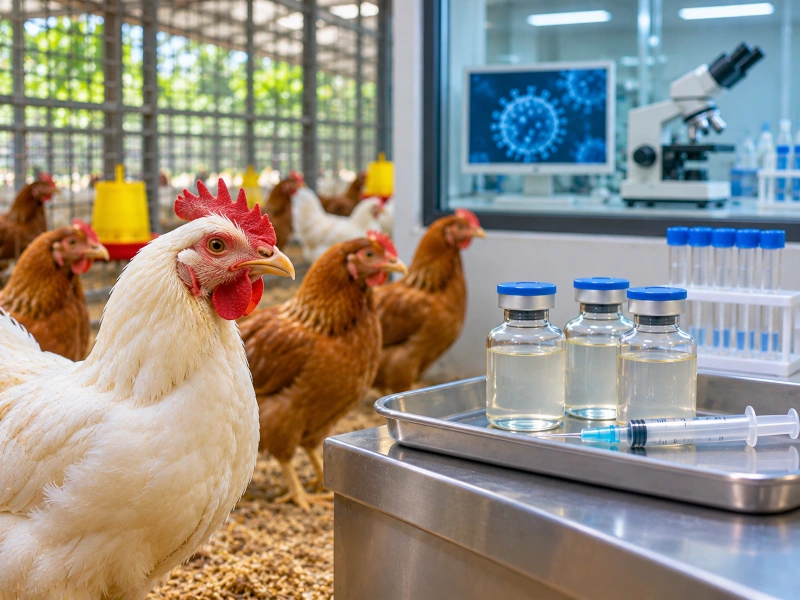
India has achieved an important milestone in veterinary biotechnology with the indigenous development of its first inactivated vaccine against the H5N1 Highly Pathogenic Avian Influenza (HPAI) virus belonging to Clade 2.3.2.1a. Developed by the ICAR-National Institute of High Security Animal Diseases (ICAR-NIHSAD) in Bhopal, the vaccine is intended to strengthen the country’s ability to protect poultry against a highly destructive infectious disease.
Union Minister of Agriculture and Farmers Welfare and Rural Development Shivraj Singh Chouhan is scheduled to dedicate the vaccine to the nation on November 20, 2026, at ICAR-NIHSAD, Bhopal. The development represents an important achievement in indigenous veterinary research, particularly because it targets a specific genetic lineage of H5N1 avian influenza associated with outbreaks in India.
The vaccine has been developed to address the need for protection against H5N1 Clade 2.3.2.1a viruses circulating in the country. Its development is significant for India’s poultry industry, which faces substantial economic and livelihood risks from outbreaks of highly pathogenic avian influenza.
Understanding Highly Pathogenic Avian Influenza
Highly Pathogenic Avian Influenza, commonly known as bird flu, is a serious infectious disease affecting domestic poultry and several species of wild birds. The disease is caused by certain strains of influenza A viruses and can spread rapidly among susceptible bird populations.
In chickens, highly pathogenic avian influenza can cause severe illness and extremely high mortality. Under certain outbreak conditions, mortality among infected poultry can approach 100 per cent, making the disease particularly destructive for commercial poultry farms and small-scale producers.
The consequences of an outbreak extend beyond the immediate loss of birds. Disease-control measures may require the destruction of infected and exposed poultry, restrictions on the movement of birds and poultry products, surveillance activities and extensive sanitation procedures. These interventions are essential for controlling infection but can impose substantial financial burdens on poultry farmers and associated industries.
Avian influenza outbreaks can also disrupt the availability of poultry products, affect market confidence and create restrictions on domestic and international trade. Consequently, effective disease prevention and surveillance are important components of poultry-sector development and national animal health management.
India’s Experience with Bird Flu Outbreaks
India first detected highly pathogenic avian influenza in 2006. Since then, the country has experienced repeated outbreaks involving H5N1 and H5N8 influenza virus subtypes.
According to the Ministry of Agriculture and Farmers Welfare, more than 500 combined outbreaks involving these two subtypes have been reported in India since the first detection. These outbreaks have demonstrated the continuing importance of veterinary surveillance, laboratory diagnosis and rapid disease-control measures.
The economic consequences of avian influenza can be substantial. The government has estimated that the 2006 outbreak resulted in direct and indirect losses ranging between ₹2,200 crore and ₹3,000 crore. An outbreak in Manipur was also reported to have caused economic losses equivalent to approximately 0.5 per cent of the state’s gross domestic product.
The government’s background assessment further highlights the potentially severe consequences of an uncontrolled major outbreak, including risks to a substantial proportion of India’s poultry population and wider economic activity. These estimates illustrate the importance of preparedness and prevention rather than representing losses that have already occurred.
For poultry farmers, disease outbreaks can have consequences extending beyond the immediate loss of livestock. Farmers may face interruptions in production, expenditure on cleaning and restocking, restrictions on poultry movement and reduced income during recovery periods.
Indigenous Vaccine Targets H5N1 Clade 2.3.2.1a
The newly developed vaccine specifically targets the H5N1 virus belonging to Clade 2.3.2.1a. A clade is a genetically related group of viruses sharing a common evolutionary lineage. Identifying these genetic lineages is important because influenza viruses evolve over time, and vaccines need to provide protection against the strains responsible for disease.
Studies cited by the government indicate that H5N1 Clade 2.3.2.1a has been associated with a substantial proportion of bird flu outbreaks affecting chickens in India.
The development of an indigenous vaccine against this lineage addresses an important requirement for poultry disease management. According to the official announcement, a specific commercial vaccine against H5N1 Clade 2.3.2.1a was not available at the time of the announcement.
The ICAR-NIHSAD vaccine has been developed as an inactivated formulation. Inactivated vaccines use virus material that has been rendered non-infectious while retaining components capable of stimulating an immune response.
Such vaccines are designed to help the immune system recognise the pathogen and develop protection against subsequent exposure. The degree and duration of protection depend on factors including the vaccine formulation, immunisation schedule, circulating virus and conditions under which vaccination is administered.
The development of a vaccine targeting a locally relevant viral lineage provides India with an indigenous technological resource for strengthening its poultry disease-control capabilities.
Role of ICAR-NIHSAD in Veterinary Disease Research
The ICAR-National Institute of High Security Animal Diseases in Bhopal is a specialised research institution under the Indian Council of Agricultural Research. It conducts research on important infectious diseases affecting livestock and poultry, including diseases requiring high-containment laboratory facilities.
Research on highly pathogenic avian influenza requires specialised infrastructure, trained scientific personnel and strict biosafety procedures because of the serious risks associated with handling infectious virus samples.
The institute’s work contributes to the scientific understanding of animal pathogens, diagnostic capabilities and disease-control technologies relevant to India’s livestock and poultry sectors.
The development of the indigenous H5N1 vaccine demonstrates the importance of maintaining national research capabilities in high-consequence animal diseases. Such capabilities support the country’s ability to respond to evolving disease threats using scientific expertise and technologies developed within India.
The achievement also reflects the contribution of publicly funded agricultural research institutions to the development of practical technologies addressing challenges faced by farmers.
Public Health Importance of Controlling Avian Influenza
Although highly pathogenic avian influenza primarily affects birds, certain influenza A viruses can cross species barriers and infect mammals, including humans.
Human infections with H5N1 remain uncommon relative to the scale of infections in birds, but they can cause severe illness. According to World Health Organization figures cited in the government’s November 18 announcement, 1,003 human cases of H5N1 infection, including 479 deaths, had been reported across 25 countries since 2003.
The official announcement also highlighted detections of the relevant viral lineage in other animal species, including mammals, along with reported human infections. These developments underline the importance of monitoring avian influenza across different animal populations.
Preventing and controlling infections in poultry can contribute to reducing opportunities for the virus to spread among animals and potentially infect humans. However, poultry vaccination alone does not eliminate zoonotic transmission risks, and its effectiveness depends on the protection achieved and the wider disease-control programme.
The development of the vaccine is therefore relevant to the One Health approach, which recognises the connections between human health, animal health and environmental health.
Effective avian influenza management requires cooperation among veterinary authorities, animal disease research institutions, public health agencies and farming communities.
Strengthening Poultry Biosecurity and Disease Preparedness
Vaccination can provide an additional disease-control tool, but effective management of avian influenza also depends on surveillance, rapid diagnosis, biosecurity and appropriate responses to suspected outbreaks.
Poultry biosecurity involves measures intended to reduce the introduction and spread of infectious agents within farms. These include controlling movement between poultry facilities, maintaining hygiene, managing exposure to potentially infected birds and ensuring that suspected disease cases are reported promptly.
Laboratory testing and epidemiological surveillance are equally important because they help identify circulating virus strains and monitor changes in disease patterns.
The availability of an indigenous vaccine against a relevant H5N1 lineage could complement these existing measures when incorporated into an appropriate vaccination strategy.
The government’s November 18 announcement establishes the vaccine’s development and forthcoming dedication to the nation. It does not, however, specify a nationwide vaccination schedule, commercial production volume or implementation timeline.
These operational aspects will be important in determining how the vaccine is introduced into poultry disease-control programmes.
Supporting India’s Poultry Farmers and Rural Economy
India’s poultry sector plays an important role in agricultural diversification, animal protein production, rural employment and farm income generation. Poultry rearing supports commercial enterprises as well as smallholder farming households that depend on livestock-related activities for supplementary income.
Disease outbreaks can be especially damaging to smaller producers because losses may affect household savings, productive assets and the ability to resume farming operations.
Improving veterinary disease prevention can therefore contribute to the economic security of rural communities while supporting greater stability in poultry production.
An indigenous vaccine developed through India’s public agricultural research system also provides an opportunity to strengthen domestic capabilities in veterinary biotechnology and animal healthcare.
The development is particularly relevant to national efforts to improve livestock health through scientific research, disease surveillance and the availability of locally developed technologies.
Advancing India’s Indigenous Veterinary Biotechnology
The development of India’s first indigenous inactivated H5N1 Clade 2.3.2.1a vaccine for chickens represents a significant step in strengthening the country’s scientific response to highly pathogenic avian influenza.
By developing a vaccine specifically directed against a viral lineage relevant to India, ICAR-NIHSAD has demonstrated the value of domestic research capabilities in addressing animal disease challenges.
The scheduled dedication of the vaccine on November 20, 2026, will mark an important occasion for India’s agricultural research and veterinary biotechnology sectors.
As the country continues to strengthen its animal health infrastructure, the combination of indigenous vaccine development, scientific surveillance, veterinary services and effective farm-level disease management can contribute to a more resilient poultry industry.
The achievement reinforces the importance of Indian agricultural research in protecting livestock resources, supporting rural livelihoods and strengthening the country’s capacity to address emerging animal health challenges.
You may also like
-
DIVERSIFARM-India Maps 652 Community Seed Banks, Releases Manual to Strengthen Indigenous Seed Conservation
-
India’s Exports Surge 58% to ASEAN and 22% to South Asia as Trade Expands Across Global Markets
-
Tata Steel Plans India’s First Hydrogen Production Facility Using Steel Plant Off-Gases in Odisha
-
India’s Memory Chip Exports Surge 2,333% to $562.4 Million as Semiconductor Trade Expands
-
Data Patterns’ Indigenous BrahMos Missile Seeker Undergoes Qualification Testing Ahead of Potential Production
