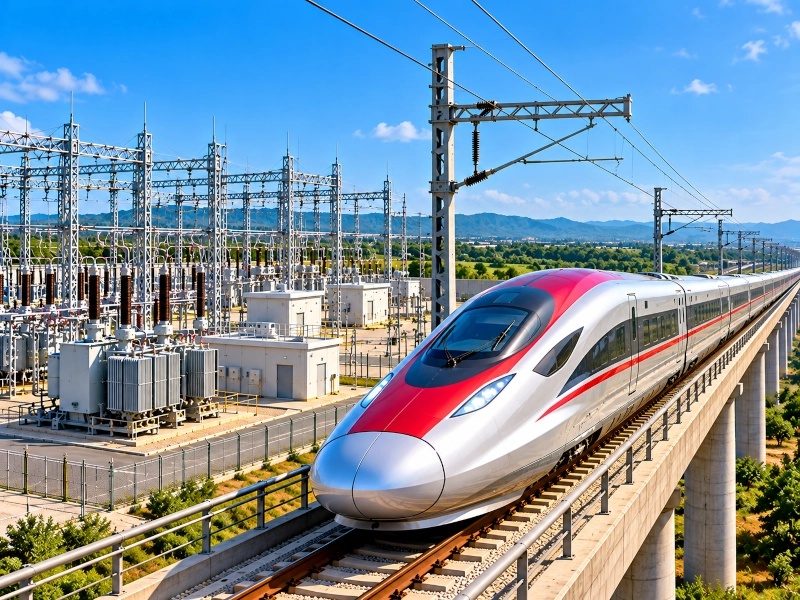
India’s first high-speed railway project has achieved another infrastructure milestone, with the first traction substation for the Mumbai–Ahmedabad Bullet Train corridor nearing completion at Bilimora in Gujarat’s Navsari district. The facility will form part of an advanced electrical network designed to supply power to high-speed trains operating along the 508-kilometre corridor connecting Maharashtra and Gujarat.
According to information released by the National High Speed Rail Corporation Limited (NHSRCL) and reported on 30 October 2026, construction of the Bilimora Traction Substation has reached an advanced stage, with major electrical equipment installed and testing and commissioning activities progressing.
Spread across approximately 18,000 square metres, the substation will receive electricity from the Gujarat Energy Transmission Corporation Limited’s (GETCO) 220 kV Ambetha Grid Substation and transform it to the voltage levels required for high-speed railway operations.
The Mumbai–Ahmedabad High-Speed Rail project will be supported by 14 traction substations strategically located along the corridor, including nine in Gujarat and five in Maharashtra. Together, these facilities will supply electricity to an advanced 2 × 25 kV overhead traction system designed to support trains operating at speeds of up to 320 kilometres per hour.
Bilimora Traction Substation Reaches Advanced Construction Stage
The Bilimora Traction Substation is among the first major electrical facilities being prepared for the Mumbai–Ahmedabad High-Speed Rail corridor. Located in Navsari district, the facility will play an important role in converting electricity received from the transmission grid into traction power suitable for high-speed train operations.
NHSRCL has confirmed that work associated with the Control Panel Building, Changeover Switch Building, Transformer Building and Circuit Breaker Building has progressed substantially, with equipment installation in these facilities completed.
The construction and installation of all gantry towers and beams have also been completed. These structures support the electrical connections and transmission arrangements required for the substation’s operations.
The remaining activities include equipment testing, commissioning procedures and the verification of electrical systems before the facility becomes operational.
Testing and commissioning are particularly important for high-speed railway electrification because the power supply infrastructure must meet stringent requirements for reliability, electrical protection and safe operation.
The near-completion of the Bilimora facility represents progress towards establishing the electrical infrastructure required for the corridor’s initial train operations.
Fourteen Traction Substations to Power the 508-Km Corridor
The Mumbai–Ahmedabad High-Speed Rail project will use 14 traction substations to supply electricity across its 508-kilometre alignment.
According to the Ministry of Railways, five traction substations are being developed in Maharashtra at Mumbai, Thane, Virar, Boisar and Thane Depot.
The remaining nine facilities are being established in Gujarat at Vapi, Bilimora, Surat, Bharuch, Vadodara, Anand, Mahemdavad, Ahmedabad and Sabarmati Depot.
These installations will receive electricity from designated grid substations and supply power to different sections of the high-speed railway network.
The distributed arrangement is intended to maintain a stable electricity supply as trains move between sections of the corridor.
Each traction substation will serve a designated portion of the railway alignment, allowing electricity to be supplied efficiently while providing facilities for monitoring and protection.
The system is being developed to meet the demanding requirements of high-speed electric trains, which require reliable power delivery during acceleration, sustained high-speed movement and braking.
Advanced 2 × 25 kV System to Supply Electricity to Bullet Trains
The Mumbai–Ahmedabad Bullet Train corridor will use an advanced 2 × 25 kV overhead traction power supply system based on Japanese high-speed railway technology.
According to the Ministry of Railways, this electrification system is being introduced in India for high-speed train operations capable of reaching 320 kilometres per hour.
The system receives electricity from the power grid through dedicated transmission and traction substations before supplying it to the overhead electrical infrastructure installed along the railway alignment.
The 2 × 25 kV system uses an autotransformer arrangement involving overhead contact wires, feeder conductors and associated electrical equipment.
The contact wire supplies electricity to the train through its pantograph, while the feeder arrangement supports efficient power transmission over longer distances.
Compared with a conventional 25 kV traction arrangement, the autotransformer system can reduce voltage drops and improve power supply performance across long railway sections.
These characteristics are particularly important for high-speed trains because they require substantial electrical power while travelling at high speeds.
The system is designed to maintain stable traction voltage and support reliable power delivery across the corridor.
Bilimora to Receive Power from GETCO’s Ambetha Grid Substation
The Bilimora Traction Substation will receive electricity from the 220 kV Ambetha Grid Substation operated by Gujarat Energy Transmission Corporation Limited.
GETCO is responsible for electricity transmission infrastructure in Gujarat and operates a network of substations and high-voltage transmission lines supplying power across the state.
The connection to the Ambetha facility will provide the incoming high-voltage electricity required for the Bilimora traction substation.
Within the traction substation, transformers and associated electrical equipment will convert and regulate the incoming supply for use in the railway’s 2 × 25 kV traction system.
The electricity will subsequently be distributed through the overhead equipment installed along the high-speed railway viaduct.
High-voltage grid connections are essential for railway electrification because high-speed trains require substantial power, particularly during acceleration.
The arrangement is intended to ensure that electrical energy can be delivered efficiently and safely to the railway’s traction infrastructure.
The Ambetha grid connection is specifically associated with the Bilimora facility. Other traction substations along the corridor will be connected to their respective designated grid supply points.
Nearly 22,000 Steel Masts to Support Overhead Electrical Network
The electrification programme involves the installation of an extensive network of overhead electrical equipment along the Mumbai–Ahmedabad High-Speed Rail corridor.
According to the Ministry of Railways, the system will be supported by nearly 22,000 steel masts and more than 25,700 cantilever assemblies distributed across approximately 1,125 track kilometres, including depot lines.
The steel masts will support the overhead conductors, electrical fittings and associated equipment required to supply electricity to high-speed trains.
The Ministry has stated that the masts will range from approximately 10.5 to 14.5 metres in height, depending on the location and engineering requirements.
The overhead system uses a carefully engineered compound catenary arrangement designed to maintain stable contact between the electrical wire and the pantograph mounted on top of the train.
At high speeds, the interaction between the pantograph and contact wire becomes particularly important because irregular contact can affect the reliability of electricity supply.
The overhead wires must therefore be installed with precise alignment, mechanical tension and positioning to support high-speed operations.
The project involves specialised installation procedures and engineering standards derived from Japan’s Shinkansen railway system.
Real-Time Monitoring Through Centralised Electrical Control Centre
The Mumbai–Ahmedabad Bullet Train project will incorporate a centralised electrical monitoring system to supervise the traction power supply network.
According to NHSRCL, the entire electrical infrastructure will be monitored continuously through a centralised control centre.
The system will provide information concerning electricity supply conditions, equipment status and operational developments across the railway’s traction network.
Real-time monitoring will allow operators to identify abnormalities, assess electrical conditions and coordinate responses to equipment failures or power supply interruptions.
Automated electrical protection systems will also form part of the network.
These systems are designed to respond rapidly to abnormal electrical conditions and isolate affected sections when necessary.
Centralised monitoring is particularly important for high-speed railways because interruptions to traction power can affect train movement and operational schedules.
The combination of remote monitoring, automated protection and distributed traction substations is intended to strengthen the reliability of electricity supply across the corridor.
Thirty-One Switching Posts to Strengthen Electrical Reliability
In addition to the 14 traction substations, the Mumbai–Ahmedabad High-Speed Rail corridor will have 31 switching posts.
According to the Ministry of Railways, these facilities will support continuity of power supply and enable the rapid isolation of faults within the traction electrical network.
Switching posts are important components of railway electrification because they allow different electrical sections to be connected, disconnected or isolated according to operational requirements.
If an electrical fault occurs in one section, suitable switching and protection arrangements can help prevent the disturbance from affecting larger portions of the network.
This sectionalisation is particularly important for long-distance high-speed railway corridors.
The project will also include 16 distribution substations responsible for supplying electricity to infrastructure other than train traction.
These facilities will provide power for railway stations, signalling equipment, maintenance installations and other operational systems.
The combination of traction and distribution substations will create a comprehensive electrical network supporting both train movement and associated railway infrastructure.
Earthquake Detection Systems Integrated into Traction Infrastructure
The Mumbai–Ahmedabad High-Speed Rail project will also incorporate advanced earthquake detection equipment as part of its safety infrastructure.
According to the Ministry of Railways, each of the 14 traction substations will be equipped with early earthquake detection seismometers.
These instruments are designed to detect seismic activity and initiate protective measures when potentially dangerous ground movements are identified.
The project will incorporate 28 seismometers, including 22 installed along the high-speed railway corridor at traction substations and switching posts.
Another six seismometers will be installed at inland locations in earthquake-prone regions of Maharashtra and Gujarat.
The Ministry has stated that 12 seismometers will be located in Maharashtra and 16 in Gujarat.
The earthquake detection network is intended to provide rapid warnings and initiate safety responses, including protective actions affecting train operations.
The integration of seismic monitoring into railway infrastructure reflects the influence of Japanese high-speed railway engineering, where earthquake detection forms an important component of operational safety.
Indian Companies Manufacture Critical Electrification Components
The Ministry of Railways has highlighted the increasing participation of Indian manufacturers in the development of the high-speed rail electrification system.
Several critical components are being manufactured domestically, including major transformers, cross arms mounted on overhead equipment masts and different categories of electrical conductors.
These include ground wires, protection wires and feeder wires used in the overhead traction system.
Indian industries are also supplying components associated with traction power distribution and other electromechanical infrastructure.
The Ministry has identified domestic manufacturing as an important aspect of the project’s technology transfer and industrial development objectives.
High-speed railway electrification requires specialised engineering capabilities because the equipment must meet demanding requirements for electrical performance, mechanical strength and reliability.
Participation in the project provides Indian manufacturers with opportunities to develop experience in advanced railway electrical systems and related infrastructure technologies.
These capabilities could become relevant to future railway modernisation projects and other applications requiring high-performance electrical equipment.
Sojitz–L&T Consortium Executing Electrification Works
The electrification package for the Mumbai–Ahmedabad High-Speed Rail corridor is being executed through a contract awarded to the Sojitz–Larsen & Toubro consortium.
NHSRCL signed the agreement in February 2024 for the design, manufacture, supply, construction, installation, testing and commissioning of the corridor’s electrical systems.
The contract covers the 2 × 25 kV traction power supply network, overhead equipment, traction substations, switching facilities and associated electrical infrastructure.
The scope also includes electrical systems required for the high-speed railway’s depots and supporting installations.
The project incorporates Japanese Shinkansen-based electrification technology adapted to the requirements of the Mumbai–Ahmedabad corridor.
The consortium’s responsibilities extend across the development and commissioning of the electrical network, making it one of the major infrastructure packages required before high-speed train services can commence.
Bullet Train Project to Connect Maharashtra and Gujarat
The Mumbai–Ahmedabad High-Speed Rail corridor is India’s first bullet train project and is being developed with technical and financial assistance from Japan.
The approximately 508-kilometre railway will connect Mumbai in Maharashtra with Ahmedabad in Gujarat, passing through several major urban and industrial centres.
The project includes 12 planned stations at Mumbai, Thane, Virar, Boisar, Vapi, Bilimora, Surat, Bharuch, Vadodara, Anand, Ahmedabad and Sabarmati.
The railway is being designed for trains operating at speeds of up to 320 kilometres per hour, substantially higher than those of conventional Indian railway services.
The high-speed corridor involves specialised civil engineering, including elevated viaducts, bridges, tunnels, stations, depots and advanced signalling infrastructure.
Its construction also requires the development of dedicated electrical systems capable of supporting high-speed train operations.
The traction substations represent an essential component of this infrastructure because the trains cannot operate without a stable and appropriately regulated electricity supply.
Surat–Bilimora Section Identified for Initial Operations
The development of electrical infrastructure around Bilimora is particularly significant because the Surat–Bilimora section has been identified for the initial phase of high-speed rail operations.
During a review of railway infrastructure projects in Gujarat in July 2026, Union Railway Minister Ashwini Vaishnaw indicated that the government was targeting the commencement of the first phase of bullet train services on the Surat–Bilimora section in 2027.
The commissioning of traction power infrastructure will be necessary before the section can support high-speed train testing and passenger operations.
The near-completion of the Bilimora Traction Substation therefore represents progress towards establishing the electrical systems required for the initial operational section.
However, the completion of a traction substation alone does not establish that a railway section is ready for commercial services.
Track installation, overhead electrification, signalling systems, rolling stock integration, safety testing and regulatory approvals must also be completed before passenger operations can begin.
Bilimora Substation Marks Progress in High-Speed Railway Electrification
The development of the Bilimora Traction Substation represents an important step in establishing the electrical infrastructure for India’s first high-speed railway.
With major equipment installations completed and testing and commissioning activities progressing, the facility is approaching the stage at which it can be integrated into the wider traction power network.
The 14 traction substations, 31 switching posts and 16 distribution substations planned for the corridor will collectively support the electricity requirements of high-speed trains, railway stations, signalling systems and maintenance facilities.
The project also demonstrates the application of advanced 2 × 25 kV traction technology, centralised electrical monitoring and seismic safety systems within India’s railway infrastructure.
The participation of Indian manufacturers in producing transformers, overhead electrical components and other specialised equipment adds an industrial development dimension to the project.
As construction and electrification activities continue along the Mumbai–Ahmedabad corridor, the completion and successful commissioning of the Bilimora facility will constitute another step towards preparing India’s first bullet train system for high-speed operations.
References
1. National High Speed Rail Corporation Limited (NHSRCL)
Official update: Progress of traction substations for the Mumbai–Ahmedabad High-Speed Rail Corridor.
Reported: 30 October 2026.
Official website: https://nhsrcl.in/
2. Press Information Bureau — Ministry of Railways
Publication date: 22 July 2026.
Official announcement: Powering India’s First Bullet Train: Electrification Works Gain Pace on the Mumbai–Ahmedabad Bullet Train Project.
PIB Release ID: 2287686.
https://www.pib.gov.in/PressReleasePage.aspx?PRID=2287686
3. National High Speed Rail Corporation Limited
Publication date: 8 February 2024.
Official announcement: Contract Agreement Signed for Electrification Works for Bullet Train Project (MAHSR Corridor).
https://www.nhsrcl.in/en/media/press-release/media-brief-contract-agreement-signed-electrification-works-bullet-train
4. National High Speed Rail Corporation Limited
Official project information: Mumbai–Ahmedabad High-Speed Rail Corridor.
https://nhsrcl.in/index.php/en/project/project-overview
5. Press Information Bureau — Ministry of Railways
Publication date: 4 July 2026.
Official announcement: Railway Minister Ashwini Vaishnaw Reviewed Ahmedabad’s Development and Railway Infrastructure Projects.
PIB Release ID: 2281025.
https://www.pib.gov.in/PressReleasePage.aspx?PRID=2281025
You may also like
-
Sun Pharma Secures US FDA Approval for ILUMYA to Treat Active Psoriatic Arthritis
-
India Expands UPI Payments for Online Tourist Bookings at Burj Khalifa and Singapore’s Resorts World Sentosa
-
India’s Economy Projected to Grow 7.35% in Q2 FY2026–27 as Industrial Activity and Exports Strengthen
-
NTPC Subsidiary’s First 250 MW Battery Energy Storage Project Begins Commercial Operations in Rajasthan
-
ONDC DigiDukaan Connects 21,000 Kirana Retailers With Over 450 Brands as Government Pushes Digital Trade
