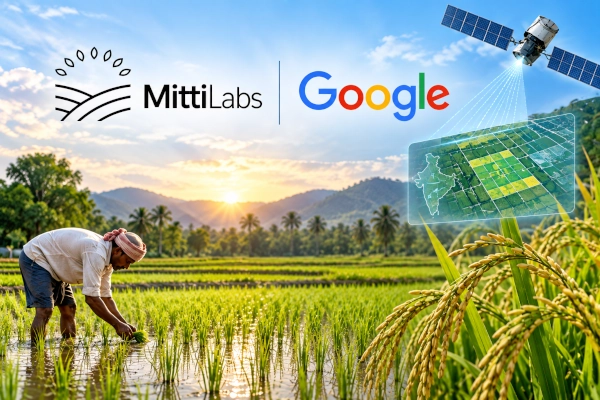
Google has signed a major four-year agreement with climate-tech startup Mitti Labs to purchase one million carbon credits by 2030, backing an Indian agricultural programme designed to simultaneously cut methane emissions from rice cultivation, conserve irrigation water and create additional income for small farmers.
Announced on September 10, 2026, the partnership is described by Google as the largest publicly announced agreement to date for carbon credits generated by reducing methane emissions from rice cultivation. The initiative represents an unusual combination of climate technology, satellite monitoring and changes in traditional agricultural practices.
Changing How Rice Fields Are Irrigated
Rice paddies are conventionally kept continuously flooded for long periods. While this helps cultivation, the waterlogged soil creates oxygen-poor conditions in which microbes generate methane, a particularly powerful greenhouse gas.
Mitti Labs works with farmers to introduce a technique known as Alternate Wetting and Drying, or AWD. Instead of maintaining permanent flooding, farmers periodically allow water levels to fall before irrigating the fields again.
According to Mitti Labs, the technique can reduce methane emissions from rice fields by around 50 per cent while lowering irrigation-water requirements by close to 40 per cent, without reducing crop yields.
Google said its partnership would initially help tens of thousands of smallholder rice farmers adopt these climate-smart agricultural practices, with the company specifically highlighting implementation across rice paddies in Telangana.
Mitti Labs expects the partnership to expand substantially over the coming years. By 2030, it says projects linked to the agreement will cover more than 100,000 hectares across critical Indian watersheds.
1.5 Trillion Litres of Potential Water Savings
The water-saving dimension is particularly significant for India, where rice cultivation places considerable pressure on groundwater and irrigation systems.
Mitti Labs estimates that the Google-backed programme could unlock approximately 1.5 trillion litres of water savings by 2030. The startup says this is roughly equivalent to three years of Bengaluru’s entire water supply.
This means the project is not simply a conventional carbon-offset programme. It could also help farmers cope with water scarcity, erratic rainfall and increasing pressure on groundwater resources.
Farmers adopting AWD can reduce the time and energy needed for irrigation while retaining crop productivity. Mitti Labs also provides direct financial payments to participating farmers from the revenues generated through carbon credits. Google highlighted these farmer payments as an important component of the programme.
Satellites and AI Verify What Happens in the Fields
A key challenge facing agricultural carbon projects is proving that emissions reductions actually occurred across thousands of dispersed farms.
Mitti Labs has developed a GeoAI platform combining high-resolution satellite radar imagery with measurements collected directly from fields. The system monitors indicators including crop health, soil moisture and the flooding status of individual plots.
The company says its technology was developed with support from NASA-related satellite capabilities and allows it to monitor small agricultural plots over very large geographical areas.
Google similarly said Mitti uses NASA-enabled satellite verification together with an on-ground monitoring network to measure the project’s impact and confirm farmers’ adoption of Alternate Wetting and Drying.
This ability to remotely verify irrigation patterns is important because each carbon credit must represent a measurable reduction in greenhouse-gas emissions.
One Million Credits Represent Major Methane Reduction
The agreement calls for Google to purchase one million carbon credits from Mitti Labs through 2030.
Mitti Labs estimates that the project will prevent warming equivalent to approximately three million tonnes of CO2-equivalent when methane’s impact is measured over a 20-year period, known as GWP20. Using the conventional 100-year measurement, GWP100, the impact is equivalent to about one million tonnes of CO2.
The distinction is important because methane remains in the atmosphere for a much shorter period than carbon dioxide but produces a much stronger warming effect while it is present.
Google has therefore increasingly treated methane and other short-lived greenhouse gases as what it calls “superpollutants.” Earlier in 2026, the company pledged at least $50 million through 2030 to projects designed to eliminate methane and other such pollutants.
Google Expands Its Climate Strategy in India
The Mitti Labs agreement forms part of a much wider sustainability push announced by Google in India on September 10.
Google said it was launching five initiatives covering climate-smart agriculture, clean energy and climate technology. These include expanding its Solar API across more than 300 million Indian rooftops and backing additional renewable-energy generation alongside the rice-methane programme.
The company faces a difficult climate challenge of its own as the rapid expansion of artificial-intelligence infrastructure drives higher electricity demand. In its 2026 Environmental Report, Google said it had signed agreements for more than 12 GW of new clean-energy capacity during 2025, while continuing efforts to reduce emissions across its operations and supply chain.
Agricultural methane reduction provides another route because it addresses a greenhouse gas with a strong near-term warming effect rather than focusing exclusively on carbon dioxide.
A Bengaluru Climate-Tech Startup Scales Up
Founded in 2023, Mitti Labs has concentrated on reducing methane emissions and water consumption in rice-growing regions.
The company says its programmes have already helped save about 500 billion litres of water, working with organisations including Cool Effect, Ebro Foods and Syngenta.
The Google agreement gives the startup something particularly valuable: a large, long-term buyer for verified agricultural carbon credits.
It also follows Mitti Labs’ $9.5-million funding round announced in August 2026, as the startup seeks to expand its climate-smart rice model across Asia.
The potential market is enormous. Rice remains one of the world’s most important staple crops, while Google estimates rice cultivation accounts for as much as 12 per cent of global methane emissions.
For India, the significance extends beyond the sale of carbon credits. A technology developed by an Indian climate startup is being used to tackle three interconnected problems at once: agricultural methane emissions, water scarcity and farmer incomes.
You may also like
-
EON Space Labs and Dhruva Space Advance Indian Space Hardware on Transporter-18 Mission
-
SatLeo Labs’ TAPAS-1 Reaches Orbit, Advancing India’s Private Thermal-Imaging Capability
-
TakeMe2Space’s MOI-1A Reaches Space on Falcon 9 Transporter-18 Mission
-
Bank of Baroda Enters Pension Fund Management After PFRDA Appointment
-
SCI and India’s Push for a Larger Indigenous Maritime Fleet
