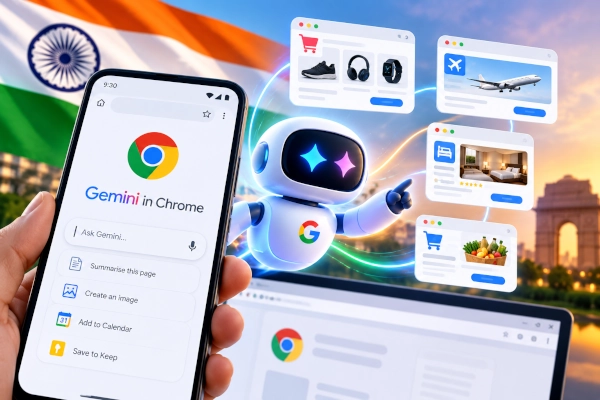
Google has expanded Gemini in Chrome to Android users in India and introduced its auto browse feature on both desktop and Android, bringing a more action-oriented form of AI-assisted browsing to the country.
The rollout allows Gemini to do more than answer questions about web pages. Eligible users can ask it to carry out multi-step tasks across websites, including comparing products, researching travel options, filling forms and adding items to shopping carts.
Gemini in Chrome Comes to Android in India
Gemini in Chrome had already been introduced on desktops in India earlier in 2026. Google has now extended the feature to Android.
On mobile, users can ask Gemini to summarise long articles, answer questions about the page they are viewing and work with Google services such as Keep and Calendar without leaving the browser.
Google also says Gemini in Chrome can use its image-generation capabilities, including Nano Banana, allowing users to create or modify images while browsing.
Auto Browse Can Complete Multi-Step Tasks
The more significant addition is auto browse, which allows Gemini to interact directly with websites and carry out a sequence of actions on the user’s behalf.
Google says the feature can compare products, search for deals, add items to shopping carts, find travel options, make restaurant reservations and schedule appointments.
It can also handle longer workflows that would normally require the user to move between several websites and repeat the same information.
This makes auto browse different from conventional tools such as autofill. Instead of simply entering stored details, Gemini can interpret a request, navigate relevant pages and work through multiple steps towards completing the task.
Available to Google AI Pro and Ultra Subscribers
Auto browse is currently available in India to eligible Google AI Pro and Google AI Ultra subscribers.
According to Google’s support documentation, users must be at least 18 years old, signed in to Chrome and using an eligible version of the browser.
The feature is currently limited to devices set to English, although Google says wider language support is planned.
The rollout is gradual, which means some eligible users may not receive access immediatelyThis version removes the repeated “AI significance” arguments and leaves one clear concluding section explaining what actually changes for users..
Users Can Watch and Take Control
Google has designed auto browse so that users remain involved while tasks are being completed.
On supported workflows, users can watch Gemini navigate websites, click options and move through pages. They can pause the process and take control manually whenever required.
This becomes important when the browser encounters steps such as signing in, accepting cookies, entering a CAPTCHA or handling information that requires direct user input.
Once the manual step is completed, Gemini can resume the task.
Sensitive Actions Require Confirmation
Because auto browse can interact directly with websites, Google has added safeguards around actions that may have financial, privacy or other significant consequences.
The company says Gemini may ask users for confirmation before carrying out sensitive steps.
Google also says its models are trained to detect known threats such as prompt injection, where malicious instructions embedded in a webpage attempt to manipulate an AI agent.
The company nevertheless describes auto browse as experimental and cautions that AI systems can still make mistakes or produce unexpected results.
Auto Browse Has Daily Usage Limits
Google has also placed limits on how many multi-step tasks subscribers can run each day.
Google AI Pro users can request up to 20 multi-step auto browse tasks per day, while Google AI Ultra users can receive up to 200 per day.
These limits reflect the greater complexity involved in agentic browsing, where a single request may require interaction with multiple pages and services.
India Among the Early Auto Browse Markets
Google’s support information lists India and the United States among the markets where auto browse is available under eligible Google AI plans.
India’s inclusion places the country among the early large-scale markets for Google’s agentic browser technology.
Earlier in March 2026, Google had already expanded Gemini in Chrome to India and added support for several Indian languages, including Hindi, Bengali, Gujarati, Kannada, Malayalam, Marathi, Telugu and Tamil.
Auto browse itself, however, currently requires an English-language device setting.
Chrome Moves From Browsing to Task Execution
The broader significance of auto browse lies in the shift from AI that primarily explains information to AI that can also act on it.
For routine online activities such as shopping, travel planning, reservations and form filling, this could reduce the number of manual steps required from the user.
At the same time, the feature changes the role of the browser itself. Chrome is increasingly becoming an interface through which AI can read information, navigate websites and complete selected tasks while keeping the user involved at important decision points.
For India, the Android rollout is especially relevant because mobile devices remain the primary means of internet access for a large share of users.
As Google develops these capabilities further, Gemini in Chrome could become an increasingly important part of how users interact with the web—moving beyond search and browsing towards assisted execution of everyday digital tasks.
References
- Google India Blog — Bringing Gemini in Chrome with auto browse to India, October 2026.
- Google One Help — Official guidance on using auto browse with Google AI Pro.
- Gemini Apps Help — Ask Gemini in Chrome to complete tasks for you with auto browse.
- Google Chrome Blog — Expanding Chrome’s AI experiences to India, New Zealand and Canada, March 11, 2026.
- Google Chrome Enterprise and Education Help — Official documentation on Gemini in Chrome and auto browse workflows.
You may also like
-
India Enters Top 10 Emerging Markets for AI Readiness as Private Investment More Than Triples
-
Starlink Builds India-Specific Security Infrastructure, Awaits Final Clearance for Commercial Launch
-
India’s EV Retail Sales Hit Record 3.33 Lakh Units in September 2026, FADA Says
-
Ericsson Expands Make in India Push as India-Made Antennas Begin Reaching Global Markets
-
MakeMyTrip Launches Price Drop Protection: Flyers Can Claim Fare Difference if Ticket Prices Fall After Booking
