GI Produce of India — 02
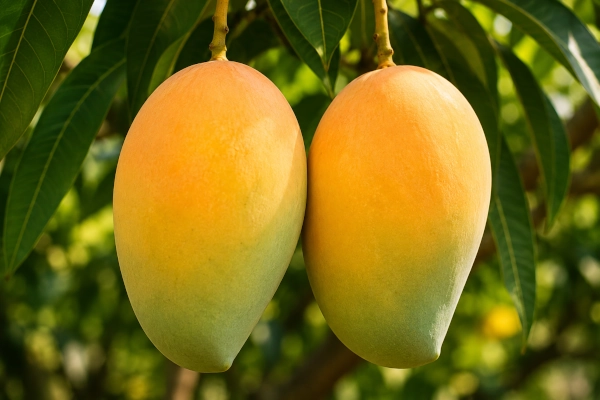
Across the dry, rugged landscape surrounding the Gir hills of Gujarat grows a mango whose identity is revealed the moment it is cut open. Beneath its greenish-yellow skin lies intensely coloured pulp ranging from deep yellow to saffron-orange, accompanied by a rich aroma, pronounced sweetness and smooth, almost fibreless texture. This is the Gir Kesar Mango, one of Gujarat’s most celebrated agricultural products and one of India’s most recognisable premium mango varieties.
The fruit is closely associated with the Junagadh–Gir region of Saurashtra, particularly the orchards around Talala and the wider landscape adjoining Gir. Its distinctive qualities eventually earned formal recognition through India’s Geographical Indications system. The Gir Kesar Mango received its GI registration certificate on 24 June 2011, making geographical origin an integral part of its protected identity.
A Mango Named After Saffron
The word Kesar means saffron, and the name immediately points to the fruit’s most striking characteristic: the deep saffron-orange colour of its ripe pulp.
This colour distinguishes Gir Kesar from many mango varieties whose flesh remains pale yellow even when fully ripe. APEDA describes Gir Kesar as a mango grown in the Junagadh region with distinctive characteristics that include its saffron-coloured pulp, characteristic aroma, sweetness and flavour.
The District Administration of Gir Somnath describes the fruit as medium-sized and generally roundish, with greenish-yellow skin that can develop a slight blush. Inside, however, the transformation is dramatic. Its flesh is richly coloured, smooth and non-fibrous, with a sweet, full-bodied flavour.
It is this combination—not colour alone—that has built Kesar’s reputation.
The Royal Story Behind Kesar
The history of Gir Kesar is closely connected with the former princely state of Junagadh and the horticultural traditions of Saurashtra during the Nawab era.
Researchers from Junagadh Agricultural University have documented that the variety’s history is associated with Junagadh, Mangrol, Vanthali, Girnar and the Gir region. Their historical account places the development of Kesar within the orchard culture that existed in this region during the first half of the twentieth century.
According to the widely preserved local account, an unusual mango was noticed in the Vanthali area near Junagadh during the period of Junagadh’s princely rulers. Material from promising trees was subsequently propagated, and grafts were planted in experimental orchards near Junagadh.
The variety eventually attracted the attention of the Junagadh court.
Its most memorable characteristic was the extraordinary colour of its flesh. Tradition associates the naming of the mango with Nawab Mahabat Khan III of Junagadh, who is said to have compared its intense orange-yellow pulp to saffron.
From that point, the name Kesar became permanently associated with the variety.
Although details of the early story survive through horticultural and regional accounts rather than one single contemporary historical document, Junagadh Agricultural University researchers confirm the mango’s strong historical association with the rulers of Junagadh and Mangrol and with the Girnar region.
From a Local Mango to Gir Kesar
Kesar mango trees can today be found outside the original Gir region. However, Gir Kesar represents something more specific than simply the Kesar cultivar.
The GI recognises the relationship between the fruit and the geography in which its reputation developed.
The traditional production zone lies in the Saurashtra region around Junagadh, Gir Somnath and adjoining areas influenced by the Gir landscape. Talala has become particularly synonymous with the crop and is today one of its best-known trading centres.
Gir Somnath district officially describes Talala and the surrounding Gir region as the heartland of Kesar cultivation. During the harvesting season, the local mango economy becomes one of the defining features of the district.
This is important because a GI does not merely identify a botanical variety. It recognises a product whose reputation or distinctive qualities are connected with a geographical origin.
Thus, a Kesar mango tree growing elsewhere may remain botanically Kesar, but Gir Kesar carries the added significance of geographical provenance.
The Gir Landscape Behind the Fruit
The character of Gir Kesar cannot be understood without looking at the landscape surrounding its orchards.
Saurashtra experiences long periods of warmth, a pronounced dry season and monsoon rainfall concentrated during part of the year. Mango flowering benefits from relatively dry conditions, while the subsequent development of the fruit depends on careful management of moisture, temperature and orchard nutrition.
Around Gir, orchards occupy an undulating terrain influenced by the Gir hills and the wider coastal climate of western Gujarat.
The Gir Somnath district administration attributes Gir Kesar’s distinctive development to the region’s characteristic soils, climate and influence of moist air moving inland from the Arabian Sea.
The dry period is particularly important for flowering. Excessive rain or humidity at the wrong stage can affect blossoms, pollination and fruit set. Conversely, extreme heat or water stress can reduce fruit development.
This seasonal balance is one reason mangoes remain highly sensitive to their places of cultivation.
What Makes Gir Kesar Different?
A mature Gir Kesar mango normally has an oblong to oval form with a relatively small beak at its lower end.
Research by scientists of Junagadh Agricultural University describes typical fruit weights of roughly 250–300 grams, although individual fruits naturally vary according to tree age, crop load and growing conditions. The skin develops from deep green towards yellow as the fruit matures and may show a pinkish blush around the shoulder.
The real signature appears inside.
Researchers have recorded approximately 69 per cent pulp, with fibreless saffron-coloured flesh surrounding a relatively flat stone. The fruit typically develops total soluble solids in the region of 18–22° Brix, giving it a rich sweetness while retaining enough acidity to prevent the flavour from becoming flat.
This sugar-acid balance is one of Kesar’s greatest strengths.
The aroma is intense without being identical to Alphonso. Kesar tends towards a rich, sweet fragrance paired with deeply coloured flesh and a smooth mouthfeel.
For this reason it performs equally well as a table mango and as a processing variety.
A Short Summer Season
Part of the appeal of Gir Kesar is its relatively limited season.
The harvest generally begins during April, strengthens through May and can continue into early June depending on location and weather. Gir Somnath district identifies mid-April to early June as the normal Kesar season, with the strongest harvest generally occurring during May.
That short window creates intense seasonal activity across the region.
Orchards are inspected for maturity, fruit is harvested carefully to minimise damage, mangoes are graded according to size and appearance, and boxes begin moving towards wholesale markets throughout Gujarat and beyond.
At the centre of this activity is Talala.
Talala — The Trading Heart of Gir Kesar
Talala in Gir Somnath has become virtually synonymous with Gir Kesar.
During mango season, large quantities of fruit from surrounding orchards arrive at the local Agricultural Produce Market Committee market. Farmers, traders, commission agents, packers and transporters converge on the market as the harvest reaches its peak.
The Gir Somnath administration identifies the Talala APMC as one of the important mango-trading hubs in the region and notes the significance of the crop to thousands of local farmers.
The economic importance therefore extends well beyond orchard owners.
Seasonal employment is generated through harvesting, sorting, packing, transport, wholesale trade, retail distribution and processing. Nurseries produce grafted planting material, while pack houses and exporters form another layer of the value chain.
A successful Kesar season consequently affects a much larger rural economy.
Why Grafting Matters
As with most premium mango cultivars, Gir Kesar is propagated through vegetative methods such as grafting rather than relying on seeds to reproduce the variety.
A mango grown from seed may not reproduce all the desirable characteristics of the parent tree. Grafting allows growers to take scion material from a proven Kesar tree and join it with a suitable rootstock.
This method allows the essential characteristics of the selected cultivar to be preserved from generation to generation.
The technique also illustrates an important truth about India’s famous fruit varieties. They are not simply natural accidents. They survive because generations of cultivators recognise superior trees, preserve their planting material and transmit horticultural knowledge across time.
The Kesar grown today therefore represents both biological inheritance and human selection.
The GI Journey
The effort to protect the geographical identity of the mango brought together agricultural institutions and the Gujarat government.
Junagadh Agricultural University states that its Department of Horticulture participated in the process of obtaining GI recognition for the Kesar mango under the name Gir Kesar Mango. The application was supported by historical records and documentation relating to the variety and its connection with the region.
The current Intellectual Property India record gives the following details:
Geographical Indication: Gir Kesar Mango
GI Application Number: 185
Category: Agricultural
Class: 31
State: Gujarat
Applicant/Registered Proprietor: Gujarat Agro Industries Corporation Limited
GI Journal: No. 38
Journal Availability Date: 14 February 2011
Certificate Number: 152
Certificate Date: 24 June 2011
Current Registration Valid Until: 16 August 2029
The registration was an important milestone for Gujarat agriculture. Research from Junagadh Agricultural University identifies Gir Kesar as the first fruit crop from Gujarat to obtain a GI registration.
GI Protection Is About Origin, Not Merely a Name
The economic significance of the GI becomes clearer when premium mangoes reach the market.
A consumer buying Gir Kesar is not paying merely for a yellow mango. The buyer is paying for a combination of cultivar, geographical origin and accumulated reputation.
As demand grows, however, names associated with prestigious agricultural products can easily be used loosely. Fruit grown outside the recognised region may be presented using geographical descriptions that imply a different provenance.
For farmers in the genuine production region, such misuse can gradually dilute the premium they have spent generations creating.
The GI system gives producers a legal mechanism for protecting geographical identity and gives consumers a basis for demanding greater traceability.
Over time, authorised-user registration, farm identification, better packaging and digital traceability can strengthen this protection further.
Kesar Versus Alphonso
Comparisons between Gir Kesar and Maharashtra’s Alphonso are almost unavoidable because both occupy the premium end of India’s mango market.
Yet they are not competing versions of the same fruit.
Alphonso is known for its intense perfume, creamy texture and distinctive combination of sweetness and acidity. Gir Kesar has its own identity, distinguished especially by its deep saffron-coloured pulp, sweetness and rich aroma.
Even their landscapes are different.
Alphonso is inseparable from the humid Konkan coast and its lateritic terrain, while Gir Kesar developed within the warmer and generally drier Saurashtra landscape around the Gir region.
Their differences illustrate exactly why India’s mango diversity is so valuable.
India does not possess one superior mango. It possesses hundreds of mango traditions shaped by different soils, climates and communities.
A Mango Made for Aamras
In Gujarat, Kesar has an especially strong association with aamras.
The mango’s deep colour, smooth flesh and intense sweetness produce an exceptionally rich pulp. Ripe fruit can be pressed and strained into aamras with comparatively little fibrous material, producing the thick golden-orange preparation served throughout western India during summer.
Kesar also performs well in milkshakes, shrikhand, lassi, ice cream, desserts, preserves and commercial mango pulp.
This processing value is important because mangoes are highly seasonal. Converting fruit into pulp allows some of the harvest to remain economically useful long after the fresh-fruit season has ended.
APEDA specifically lists Kesar Mango Pulp among India’s commercially processed mango-pulp varieties. India exported more than 62,800 tonnes of mango pulp worth about US$68.39 million during 2025–26, although those figures include all exported mango-pulp varieties rather than Kesar alone.
Gir Kesar in India’s Export Economy
Fresh Kesar mangoes also form part of India’s growing premium fruit-export ecosystem.
Indian mango exporters now operate with specialised pack houses, traceability systems and phytosanitary treatments designed around the requirements of different destination countries.
APEDA states that India exported 31,819.46 tonnes of fresh mangoes worth approximately US$53.99 million during 2025–26. The principal destinations included the United Arab Emirates, United Kingdom, United States, Kuwait and Canada. These are overall mango-export figures and are not exclusive to Gir Kesar, but premium varieties such as Kesar form an important part of India’s high-value mango offering.
For Gujarat growers, better cold chains, controlled ripening, improved packaging and reliable traceability could allow an even greater share of Gir Kesar to reach premium international markets.
Climate Is Becoming the Greatest Uncertainty
Despite its reputation, Gir Kesar remains highly dependent on weather.
Mango flowering can be disrupted by unusually warm winters, sudden changes in temperature, excessive humidity or unexpected rainfall. Poor flowering inevitably reduces fruit set several months later.
Strong winds and storms can cause immature mangoes to fall. Excessive heat can affect fruit development. Prolonged moisture can encourage fungal diseases.
These risks have become increasingly important for orchard farmers because a mango tree represents a long-term investment. Unlike a seasonal crop that can simply be replanted the following year, a mature orchard may embody decades of accumulated work.
Climate adaptation will therefore become increasingly important for protecting the Gir Kesar economy.
Improved irrigation efficiency, soil-moisture conservation, pest and disease forecasting, scientific pruning, orchard rejuvenation, wind protection and better weather information can all help growers reduce risk.
Researching the Mango for the Future
Junagadh Agricultural University has played an important role in scientific horticulture across the Saurashtra region.
Its fruit-science programmes work on mango production, planting methods, high-density planting, plant-growth regulation, integrated nutrient management, pest management, disease management, post-harvest technology and value addition. The university has also formally endorsed Kesar as an important mango variety for the region.
This scientific support is vital because protecting a GI product does not mean freezing agriculture in the past.
Traditional identity can coexist with improved cultivation.
The objective should be to increase productivity and resilience without losing the sensory characteristics and genetic material that made Gir Kesar distinctive in the first place.
Preserving the Original Kesar
The success of famous mangoes carries an unexpected danger.
Once a variety becomes commercially valuable, nurseries begin selling large numbers of grafts. If planting material is poorly identified or derived from inferior mother trees, gradual variation in orchard quality can follow.
Maintaining authenticated mother plants and good nursery standards is therefore fundamental.
The integrity of Gir Kesar ultimately begins long before a mango reaches the market. It begins with the scion selected for propagation.
The GI system, agricultural universities, nurseries and growers therefore share a common responsibility: ensuring that the Kesar planted decades from now still possesses the qualities that created the reputation of today’s fruit.
Gir, Lions and Mango Orchards
There is also something unusual about the geographical setting of this mango.
The Gir landscape is internationally famous as the last natural stronghold of the Asiatic lion. Yet beyond the forests and wildlife sanctuaries lies a human agricultural landscape of villages, farms and orchards.
Gir Kesar is one of the products that connects those two identities.
The same broader region known around the world for wildlife also produces one of India’s most distinctive mangoes.
This combination gives Gir Kesar an unusually powerful geographical story. It can be marketed not merely as another premium fruit but as agricultural produce associated with one of India’s most recognisable landscapes.
A Fruit That Became the Colour of Its Name
The history of Gir Kesar demonstrates how geographical identity develops.
A distinctive mango emerged in the Junagadh region. Growers recognised its qualities and propagated it through grafting. Orchards expanded. Talala became a major centre of cultivation and trade. The saffron colour of the flesh gave the variety its name, while generations of farmers created the reputation that eventually travelled far beyond Gujarat.
Then, on 24 June 2011, the Geographical Indications Registry formally recognised that accumulated history by issuing Certificate No. 152 for Gir Kesar Mango.
The GI certificate did not create the mango.
It recognised a relationship that had already been built between fruit, farmer and geography.
Today, cutting open a ripe Gir Kesar still reveals the characteristic that inspired its name nearly a century ago: brilliant saffron-orange flesh hidden beneath an understated exterior.
That colour is more than an attractive feature.
It has become the signature of Gujarat’s Gir landscape—and one of the most distinctive identities in India’s extraordinary world of mangoes.
You may also like
-
India Ranks Third Globally in Contracted Clean Hydrogen Volumes, Secures 3 Lakh Tonnes Annually
-
Government Finalises Airfare Pricing Rules to Protect Passengers from Excessive Ticket Charges
-
India’s Inland Waterway Cargo Movement Reaches 218 Million Tonnes, Surpasses 2030 Target Four Years Early
-
SberIndia Partners with Space 1 to Develop Russian-Indian Cooperation Center in New Delhi
-
GRSE Signs ₹1,032 Crore Contract with ONGC to Build Four Hybrid Platform Supply Vessels
