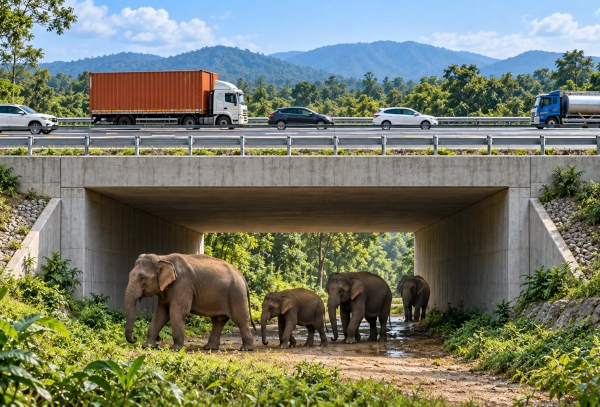
India is incorporating dedicated wildlife crossings into a major strategic highway expansion in North Bengal, with five elephant underpasses planned as part of the ₹2,077.18-crore four-laning of NH-327 through the Siliguri Corridor region.
The project will upgrade 31.02 kilometres of the Bagdogra–Panitanki–Kharibari–Galgalia section of National Highway 327, improving one of the important road links connecting northern West Bengal with Bihar and routes leading toward Northeast India. Union Road Transport and Highways Minister Nitin Gadkari announced the approval on September 3, 2026.
Along with four-laning, the project includes three major bridges, one Road Over Bridge, service roads on both sides and five elephant underpasses. Gadkari said the design is intended to improve connectivity while providing safer movement for both people and wildlife.
The wildlife component is particularly significant because the highway passes through areas used by elephants moving across the North Bengal landscape. The five crossings are planned at Sannyasithan, Atal, Panitanki and two locations around Deomani, where the road intersects elephant habitat.
These are not simply generic culverts added to the road plan. The underpasses have been proposed specifically as mitigation structures to maintain wildlife movement and reduce the danger created when elephants attempt to cross a high-speed, multi-lane highway. Local forest officials say the proposed locations were inspected by the Chief Conservator of Forests, Wildlife, North.
The environmental safeguards became particularly important because construction of the expanded highway will require the diversion of some forest land. The Forest Department raised concerns during the environmental-clearance process, after which the wildlife crossings were incorporated into the project design.
For elephants, maintaining movement between fragmented habitats is essential. Herds can travel considerable distances in search of food, water and seasonal habitat, often following routes used across generations. When major roads cut through those routes without safe crossings, the result can be collisions, disrupted movement and increased encounters between elephants and nearby settlements.
The NH-327 project therefore illustrates an increasingly important challenge for Indian infrastructure: how to expand strategic transport corridors without severing the ecological corridors running through the same landscape.
The road itself has considerable national importance. The wider Siliguri Corridor, often described as India’s narrow land connection with the Northeast, carries civilian freight, passenger traffic and strategic logistics. The upgraded NH-327 will improve connections toward the Northeast while also strengthening access to Nepal, Bhutan and Bangladesh.
The project is also expected to ease congestion around Bagdogra, Naxalbari, Kharibari and Panitanki, improve access to Bagdogra Airport and speed up transportation of tea, agricultural and horticultural produce to larger markets.
This makes the highway unusual because two very different forms of connectivity are being addressed simultaneously.
For people and freight, four lanes, bridges and service roads are intended to improve movement through one of India’s most strategically sensitive regions.
For elephants, the underpasses are intended to preserve movement beneath the highway rather than across it.
The effectiveness of the structures will ultimately depend on more than their number. Their dimensions, placement along established movement routes, surrounding vegetation, drainage, human disturbance and the ability to guide elephants toward the entrances will influence how readily animals use them once the highway becomes operational.
India has increasingly incorporated such wildlife engineering into road projects passing through sensitive landscapes. The NHAI’s projects elsewhere have combined large wildlife underpasses with measures such as guide vegetation, sound barriers, anti-glare screens, warning signs and speed-control measures to preserve habitat connectivity.
The Siliguri project is especially noteworthy because wildlife protection is being designed into infrastructure serving an area with exceptional strategic and economic importance.
Rather than treating elephant movement as a problem to be addressed only after the road is widened, the proposed crossings place it inside the highway’s engineering plan from the beginning.
The ₹2,077-crore NH-327 project will therefore carry more than vehicles through the Siliguri region. Its design attempts to preserve two critical corridors at once — a strategic transport corridor above ground and an ecological corridor for elephants underneath it.
You may also like
-
India’s Inland Waterway Cargo Movement Reaches 218 Million Tonnes, Surpasses 2030 Target Four Years Early
-
SberIndia Partners with Space 1 to Develop Russian-Indian Cooperation Center in New Delhi
-
Premier Energies and Germany’s RCT Group Establish Joint Venture for 12 GWh Battery Storage Manufacturing Facility
-
Bharat Small Reactors Take Centre Stage at ICC India Energy Summit as India Advances 100 GW Nuclear Power Mission
-
Mormugao Port Becomes India’s First Major Port to Secure Private 5G Network Authorisation
