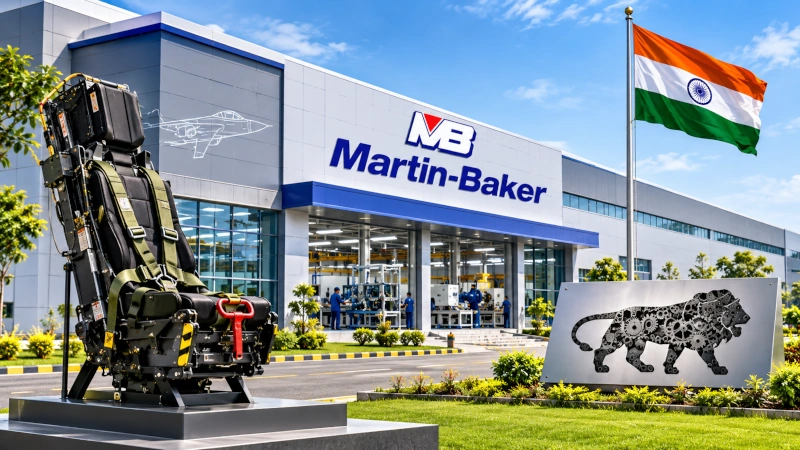
British aerospace and defence manufacturer Martin-Baker has proposed an investment of ₹380 crore to establish an aircraft ejection seat manufacturing facility in Karnataka, marking an important development in India’s expanding aerospace manufacturing ecosystem. The proposed facility, to be located in the Harohalli Industrial Area, is expected to generate more than 500 highly skilled employment opportunities while strengthening domestic production, maintenance and supply chain capabilities for critical military aviation safety systems.
Karnataka Minister for Large and Medium Industries M. B. Patil announced the investment proposal on November 4 following discussions with senior representatives of the company. Martin-Baker has requested 10 acres of land in the fifth phase of the Harohalli Industrial Area to establish its manufacturing operations. The state government has indicated that it will facilitate the land allotment process, supporting the company’s plans to expand its industrial presence in India.
Manufacturing Critical Aircraft Safety Systems in India
Martin-Baker is internationally recognised for developing and manufacturing ejection seats and aircrew escape systems used in military aircraft. These specialised systems provide pilots with an emergency escape capability when an aircraft becomes uncontrollable or experiences a critical failure during flight. Their development requires advanced engineering expertise, precision manufacturing and rigorous testing to ensure reliable performance under demanding operational conditions.
An aircraft ejection seat is a sophisticated safety system incorporating multiple mechanical, structural and electronic components. Depending on its design, the system may include propulsion mechanisms, seat stabilisation equipment, parachute deployment arrangements and automatic sequencing technologies that enable the pilot to separate safely from an aircraft during an emergency.
The proposed Karnataka facility would introduce additional domestic manufacturing capacity for this specialised category of aerospace equipment. Establishing production infrastructure in India can support closer coordination with aircraft manufacturers, military operators and maintenance organisations while creating opportunities for Indian engineering companies to participate in the associated supply chain.
The investment would also contribute to the localisation of advanced aerospace manufacturing activities that require high standards of quality assurance, materials engineering and component reliability. These capabilities are important not only for ejection seat production but also for developing a broader industrial ecosystem supporting complex military aviation systems.
More Than 900 Martin-Baker Ejection Seats Already Serve Indian Armed Forces
According to Karnataka Industries Minister M. B. Patil, more than 900 ejection seats manufactured by Martin-Baker are currently in service across aircraft operated by the Indian Air Force and the Indian Naval Air Arm. The figure highlights the company’s established relationship with India’s military aviation sector and the importance of its equipment to operational flight safety.
Ejection seats are among the most critical safety components of military aircraft because they provide pilots with a means of survival during emergencies when conventional landing or recovery is no longer possible. Their reliable operation requires careful integration with the aircraft, regular inspections, maintenance and adherence to prescribed safety procedures throughout their service life.
The substantial installed base of Martin-Baker systems in Indian military aircraft creates a continuing requirement for technical support, replacement components, maintenance services and periodic equipment upgrades. Developing manufacturing and associated support capabilities within India could improve access to specialised components and strengthen the domestic infrastructure available for maintaining these systems.
The proposed investment is therefore relevant to both new aircraft production and the long-term support requirements of existing military aviation fleets. It offers opportunities to expand industrial capabilities around an established category of defence equipment already used extensively by India’s armed forces.
Strengthening Domestic Aerospace Manufacturing and MRO Capabilities
The Karnataka government expects Martin-Baker’s proposed investment to strengthen domestic aerospace manufacturing while supporting maintenance, repair and overhaul (MRO) activities. These capabilities are particularly important for military aviation systems because specialised equipment must remain reliable throughout extended operational service periods.
Domestic manufacturing and technical support infrastructure can reduce dependence on overseas facilities for certain production and maintenance requirements. It can also improve coordination among equipment manufacturers, aircraft operators and engineering organisations responsible for maintaining complex aviation systems.
The proposed facility could create opportunities for Indian suppliers involved in precision machining, specialised materials, electronic components, mechanical assemblies and aerospace engineering services. The development of such supply chains contributes to the broader objective of expanding India’s participation in high-value defence manufacturing.
Localisation of aerospace manufacturing also supports the development of technical expertise in quality control, certification processes, production engineering and equipment maintenance. These specialised skills are valuable across the wider aviation industry, particularly as India continues to expand its domestic military aircraft manufacturing and support capabilities.
The exact manufacturing scope, production capacity and proposed MRO arrangements for the Harohalli facility have not yet been disclosed. However, the investment proposal establishes a framework for expanding the company’s industrial activities in India and developing closer integration with the domestic aerospace sector.
Creating More Than 500 Skilled Employment Opportunities
The proposed manufacturing facility is expected to generate more than 500 highly skilled jobs, according to the Karnataka government. The employment opportunities would be associated with specialised aerospace manufacturing and related technical activities, supporting the development of a workforce trained in advanced engineering and precision production.
Manufacturing aircraft ejection seats requires expertise across mechanical engineering, materials technology, manufacturing processes, electronics, testing and quality assurance. The establishment of a dedicated production facility would create demand for personnel with these specialised capabilities while providing opportunities for technical training and professional development.
The investment could also support indirect employment through domestic suppliers, engineering contractors, logistics providers and industrial service organisations. As specialised aerospace manufacturers establish operations within India, their requirements for components, services and technical support can encourage the development of additional local industrial capabilities.
Karnataka’s established engineering and aerospace education ecosystem provides access to a skilled workforce capable of supporting such activities. The proposed investment would contribute to the state’s efforts to attract advanced manufacturing projects that generate high-value employment and strengthen the capabilities of its industrial workforce.
Harohalli Emerges as an Aerospace Manufacturing Location
Martin-Baker has identified the fifth phase of the Harohalli Industrial Area as the proposed location for its manufacturing facility. The industrial area forms part of Karnataka’s expanding manufacturing infrastructure and provides access to the wider Bengaluru industrial region.
Bengaluru is already a major centre for India’s aerospace and defence industries, hosting organisations involved in aircraft manufacturing, aerospace research, defence electronics, propulsion systems and specialised engineering. The presence of established industrial infrastructure and technical expertise makes the region attractive to international aerospace companies seeking to establish manufacturing operations in India.
The proposed Martin-Baker facility would complement these existing capabilities by introducing specialised production infrastructure for military aircraft escape systems. Such investments contribute to the development of industrial clusters in which manufacturers, suppliers and engineering service providers can operate within a connected ecosystem.
The project also reflects Karnataka’s continuing efforts to attract investments in aerospace, defence manufacturing and advanced technologies. The state government’s discussions with Martin-Baker representatives form part of a broader approach to facilitating industrial development and expanding opportunities for domestic and international companies.
Senior company representatives, including Chief Financial Officer Robert Morgan and Programme Manager Tom Dutton, participated in the discussions with the Karnataka government. Officials from the Karnataka Industrial Areas Development Board and Karnataka Udyog Mitra were also involved, reflecting the institutional coordination supporting the proposed project.
Supporting India’s Defence Manufacturing and Self-Reliance Objectives
The proposed investment is significant for India’s wider efforts to strengthen domestic defence manufacturing and reduce dependence on overseas production facilities. Although Martin-Baker is a British company, establishing manufacturing operations in India can contribute to the localisation of specialised aerospace equipment and the development of domestic industrial capabilities.
India’s Atmanirbhar Bharat initiative places emphasis on expanding indigenous manufacturing, developing domestic supply chains and strengthening technological capabilities in strategically important sectors. Foreign aerospace manufacturers establishing production facilities in India can contribute to these objectives through local employment, supplier development, manufacturing expertise and potential technology partnerships.
The proposed Martin-Baker facility is particularly relevant because aircraft ejection seats represent a specialised category of defence equipment requiring advanced engineering capabilities and stringent manufacturing standards. Developing production expertise in such systems can strengthen the broader aerospace industry and provide opportunities for Indian companies to participate in high-precision manufacturing activities.
The investment also reflects the growing importance of India as a manufacturing location for international defence and aerospace companies. With expanding military aviation requirements and an established aerospace industrial base, the country offers opportunities for manufacturers seeking closer engagement with Indian defence programmes and domestic supply networks.
Expanding India-UK Aerospace Industrial Cooperation
Martin-Baker’s proposed manufacturing investment also adds an industrial dimension to defence and aerospace cooperation between India and the United Kingdom. The two countries maintain established commercial and technological relationships in sectors involving aerospace equipment, engineering services and defence manufacturing.
The proposed facility would represent an opportunity to deepen industrial engagement through manufacturing activities located in India. Such investments can support cooperation between international technology providers and Indian engineering organisations while encouraging the development of specialised production capabilities within the domestic market.
For India’s aerospace industry, the presence of international manufacturers can provide opportunities to participate in global supply chains and develop expertise in specialised equipment production. Manufacturing partnerships can also create demand for high-quality components and services from Indian suppliers, supporting the growth of domestic industrial capabilities.
The proposed project highlights the potential for international investment to complement India’s efforts to build a stronger and more diversified aerospace manufacturing sector. By combining established international technological expertise with domestic production infrastructure, such initiatives can contribute to long-term industrial development and greater manufacturing self-reliance.
Advancing India’s Military Aviation Manufacturing Ecosystem
Martin-Baker’s proposed ₹380 crore investment represents an important addition to Karnataka’s aerospace and defence manufacturing pipeline. The planned facility at Harohalli would establish a domestic production base for specialised aircraft ejection seat systems while creating more than 500 skilled employment opportunities and supporting the development of associated engineering and maintenance capabilities.
The announcement is particularly relevant because Martin-Baker equipment is already used extensively by the Indian Air Force and Indian Naval Air Arm. Expanding manufacturing activities within India could strengthen the industrial support ecosystem for these critical aviation safety systems while creating opportunities for domestic suppliers and technical professionals.
The project is presently at the investment proposal and land allocation stage, with construction schedules. Nevertheless, the proposed facility reflects the continuing expansion of India’s aerospace industrial ecosystem and the growing interest of international defence manufacturers in establishing specialised production capabilities within the country.
By attracting investment in advanced aircraft safety equipment, Karnataka is strengthening its position as a centre for aerospace manufacturing and engineering expertise. The Martin-Baker proposal contributes to India’s broader objective of developing a more capable, technologically sophisticated and self-reliant defence manufacturing sector.
You may also like
-
CFF Fluid Control and Germany’s TKMS Partner for Anti-Submarine Warfare Manufacturing
-
Tonbo Imaging Plans High-Power Microwave Manufacturing and Testing Facilities in Karnataka
-
India Approves 12 Electronics Manufacturing Projects Worth ₹7,503 Crore, Launches Semicon 2.0 Portal
-
Indian Navy Receives Indigenous Anti-Submarine Warfare Vessel ‘Amini’ from GRSE with Over 80% Domestic Content
-
India Hosts First BIMSTEC Maritime Security Exercise in Andaman and Nicobar Islands, Strengthening Bay of Bengal Cooperation
