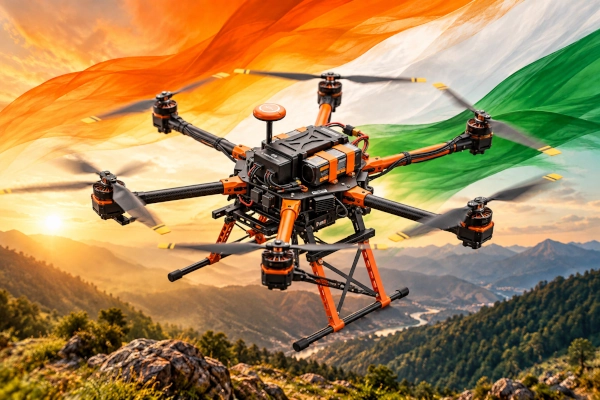
Indian unmanned aerial systems manufacturer EndureAir Systems has announced the successful delivery of its indigenous ALAKH Kamikaze UAV, marking another development in India’s expanding defence drone manufacturing sector.
The company announced the delivery on October 16, 2026, highlighting the platform’s precision-strike capabilities, electronic warfare resilience and ability to conduct coordinated multi-drone operations.
Developed as a compact, backpack-deployable loitering munition, the ALAKH Kamikaze combines First-Person View (FPV) surveillance, electro-optical and infrared imaging, encrypted communications and operator-controlled target engagement.
According to EndureAir’s official product specifications, the drone offers an operational range of up to 10 kilometres, flight endurance of 30 minutes and a payload capacity of one kilogram.
The successful delivery represents progress in EndureAir’s efforts to develop indigenous unmanned systems designed for India’s evolving defence requirements.
ALAKH Kamikaze Combines Surveillance and Precision-Strike Capabilities
EndureAir developed the ALAKH Kamikaze as a lightweight tactical unmanned aircraft designed to combine aerial reconnaissance with precision engagement capabilities.
The platform follows a Search, Detect and Destroy operational concept, allowing operators to survey an area, identify designated targets and authorise engagement using live aerial imagery.
Unlike conventional reconnaissance drones that primarily collect information and return to their operating bases, loitering munitions combine surveillance capabilities with an onboard payload intended for terminal engagement.
The ALAKH Kamikaze uses FPV technology to transmit live images from the aircraft to its operator. This provides continuous visual information during surveillance and target assessment.
The company has incorporated electro-optical and infrared imaging capabilities to support operations during daylight and low-light conditions.
EndureAir identifies tactical surveillance, loitering munition missions and precision payload delivery among the platform’s intended applications. The manufacturer has also designed the aircraft for operations in environments where electronic interference can affect conventional unmanned systems.
Indigenous Drone Offers 10-Kilometre Range and 30-Minute Endurance
The ALAKH Kamikaze has been developed around a compact airframe intended for rapid deployment in demanding operational environments.
According to the manufacturer’s published specifications, the drone has an operational range of up to 10 kilometres and can remain airborne for approximately 30 minutes.
Its stated operational speed reaches 100 kilometres per hour, while the maximum payload capacity is one kilogram. The aircraft has an all-up weight of up to four kilograms, making it suitable for transportation by personnel operating in the field.
The platform incorporates vertical take-off and landing capabilities, allowing it to operate without requiring a conventional runway or extensive launch infrastructure.
EndureAir states that the drone can be launched at altitudes of up to 5,000 metres above mean sea level and can operate in temperatures ranging from minus 20°C to 55°C.
These specifications reflect the company’s emphasis on developing unmanned systems suitable for varied terrain and environmental conditions.
The backpack-deployable configuration also supports tactical mobility by reducing the infrastructure required to transport and launch the aircraft.
Swarm Capability Supports Coordinated Multi-Drone Operations
One of the distinguishing features of the ALAKH Kamikaze is its ability to support coordinated operations involving multiple unmanned aircraft.
EndureAir states that the platform incorporates swarm capabilities, enabling several drones to operate through a common control system.
According to the company’s published technical information, a single transmitter can control up to five UAVs.
This capability allows operators to manage multiple aircraft from one control arrangement, supporting wider surveillance coverage and greater flexibility during tactical operations.
Coordinated multi-drone systems are becoming increasingly important in modern defence technology because they allow several unmanned platforms to undertake complementary tasks within the same operational environment.
Such systems can also distribute surveillance activities across multiple aircraft while maintaining coordination through a central control arrangement.
EndureAir’s integration of multi-UAV functionality into a compact tactical drone reflects the growing sophistication of indigenous unmanned aerial technologies.
Electronic Warfare Resilience Strengthens Communication Security
The ALAKH Kamikaze incorporates communication technologies intended to support operations in electronically contested environments.
Modern unmanned aircraft can encounter interference from electronic warfare systems that disrupt radio communication, interfere with navigation signals or attempt to manipulate telemetry.
EndureAir has designed the platform with frequency-hopping communication technology, telemetry-spoofing resilience and encrypted command-and-control links.
The company specifies the use of AES-256 encryption to strengthen communication security between the aircraft and its control system.
Frequency-hopping technology allows a communication system to change operating frequencies, improving its ability to maintain communication under certain interference conditions.
The platform’s electronic warfare resilience is intended to support operations in environments where conventional navigation and communication systems may experience disruptions.
EndureAir also highlights the drone’s suitability for GPS-denied operational conditions, reflecting the importance of maintaining unmanned aircraft functionality when satellite-navigation signals are unavailable or unreliable.
These capabilities form an important part of the company’s approach to developing indigenous tactical UAV systems for challenging environments.
Operator Retains Control Over Target Engagement
EndureAir has emphasised the role of the human operator in the ALAKH Kamikaze’s target engagement process.
The platform uses live FPV imagery to support surveillance and target identification before an engagement decision is made.
According to the company, the aircraft maintains an operator-confirmed targeting approach, with the decision to initiate engagement remaining under human control.
This arrangement allows the operator to assess the mission area using the aircraft’s onboard imaging systems before authorising terminal engagement.
The company has developed the platform to support controlled engagement against designated targets while maintaining visual oversight throughout the mission.
The combination of surveillance, target assessment and operator-controlled engagement reflects the increasing integration of multiple operational functions within compact unmanned aircraft systems.
EndureAir Strengthens Indigenous Drone Manufacturing Capabilities
EndureAir Systems is an Indian unmanned aerial technology company headquartered in Noida, Uttar Pradesh.
Incubated at the Indian Institute of Technology Kanpur in 2018, the company develops indigenous UAV platforms for defence, logistics, surveillance and specialised civilian applications.
Its technological capabilities include airframe design, propulsion systems, autonomous flight technologies, communication systems and mission-specific equipment integration.
The company has established manufacturing infrastructure in Noida and developed an expanding portfolio of unmanned platforms.
Its product range includes the SABAL family of heavy-lift logistics drones, the ALAKH micro-surveillance UAV and the ALAKH Kamikaze precision-strike platform.
The SABAL series focuses on transporting equipment and supplies across difficult terrain, including remote and high-altitude locations.
The ALAKH surveillance platform has been developed for reconnaissance and operations in confined environments, while the Kamikaze variant addresses tactical loitering munition requirements.
EndureAir states that it undertakes several important engineering and manufacturing activities internally, including the development of propulsion technologies, flight-control systems and carbon-composite airframes.
The company has also highlighted its AS9100 aerospace quality certification and expanding manufacturing capabilities.
These activities contribute to the development of India’s private-sector aerospace and defence manufacturing ecosystem.
Indigenous Loitering Munitions Support India’s Defence Modernisation
Loitering munitions have emerged as an important category of unmanned military technology because they combine reconnaissance, surveillance and precision-engagement capabilities.
Their relatively compact dimensions allow tactical units to deploy unmanned platforms without the extensive infrastructure required by larger aircraft.
Advances in electro-optical sensors, battery technology, miniaturised electronics and secure communication systems have enabled manufacturers to develop increasingly capable lightweight platforms.
Indian companies are expanding their participation in this sector through indigenous product development, manufacturing and technological integration.
The ALAKH Kamikaze programme demonstrates how domestic manufacturers are incorporating electronic warfare resilience, secure communications and coordinated multi-drone capabilities into compact unmanned systems.
The development also supports India’s broader efforts to strengthen domestic expertise in defence electronics, aerospace engineering and autonomous technologies.
Through continued investment in indigenous research and manufacturing, Indian companies are developing capabilities relevant to the changing technological requirements of the armed forces.
EndureAir’s ALAKH Delivery Advances India’s Defence Drone Ecosystem
EndureAir’s announcement of the successful delivery of the ALAKH Kamikaze represents another milestone in the company’s indigenous unmanned aerial systems programme.
The drone combines a compact, backpack-deployable airframe with FPV surveillance, day-and-night imaging, encrypted communications and electronic warfare resilience.
Its stated 10-kilometre operational range, 30-minute endurance and coordinated multi-drone capabilities reflect the company’s focus on developing flexible tactical platforms.
The delivery announcement also highlights the increasing contribution of Indian private-sector enterprises to specialised defence technologies.
With the ALAKH Kamikaze, EndureAir is strengthening India’s capabilities in indigenous loitering munitions and advanced unmanned aerial systems. The development supports the continued growth of domestic aerospace engineering, defence electronics and precision manufacturing under the Make in India and Aatmanirbhar Bharat initiatives.
References
- EndureAir Systems — Official Corporate Announcement, October 16, 2026. Announcement confirming the successful delivery of the indigenous ALAKH Kamikaze UAV.
https://www.linkedin.com/company/endureair/ - EndureAir Systems — Official Product Specifications. ALAKH Kamikaze: Precision Strike FPV UAV. Technical information covering range, endurance, payload, electronic warfare resilience and swarm operations.
https://www.endureair.com/products/alakh/kamikaze - EndureAir Systems — Official Corporate Website. Company background, indigenous drone development, manufacturing capabilities and product portfolio.
https://www.endureair.com/about - EndureAir Systems — Official Product Applications. Loitering munitions, operator-controlled engagement and multi-UAV operations.
https://www.endureair.com/applications/construction
You may also like
-
India’s ₹1,000 Crore Space Venture Capital Fund to Accelerate Indigenous Space Startups and Advanced Technologies
-
Biocon Secures Global Patent Settlement with Genentech for Pebrilzo Biosimilar, Targets European Launch in 2027
-
Segritech Develops AI-Powered Fruit Grading Machines to Improve Farmers’ Income and Reduce Post-Harvest Losses
-
Bharat Small Reactors Take Centre Stage at ICC India Energy Summit as India Advances 100 GW Nuclear Power Mission
-
OSTO Launches AI-Native Cybersecurity Platform for Indian Startups and SMEs
