
A new study by an international team of researchers has concluded that classical communication has a hard limit: no finite amount of classical messaging can perfectly simulate a quantum communication channel. The finding sharpens the scientific boundary between classical and quantum information, while also strengthening the case for genuinely quantum technologies in future communication networks.
The research was carried out by Sahil Gopalkrishna Naik and Manik Banik of the S. N. Bose National Centre for Basic Sciences, working with Mani Zartab of the Universitat Autònoma de Barcelona and Nicolas Gisin of the University of Geneva. According to the Press Information Bureau, the team examined whether quantum processes can be faithfully reproduced using only classical resources, a question tied closely to the idea of “quantum advantage.”
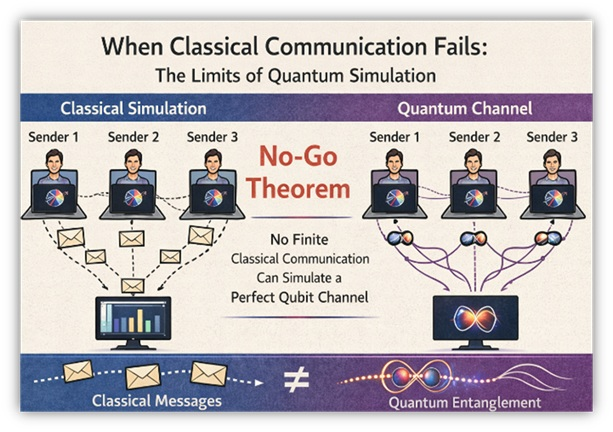
Their work focused on quantum channel simulation in network settings, where multiple distant parties try to reproduce the outcome statistics of quantum measurements at a central location using only classical communication. While earlier work showed that such simulation can succeed in simpler two-party cases, the new study found that the approach breaks down in more complex multi-party configurations.
At the centre of the result is a “no-go theorem”: a perfect qubit channel cannot be simulated with any finite amount of classical communication, even if the protocol allows multiple rounds of two-way messaging. The obstacle comes from entangled measurements, a distinctly quantum feature that cannot be reproduced exactly through classical means alone.
Beyond its technical implications, the study also feeds into deeper debates in quantum mechanics. The findings place stronger limits on interpretations that treat the quantum state as merely a state of knowledge, and instead lend support to the view that quantum states reflect something physically real. The result also reinforces the broader claim that quantum systems possess capabilities that are not just practically useful, but fundamentally beyond classical imitation.
The study was published in Proceedings of the Royal Society A in 2026, according to the PIB release and the journal listing surfaced in search results
Publication Link: https://doi.org/10.1098/rspa.2025.0831
Reference: PIB
You may also like
-
Molecular Geometry Tweak Opens New Way for Smart Biomaterials
-
IISc Scientists Show How Strong Magnetic Fields Could Allow White Dwarfs to Exceed Chandrasekhar Limit
-
IIT Madras to Launch Global Mission to Map 100 Human Brains in 3D
-
3,898 Indian Scientists Feature in 2026 Global Top 2% Research Database; IISc Leads Indian Institutions
-
New Metal-free Porous Material can Help Produce Affordable Clean Energy
