Vidya

News, articles and Essays on ancient Indian Texts

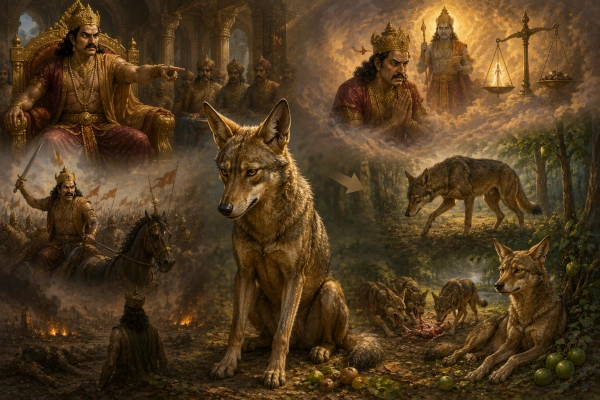
The Jackal Who Remembered a Former Life: The King Who Learned That Conduct Matters More Than Birth

Long ago there was a prosperous city called Purika ruled by a king named Paurika. He possessed wealth, authority and all the outward signs of royal greatness, yet his conduct was harsh and destructive. Instead of protecting those who depended upon him, he frequently harmed living beings and allowed cruelty to shape his rule. Power gave him opportunities to act according to his desires, but it did not give him wisdom or compassion.

The Vulture and the Jackal: When Wisdom and Hope Hid the Motive of Hunger

In the forest country of Naimisha lived a Brahmana who had remained without a child for a long time. The absence of an heir had caused him deep sorrow, and after great difficulty he was finally blessed with a son. The boy became the centre of the household’s affection. To his parents and relatives, he was not simply another member of the family but the child for whom they had waited and prayed, the continuation of their lineage and the source of countless hopes for the future.

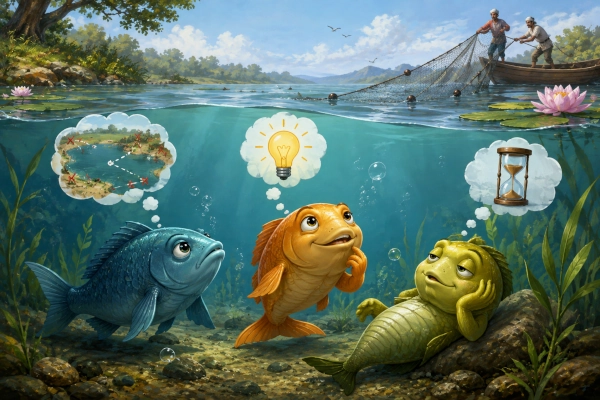
The Three Fishes: The Mahabharata’s Lesson on Foresight, Presence of Mind and Delay

The three fishes lived together in a lake and were close companions, but their temperaments were very different. The first fish was cautious and farsighted. He preferred to recognise danger early and take precautions before circumstances became difficult. The second fish did not always prepare in advance, but he possessed considerable intelligence and believed that he could find a solution whenever a crisis actually appeared. The third fish had neither habit. He constantly delayed decisions and assumed that there would always be enough time to act later.

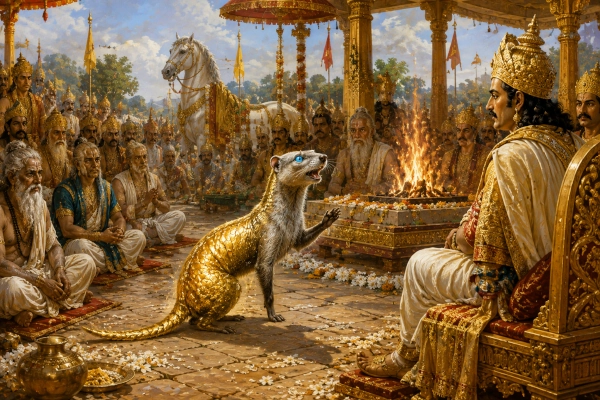
The Golden Mongoose at the Ashvamedha: The Humble Gift That Outweighed Yudhishthira’s Great Sacrifice

A strange mongoose with blue eyes and half its body shining like gold entered the sacrificial ground. To the astonishment of everyone present, the animal spoke in a human voice and declared that Yudhishthira’s magnificent Ashvamedha did not equal the merit of a small quantity of powdered barley once given away by a poor Brahmana family at Kurukshetra.

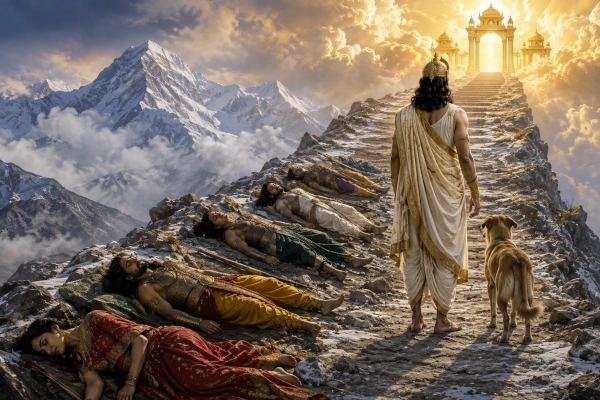
Yudhishthira and the Faithful Dog: The Final Test of Dharma on the Road to Heaven

When Indra arrives in a celestial chariot and offers Yudhishthira entry into heaven, the king faces his final test. Indra refuses to allow the dog to accompany him, but Yudhishthira declares that he will not abandon a creature that has remained loyal to him. At that moment, the dog reveals itself as Dharma, Yudhishthira’s divine father, who had taken animal form to test his compassion, loyalty and commitment to righteousness.

Indian Indology and Sanskrit Programmes Build Growing Academic Presence in Poland

Poland’s interest in Indian civilisation is not a recent development. The country has one of Europe’s longest academic traditions of studying India, with Polish scholars engaging with Sanskrit texts from the nineteenth century. According to the Embassy of India in Warsaw, Sanskrit was being studied at Jagiellonian University in Kraków in 1860–61, while a dedicated Chair of Sanskrit was established there in 1893.