Vidya

News, articles and Essays on ancient Indian Texts

Sanskrit: The Ancient Language That Still Carries India’s Civilisational Genius

The greatness of Sanskrit begins with the Vedic tradition. The Vedas were preserved not merely through writing, but through an astonishing oral discipline where pronunciation, accent, metre and sequence were protected with almost scientific care. This made Sanskrit a language of sound as much as meaning. Every syllable mattered. Every pause mattered. Every tonal movement carried weight. That is why Sanskrit survived political change, regional diversity and long historical disruptions with unusual continuity.

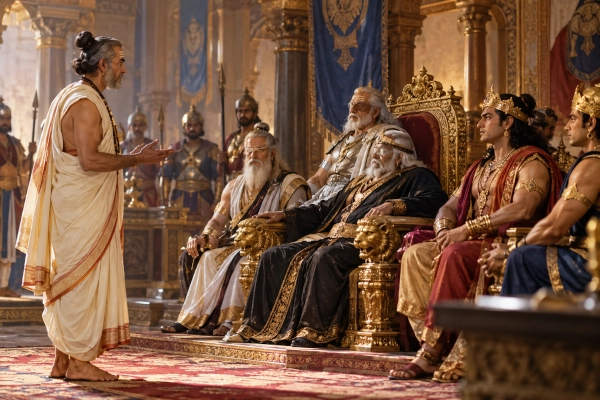
Before Nash: How Kautilya’s Arthashastra Anticipated the Logic of Game Theory

That is why the modern comparison between Kautilya and Nash is so fascinating. John Nash’s contribution to game theory was mathematical and formal. A Nash equilibrium describes a situation where no player can improve their outcome by changing strategy alone, assuming the other players keep their strategies unchanged. Stanford’s philosophy entry explains Nash equilibrium as a set of strategies where each player has no incentive to change given what the others are doing.

CBSE’s Three-Language Rule for Classes 9 and 10 Marks a Major Shift in Secondary Education

Under the new arrangement, students will study three languages, and at least two of them must be native Indian languages. Students who wish to take a foreign language may do so as the third language only if the other two are Indian languages, or they may take it as an additional fourth language. This means the policy does not shut the door on foreign languages, but it clearly gives priority to Indian languages within the core curriculum.

Wayanad’s Tribal Women Step Into Ayur Care Careers Through CSR-Backed Training

Wayanad has one of Kerala’s most significant tribal populations, and many families in the district continue to face challenges related to income security, access to higher education, professional exposure and social mobility. For young tribal women, the barriers are often even more layered. Distance from urban job markets, limited networks, family responsibilities and lack of confidence in formal workplaces can make employment difficult even when talent and willingness are present. A training initiative that helps them move into a structured profession therefore carries importance far beyond the classroom.

Jaishankar Opens UN Exhibition Showcasing India’s 2,000-Year Mathematical Legacy

The exhibition also underlines a broader historical point: mathematics may be universal, but many of its key tools were shaped by Indian intellectual traditions before travelling through West Asia and into Europe. Indian decimal place-value numerals are recognised as ancestors of the modern decimal number system, while Brahmagupta’s work laid foundations in arithmetic and algebra.

Jaishankar Hands Over Made-in-India Laptops to Trinidad and Tobago Schoolchildren

The ceremony was held during Jaishankar’s official visit to Trinidad and Tobago from May 8 to 9, 2026. According to the Ministry of External Affairs, the first set of 2,000 laptops was handed over to selected schoolchildren in the presence of Prime Minister Persad-Bissessar. The initiative was presented as a message of learning, awareness and opportunity, showing how India’s development cooperation is increasingly extending into education and digital access.

Gujarat Educational Institution Turns Waste Into Biogas, Uses It to Cook 500+ Meals Daily

The campus now prepares daily meals for over 500 people, including around 250 hostel students who are served twice a day, along with 15 staff families residing on the premises. Instead of relying on LPG cylinders, the institution uses two biogas plants with a combined capacity of 90 cubic metres per day. These plants convert cow dung, kitchen waste and agricultural residue into usable cooking gas.