Infrastructure

Indian Infrastructures and Capabilities

India Opens Single-Window Investor Support Portal to Strengthen Semiconductor Ecosystem

Under the Semicon India Programme, the government has so far approved 12 fabrication and packaging projects, along with 24 semiconductor design projects. This means the country’s semiconductor strategy is expanding across multiple layers of the value chain: chip design, fabrication, assembly, testing, packaging and ecosystem support. The new portal is meant to act as a bridge between policy ambition and investor execution.


BSNL’s Turnaround Story: Indigenous 4G, Rising Revenue and the Return of India’s Public Telecom Network

According to the Minister, the revival effort began by identifying practical problem areas: work culture, tower condition and outdated infrastructure. In states such as Andhra Pradesh, tower uptime was earlier around 75%, and the target was raised to 95%. BSNL replaced 50,000 batteries across 50,000 towers, upgraded power plants and replaced ageing cables to improve service reliability.

PAIMANA Tracks 1,981 Central Infrastructure Projects Worth ₹42.78 Lakh Crore as India Sharpens Project Monitoring

A large share of the monitored projects is already at an advanced stage. Around 801 projects, or roughly 40%, have achieved more than 80% physical progress, while 277 projects, or about 14%, have crossed 80% financial completion. This is a crucial indicator because it shows that a significant portion of the infrastructure pipeline is moving towards completion, while another group of newly started projects is entering the implementation cycle.

India’s Telecom Market Crosses 1.33 Billion Subscribers as Broadband Becomes the Core of Digital Growth

The data reveals a clear pattern: India’s telecom story is now overwhelmingly wireless-led, broadband-heavy and increasingly shaped by digital demand beyond voice calling. Out of the total subscriber base, wireless connections accounted for 1,288.96 million, while wireline connections stood at 48.58 million. Wireless services contributed around 95% of the net subscriber additions during April, showing that mobile connectivity remains the main engine of India’s communication economy.

Mysuru Steps Into the Quantum-AI Era With New Community-Led Deep-Tech Initiative

The initiative is powered by Excelsoft Technologies and supported by ecosystem partners including Karnataka Digital Economy Mission, TiE Mysuru, SJCE-STEP and Young Indians. This gives the platform an important local foundation: industry support, startup mentoring, academic incubation and community mobilisation coming together around a subject that is usually seen as highly specialised and inaccessible.

Southwest Airlines Opens First Global Innovation Centre Outside the US in Hyderabad

The Hyderabad centre is important because it is far more than a routine support office. Reuters reported that Southwest plans to expand the facility to about 1,000 employees over the next few years, with an immediate focus on platform engineering, cloud engineering and network engineering. The company is also expected to build capabilities in data science and machine learning as the centre grows.

Ladakh’s Geothermal Leap: ONGC Pact Extension Pushes India’s First Hot-Rock Power Project Forward

The project is located in Puga Valley, a high-altitude geothermal field in Ladakh’s Changthang region, at over 14,000 feet. Unlike solar or wind power, geothermal energy does not depend on sunlight, cloud cover or wind speed. It taps heat stored beneath the Earth’s surface and converts it into usable energy through hot fluids and steam. For Ladakh, where winter conditions are severe and energy logistics are difficult, this makes geothermal power especially valuable. It can provide a steadier renewable-energy source while reducing dependence on transported fossil fuels.

HMT Kalamassery’s South Africa Export Signals India’s Renewed Push in Precision Manufacturing

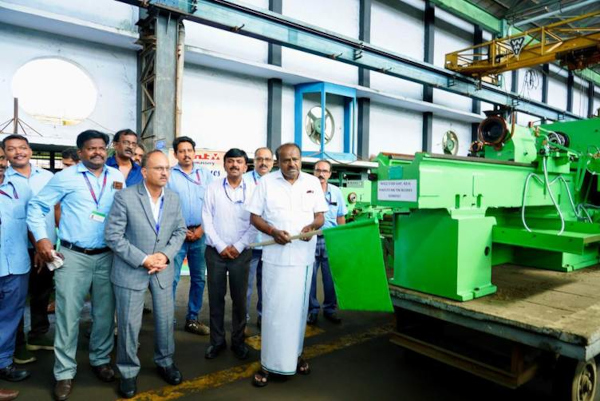
During the visit, the Minister reviewed the operations of HMT’s Machine Tool Division, Foundry Division and strategic manufacturing sections. He also inspected manufacturing, assembly and testing processes related to CNC systems, precision machine tools, specialised engineering equipment and indigenously developed Sonar Directing Gear systems used for Indian Naval platforms. This defence-linked capability gives the visit a deeper strategic meaning, because HMT is not only serving commercial industry but also supporting India’s self-reliance in sensitive engineering domains.

India’s Industrial Superpower Test: The Shift From Assembly to Deep Manufacturing

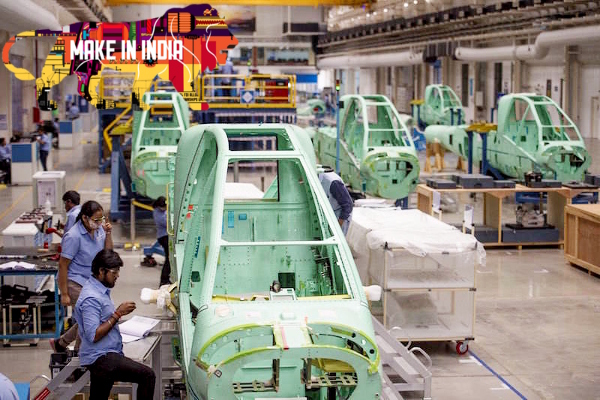
The policy direction is now clearly visible. India’s Production Linked Incentive framework has become one of the central instruments for converting manufacturing ambition into factory-level investment. Across 14 sectors, PLI schemes had generated investments exceeding ₹2.16 lakh crore by the end of December 2025, while incremental production and sales crossed ₹20.41 lakh crore. The schemes have also resulted in more than 14.39 lakh direct and indirect jobs, with 836 applications approved across the PLI framework.

NTPC Group Crosses 90 GW Capacity Mark, Signalling India’s Expanding Power Backbone

The latest addition came after the successful trial operation of Unit 2 of Patratu Vidyut Utpadan Nigam Ltd, an NTPC group arm. With this, the group now operates more than 90 GW of installed capacity across India, while also maintaining a large pipeline of projects under construction. NTPC has stated that it has around 32 GW of capacity under construction, showing that the company’s expansion is not a one-time jump but part of a long-term buildout of national power infrastructure.