Defense

News , articles and essays on Indian Defense

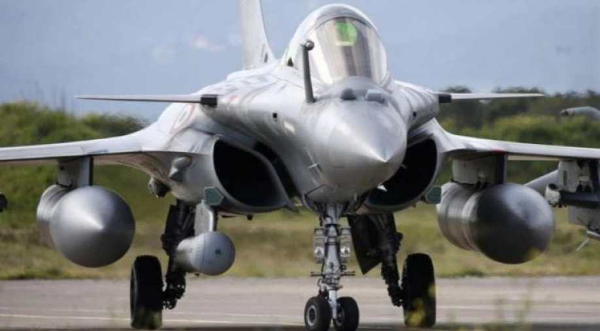
India’s 114-Rafale Push Signals a Major Air-Power Reset for the IAF

According to the reported plan, around 90 to 92 aircraft may be manufactured in India through a partnership involving Dassault Aviation and an Indian private-sector company, while the remaining aircraft would arrive in fly-away condition from France. The Indian Express reported that around 90 aircraft are expected to be made in India, while ThePrint earlier reported a 22 fly-away and 92 India-made split.
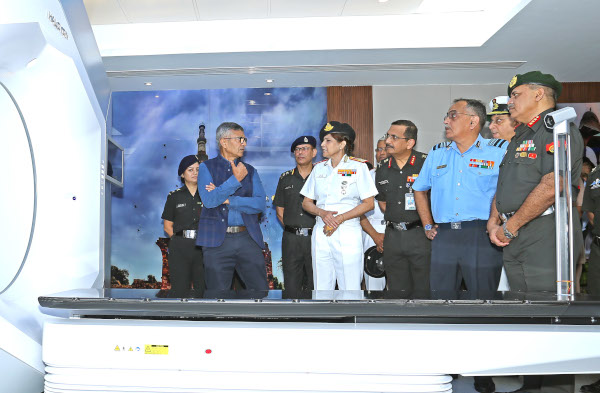
Army Hospital R&R Gets Advanced Linear Accelerator, Strengthening Cancer Care for Soldiers, Veterans and Families

The new equipment is designed to improve access to modern cancer treatment for serving personnel, veterans and their dependents. Army Hospital R&R handles a significant patient load, and the induction of this technology is expected to expand in-house treatment capacity, reduce dependence on external facilities, and provide more advanced care within the military medical system itself.

Biomimetic AUV: DRDO’s Fish-Inspired Step Toward Smarter Underwater Defence Robotics

The idea behind a biomimetic AUV is simple and powerful: the ocean already contains highly efficient underwater designs. Fish, tuna, rays, dolphins and whales move through water with efficiency, agility and reduced disturbance. Biomimetics translates such natural engineering into mechanical systems. IIT Madras describes biomimetic AUVs as platforms that mimic aquatic creatures for high propulsive efficiency, silent operation, fewer wake signatures and strong manoeuvrability.

Project Navbharat: Indian Army’s Youth Outreach Builds Patriotism, Career Awareness and Civil-Military Trust in the Northeast

The programme was organised around the larger national idea of Viksit Bharat, where young Indians are encouraged to see themselves as active participants in India’s development journey. Instead of treating defence outreach only as a recruitment exercise, Project Navbharat presents the Army as a disciplined institution of national service, technological capability and civic responsibility. This makes the initiative especially relevant in border and frontier regions, where the Army’s presence is deeply connected with security, public confidence and national integration.

MUNTRA: DRDO’s Robotic Tracked Vehicle Family and India’s Move Toward Unmanned Ground Warfare

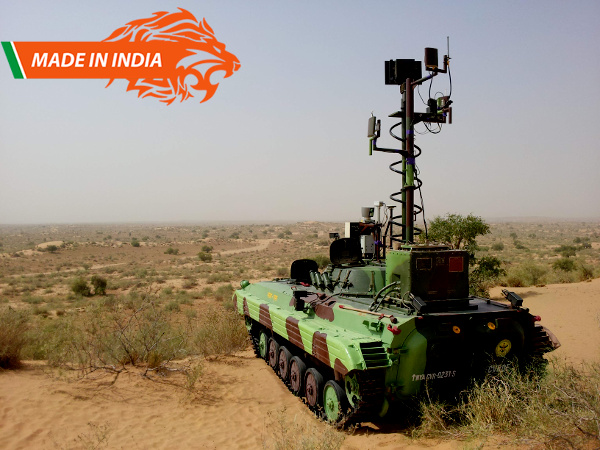
The project began as CVRDE’s effort to convert BMP-II class tracked amphibious vehicles into tele-operated and autonomous platforms. According to DRDO’s Technology Focus account, CVRDE took up the “Conversion of BMP-II into Tele-operated and Autonomous Vehicle” project in 2007, later naming it MUNTRA. The programme developed technologies such as drive-by-wire control, tele-operation, perception systems, robotic manipulators, autonomous navigation, multi-sensor fusion, payload tele-operation, power management and software integration.

Shirdi Enters India’s Defence Map as Rajnath Singh Opens NIBE Manufacturing Facility

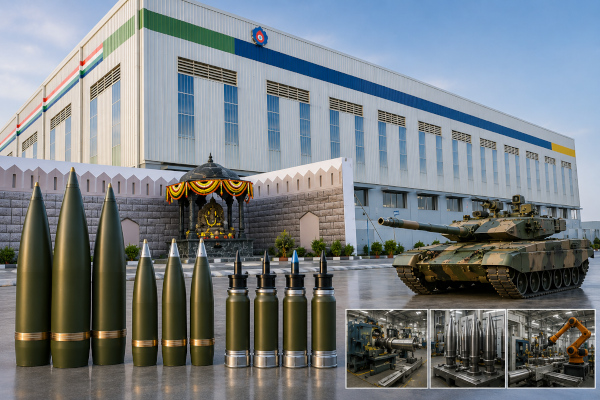
The most important part of the project is its ammunition manufacturing capability. Reports say the Shirdi facility includes an artillery shells plant with an annual production capacity of around five lakh shells. The unit is expected to produce 155 mm and 120 mm artillery shell hardware, tank ammunition and related systems. In a world where the Ukraine war and other modern conflicts have shown the centrality of high-volume ammunition production, such a facility has direct strategic relevance for India.

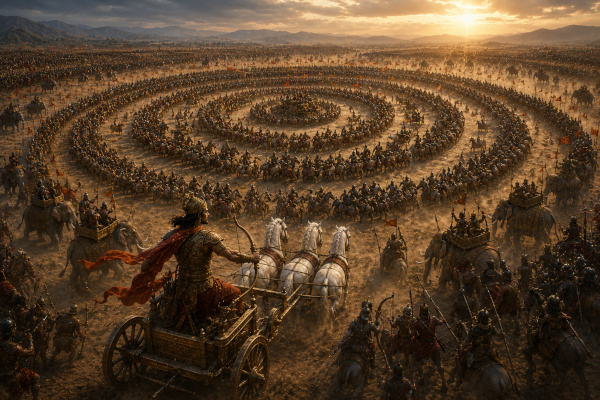
Chakra Vyuham: The Trap Formation That Turned Battlefield Geometry into Psychological Warfare

The original Mahabharata passages describe the formation as a firm, fierce, foremost and impenetrable circular array formed by Drona. Abhimanyu openly says he has been taught by Arjuna how to penetrate and strike such an array, but he also admits that if danger overtakes him, he does not know how to come out. This single admission gives the episode its entire military depth: Abhimanyu has entry knowledge, but lacks complete exit doctrine.

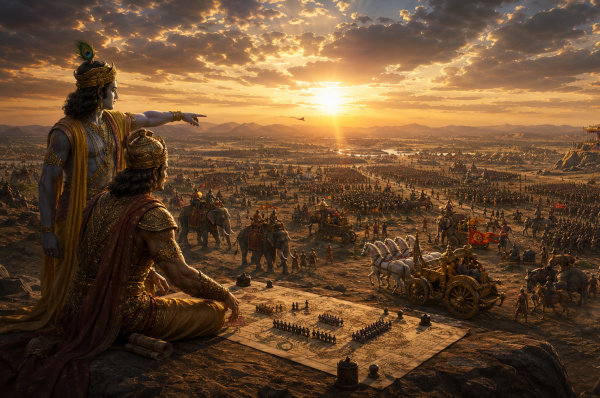
Kurukshetra as a War Studies Manual: What Modern Armies Can Still Learn from the Mahabharata

The epic describes the war as a clash of enormous scale, with eighteen Akshauhinis gathered at Samanta-panchaka and destroyed in the conflict. One Akshauhini itself was counted as 21,870 chariots, 21,870 elephants, 65,610 horses and 109,350 foot soldiers, giving the war a military scale that naturally invites comparison with modern corps-level and theatre-level planning.

Categories