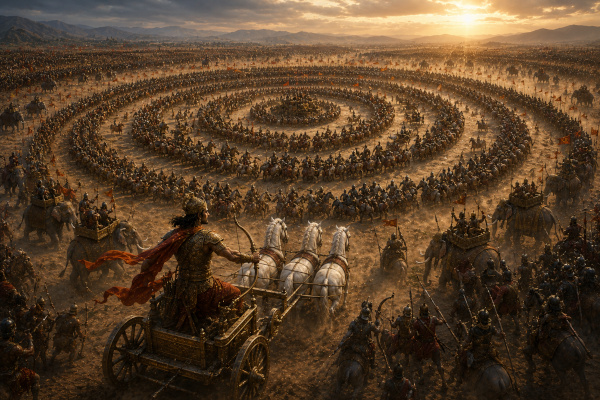
The Chakra Vyuham occupies a special place in Indian military memory because it is more than a formation. It is a battlefield idea: a circular, layered, hard-to-penetrate arrangement that tests courage, training, timing, support and command discipline at once. In the Mahabharata, its most famous moment comes through Abhimanyu, the young son of Arjuna and Subhadra, who enters the formation during Drona’s command and becomes the tragic centre of one of the epic’s most powerful war episodes. Read as defence literature, Chakra Vyuham is not merely a mythic pattern; it is a study in defence in depth, controlled entry, isolation of the attacker, breach failure, morale shock and the cost of incomplete training.
The original Mahabharata passages describe the formation as a firm, fierce, foremost and impenetrable circular array formed by Drona. Abhimanyu openly says he has been taught by Arjuna how to penetrate and strike such an array, but he also admits that if danger overtakes him, he does not know how to come out. This single admission gives the episode its entire military depth: Abhimanyu has entry knowledge, but lacks complete exit doctrine.
The common modern popular imagination often shows Chakra Vyuham as a spiral maze. The safer textual reading is that the epic presents it as a powerful circular formation with layered tactical difficulty. The “maze” idea is useful as a visual metaphor, but the defence-level interpretation should be grounded in what the text clearly gives us: a circular array, difficult penetration, isolation inside enemy depth, senior warriors converging, and the attacker being cut off from support.
The Military Logic of Chakra Vyuham
A circular formation has one major advantage: it can convert the battlefield from a straight-line clash into a controlled space. In a simple line battle, the attacker sees a front and tries to break it. In a circular or layered array, the attacker enters a system. Once inside, his direction, speed and support become harder to maintain. He may defeat the first ring and still face another. He may break one group and find himself exposed to flanks. He may move deeper, but each step takes him farther from his own army.
That is exactly what happens to Abhimanyu. He enters with astonishing force and breaks into the array, but the supporting Pandava warriors fail to follow him inside. The military tragedy is not simply that a brave youth entered a dangerous formation. The deeper failure is that the breach was not exploited by the follow-on force. In modern language, Abhimanyu creates penetration, but the supporting force fails to widen, secure and sustain the breach.
A proper breach operation requires more than courage at the front. It requires reconnaissance, suppression, route marking, follow-through, reserve movement, casualty evacuation, communications and extraction planning. Abhimanyu has the skill to open the door, but the Pandava side loses the chance to keep that door open. This is why Chakra Vyuham is still valuable as a defence study: it shows how a brilliant tactical entry can turn into operational isolation.
Drona’s Design: A Formation Built Around Control
Drona’s command style was technical, disciplined and formation-heavy. After Bhishma’s fall, the war becomes more aggressive and complex. Drona’s use of the circular array should be read as the work of a commander who understands how to force the enemy into a difficult decision. The formation presents a challenge: break it and risk isolation; avoid it and lose battlefield initiative.
A strong defensive formation is never passive. Modern U.S. Army doctrine says defence is usually stronger than offence, but defence alone normally does not decide battles; its purpose is to create conditions for offence and regain initiative. It also says a defending force should not wait passively, but should weaken the enemy before close combat, place enemy forces at disadvantage and combine static and mobile elements.
That is the modern lens through which Chakra Vyuham becomes clearer. The formation is not only a shield. It is a machine for shaping enemy movement. It draws the attacker in, disrupts his support, slows his momentum, exposes his flanks and creates the conditions for concentrated counter-action.
Abhimanyu’s Entry: Penetration Without Sustainment
Abhimanyu’s role is that of an elite breakthrough fighter. He knows how to enter the formation and is willing to take the risk because the Pandava army needs a breach. The Mahabharata says he pierced the impenetrable circular array in many places and performed extraordinary feats before being encountered by multiple heroes together.
In modern doctrine, penetration is a recognised form of manoeuvre. Doctrines define penetration as an attack on a narrow front to destroy the continuity of a defence, enabling the enemy’s subsequent isolation and defeat in detail. It also notes that successful manoeuvre requires trained forces capable of shifting formations quickly in response to changing enemy situations.
This gives a precise modern comparison. Abhimanyu achieves penetration at the tactical level. The wider Pandava force fails in the next requirements: follow, support, reinforce, widen the breach and prevent the penetrator from being isolated. Modern armies know that a breach lane becomes dangerous if the first assault element outruns engineers, artillery, armour, infantry support, communications and evacuation. The forward element may appear successful for a short time, but once the enemy closes the gap, that same element becomes trapped inside hostile depth.
The Trap: Isolation, Encirclement and Destruction in Detail
The tragedy of Chakra Vyuham lies in isolation. Once Abhimanyu is inside, the battle becomes a many-against-one contest. The text says he was eventually encountered by six heroes together, and another passage says he was one slain by many after grinding the hostile army .
A modern commander would recognise this as the destruction of an isolated penetration force. If a defending side can cut off the lead element from its parent formation, the attacker’s strength turns into vulnerability. The penetrator has enemies on several sides, reduced freedom of movement, limited resupply, unclear communications and no secure exit. The deeper he moves, the greater his tactical brilliance appears — and the greater his operational danger becomes.
This is close to modern ideas of engagement areas and kill zones, though the comparison should remain conceptual.
That is the modern tactical language closest to the Chakra Vyuham episode: draw in, isolate, block support, compress movement, attack from several directions and destroy in detail.
Chakra Vyuham and Defence in Depth
Chakra Vyuham is best compared with defence in depth rather than a single modern formation. Defence in depth places successive layers between the attacker and the objective. The first layer detects and disrupts. The next absorbs and channels. Further layers contain and counterattack. The attacker may win contact at the front and still lose the battle because the system has more depth than his support plan.
Modern layered defence appears in many forms: fortified belts, urban defensive districts, anti-access zones, minefield-obstacle complexes, integrated air defence systems, layered base security and naval task-force screens. In each case, the attacker must do more than enter. He must survive the inner layers, preserve communications, suppress defenders, keep the route open and retain enough combat power for the final objective.
The epic gives the same idea through battlefield narrative. Abhimanyu enters the formation, but entry is only the first problem. The real challenge is movement through depth. His courage defeats immediate resistance, but the system keeps generating new pressure. That is the genius of a layered defensive arrangement: it makes the attacker fight the formation, not merely the men in front of him.
Chakra Vyuham as Psychological Warfare
A trap formation works on the mind before it works on the body. The attacker sees the prestige of the formation and feels compelled to break it. The defender knows that once the attacker enters, the battlefield can be shaped. The surrounding troops gain confidence because the formation gives them structure. The attacker’s supporting troops feel anxiety because every moment of delay deepens the isolation of the lead warrior.
Abhimanyu’s death also becomes psychological warfare after the fact. It devastates the Pandavas, enrages Arjuna and creates the next day’s operational crisis: Arjuna vows to kill Jayadratha before sunset. The Kaurava side wins a tactical success by eliminating Abhimanyu, but the moral and psychological cost is enormous. The death becomes a rallying wound for the Pandavas.
Modern defence readers will recognise this pattern. Destroying an elite enemy unit can damage morale, but if the method appears dishonourable or excessive, it can strengthen the enemy’s will. Tactical success and strategic messaging are different things. A battlefield act can win ground and still lose legitimacy. Abhimanyu’s death turns Chakra Vyuham from a clever formation into a moral wound in Indian memory.
The Ethical Question: Tactical Success and Battlefield Honour
The Mahabharata preserves the pain of Abhimanyu’s death because the episode raises an ethical question. Was he a legitimate combatant inside an active battle? Yes. Was he a devastating threat to the Kaurava army? Yes. Did the manner of his destruction violate the honour expectations of heroic warfare? The epic strongly pushes the reader toward that conclusion.
This is where the story becomes richer than a tactical diagram. A modern article should avoid simplistic claims such as “encirclement itself is unlawful.” Concentrating force against a combatant is a normal part of warfare. The ethical issue emerges when a warrior is disabled, weaponless, overwhelmed under breached rules, or denied the expected protections of the battlefield code. The epic’s own emotional framing — one slain by many — makes the event a symbol of collapsing dharma.
For modern armies, the lesson is that tactics must remain connected to rules of engagement, proportionality, command discipline and strategic legitimacy. A commander can win a local action through harsh concentration of force, but if the method damages the moral authority of the campaign, the victory becomes unstable.
Modern Parallels: Where Chakra Vyuham Lives Today
Chakra Vyuham has no exact one-to-one modern equivalent, and forcing one would weaken the analysis. Its value lies in concepts that remain central to warfare.
It resembles layered defensive belts where the enemy is allowed to breach the outer line but is slowed, observed and destroyed in depth. It resembles urban defensive traps, where streets, buildings and barricades channel attackers into pre-arranged engagement areas. It resembles integrated air defence networks, where an aircraft may penetrate one sensor or missile layer only to meet another. It resembles anti-armour kill zones, where mines, obstacles, drones, artillery and anti-tank teams cooperate to stop a thrust. It resembles cyber and electronic defence, where an intruder may enter a network segment and then be isolated, monitored and neutralised before reaching the real objective.
The deepest parallel is system warfare. Chakra Vyuham is dangerous because it is not a single line. It is a system. Modern defence works the same way. A battlefield today is a network of sensors, shooters, communications, reserves, fires, drones, obstacles, logistics and information operations. The attacker must defeat the system, not merely one visible position.
Lessons for Modern Military Thought
The Chakra Vyuham episode gives several serious defence lessons.
First, entry is not success. A breach only matters when it is exploited and sustained.
Second, elite capability requires support. Abhimanyu is a brilliant fighter, but even brilliance can be isolated without follow-on forces.
Third, defensive depth multiplies strength. A formation with layers can absorb penetration and convert attacker momentum into vulnerability.
Fourth, command knowledge must be complete. Training a warrior to enter a formation while leaving the exit problem unresolved creates a fatal gap.
Fifth, psychological effects outlive tactical events. Abhimanyu’s death becomes a strategic emotional force for the Pandavas.
Sixth, battlefield legitimacy matters. A victory achieved through questionable conduct can carry moral cost across the rest of the campaign.
Conclusion
Chakra Vyuham survives in Indian memory because it combines battlefield design, youthful courage, tactical brilliance and ethical tragedy. It is a formation, but also a warning. It tells commanders that complex systems can trap unsupported heroism. It tells soldiers that courage needs doctrine. It tells planners that a breach without sustainment becomes a grave. It tells strategists that tactical success can create strategic backlash when honour collapses.
For a modern defence reader, Chakra Vyuham should be studied neither as fantasy nor as a direct ancestor of today’s formations. It should be studied as a civilisational military concept: a layered defensive system designed to shape enemy movement, isolate penetration, create psychological pressure and test the relationship between skill, support and command judgment.
In that sense, the most famous trap formation in Indian military memory still teaches a very modern lesson: wars are not won by entering the enemy’s system with courage alone. They are won by understanding the system, breaking it with coordination, sustaining the breach, protecting the force and preserving the moral purpose for which the battle is fought.
You may also like
-
PRAHAAR: India’s First National Counter-Terrorism Policy and Strategy
-
Takshak Heavyweight Torpedo: How India’s Indigenous Submarine Weapon Compares With the World’s Leading Torpedoes
-
Embraer Builds Dual Aerospace Strategy in India Through C-390 Military and E175 Regional Aircraft Programmes
-
NextLeap Tests Indigenous Jet Engine for Long-Range Stryker Kamikaze UAV
-
Côte d’Ivoire Military Delegation Visits HAL, Shows Interest in India’s Indigenous Aerospace Platforms
