Defense

News , articles and essays on Indian Defense

MUNTRA: DRDO’s Robotic Tracked Vehicle Family and India’s Move Toward Unmanned Ground Warfare

The project began as CVRDE’s effort to convert BMP-II class tracked amphibious vehicles into tele-operated and autonomous platforms. According to DRDO’s Technology Focus account, CVRDE took up the “Conversion of BMP-II into Tele-operated and Autonomous Vehicle” project in 2007, later naming it MUNTRA. The programme developed technologies such as drive-by-wire control, tele-operation, perception systems, robotic manipulators, autonomous navigation, multi-sensor fusion, payload tele-operation, power management and software integration.

Shirdi Enters India’s Defence Map as Rajnath Singh Opens NIBE Manufacturing Facility

The most important part of the project is its ammunition manufacturing capability. Reports say the Shirdi facility includes an artillery shells plant with an annual production capacity of around five lakh shells. The unit is expected to produce 155 mm and 120 mm artillery shell hardware, tank ammunition and related systems. In a world where the Ukraine war and other modern conflicts have shown the centrality of high-volume ammunition production, such a facility has direct strategic relevance for India.

Chakra Vyuham: The Trap Formation That Turned Battlefield Geometry into Psychological Warfare

The original Mahabharata passages describe the formation as a firm, fierce, foremost and impenetrable circular array formed by Drona. Abhimanyu openly says he has been taught by Arjuna how to penetrate and strike such an array, but he also admits that if danger overtakes him, he does not know how to come out. This single admission gives the episode its entire military depth: Abhimanyu has entry knowledge, but lacks complete exit doctrine.

Kurukshetra as a War Studies Manual: What Modern Armies Can Still Learn from the Mahabharata

The epic describes the war as a clash of enormous scale, with eighteen Akshauhinis gathered at Samanta-panchaka and destroyed in the conflict. One Akshauhini itself was counted as 21,870 chariots, 21,870 elephants, 65,610 horses and 109,350 foot soldiers, giving the war a military scale that naturally invites comparison with modern corps-level and theatre-level planning.

BEL-RRP Optics Contract Marks a Quiet but Important Step in India’s Thermal Imaging Supply Chain

The contract covers optical lens components identified as GE SF Lens 1 and GE SF Lens 2, with execution planned through sample approval, first-lot delivery within roughly 8–10 weeks after purchase-order receipt, and phased monthly deliveries up to December 2026. The order value is listed as ₹29,83,81,230 plus applicable GST, and the award has been disclosed under SEBI’s Regulation 30 framework.

Agni-I Test Launch: India Validates the Readiness of Its Short-Range Strategic Deterrent

The missile is generally assessed to have a range of around 700 km, with an estimated payload capacity of about 1,000 kg. Open-source technical assessments describe Agni-I as roughly 15 metres long, around 1 metre in diameter, and solid-fuelled, making it a compact and mobile member of the Agni family. Its shorter range gives India a focused strategic option within the regional theatre, while its solid-fuel configuration supports faster readiness compared to older liquid-fuel systems.

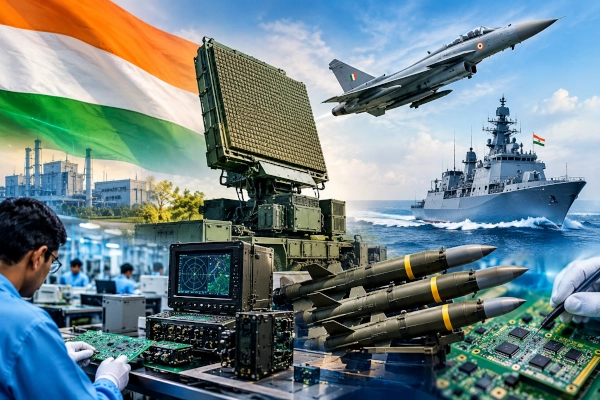
India-Israel Radar Manufacturing Push in Tamil Nadu Marks a New Step in Defence Electronics Self-Reliance

The new plant is expected to serve as a specialised centre for the manufacture, integration and testing of advanced radar systems. Its focus will include high-end radar technologies for airborne and ground-based applications, supporting both Indian defence requirements and potential international demand. Construction is expected to be completed by April 2027, with production planned to begin soon after.