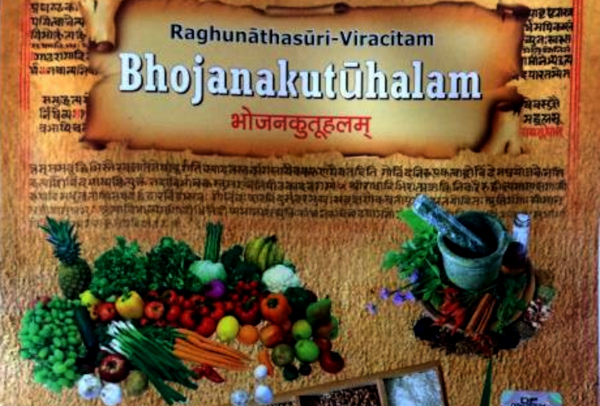
Bhojana Kutuhala is one of the most fascinating Sanskrit works in the Ayurvedic tradition because it treats food as a complete science. The title itself means “curiosity about food” or “enquiry into food.” This simple title carries a deep civilisational meaning. It shows that ancient Indian knowledge looked at food with wonder, discipline and medical intelligence. Food was studied through taste, digestion, nourishment, strength, season, cooking method, compatibility, quantity, water, vessels, appetite, routine and the condition of the person eating it.
The text is attributed to Raghunatha Ganesa Navahasta, also known as Raghunatha Suri, a 17th-century Maratha scholar. He belonged to a period when Sanskrit learning, Ayurveda, temple culture, royal patronage and regional culinary traditions were all active. Bhojana Kutuhala stands at this meeting point. It gathers the older wisdom of Ayurvedic classics and combines it with practical knowledge of cooking, diet, food processing and daily eating.
In Ayurveda, food is called Ahara, and Ahara is one of the great supports of life. Classical Ayurveda speaks of three supporting pillars of life: Ahara, Nidra and Brahmacharya. Food is therefore not treated as a casual activity. It is a pillar of strength, immunity, clarity, tissue formation and longevity. Bhojana Kutuhala expands this idea in a detailed and practical way. It teaches that the right food, prepared properly and eaten correctly, becomes medicine. The wrong combination, wrong timing, wrong method or wrong quantity can disturb health.
This is why Bhojana Kutuhala is such an important Ayurvedic food text. It does not merely list recipes. It studies the nature of food. It asks what a food does inside the body. It studies whether it is heavy or light, heating or cooling, nourishing or drying, digestive or obstructive, suitable for Vata, Pitta or Kapha, helpful in weakness, useful in appetite, strengthening for the body, or suitable for a particular season. This makes the book a bridge between kitchen and clinic.
The first major strength of Bhojana Kutuhala is its understanding of Dravya Guna, the qualities and actions of substances. Every food item is treated as a dravya, a substance with its own nature. A grain, vegetable, fruit, spice, milk preparation, ghee preparation, drink or cooked dish carries specific qualities. Ayurveda does not judge food only by calories. It understands food through rasa, guna, virya, vipaka and karma. Rasa is taste. Guna is quality. Virya is potency. Vipaka is post-digestive effect. Karma is action in the body. Bhojana Kutuhala applies this classical logic to daily food.
The second strength of the text is its attention to cooking. Cooking is seen as transformation. A raw substance and a cooked substance can behave differently in the body. The same rice can become manda, peya, vilepi or odana depending on water, heat, texture and preparation. The same grain can become light, heavy, nourishing, soft, drying or strengthening depending on processing. This is a major Ayurvedic insight. Food is shaped by agni outside the body before it meets jatharagni inside the body.
Bhojana Kutuhala gives great importance to cooked rice preparations, grains and cereal-based foods. Rice, wheat, barley, pulses and other staples are examined through their properties and preparations. The text shows that Indian food science was highly refined. A meal was built with attention to digestibility, strength and balance. Thin gruels, thicker porridges, steamed preparations, fried items, sweet dishes, pulse-based foods and grain-based recipes all had different roles. Food was selected according to the state of digestion and the need of the body.
The section known as Siddhanna Prakarana is especially important because it deals with prepared foods. Siddhanna means cooked or prepared food. This section shows the practical genius of the text. It moves from raw ingredients to actual dishes. It describes food as it appears in the kitchen and on the plate. This makes Bhojana Kutuhala valuable for historians of Indian cuisine as well as Ayurvedic physicians. It preserves the older Indian understanding that cooking is both an art and a medical discipline.
The book also pays attention to vegetables, roots, tubers, fruits, milk products, buttermilk, ghee, oils, sweets, drinks and digestive preparations. These categories show the fullness of the Indian diet. Ayurveda studied the field, forest, garden, cowshed, water source and kitchen together. A vegetable was not merely a side dish. A fruit was not merely a sweet object. Buttermilk was not merely a drink. Ghee was not merely fat. Each carried a specific action on digestion, tissues, strength and doshas.
Water receives special importance in Ayurvedic dietetics, and Bhojana Kutuhala belongs to that larger tradition. Water changes according to source, season, storage, boiling, cooling and method of intake. Ayurveda gives importance to boiled water, warm water, rainwater, river water, well water and water consumed before, during or after food. This reveals a fine understanding of digestion. Food and water together shape agni, metabolism and comfort after eating.
A major theme in Bhojana Kutuhala is the relationship between food and agni. Agni is the digestive fire. Ayurveda holds that strong agni creates good digestion, proper tissue formation, strength and clarity. Weak agni creates heaviness, undigested residue, disease tendency and loss of vitality. Bhojana Kutuhala teaches food through this lens. A food is valuable only when it can be digested properly by the person eating it. Even a rich and nourishing food can become troublesome when agni is weak. A light and simple food can become deeply healing when chosen at the correct time.
The text also reflects the Ayurvedic idea of Pathya and Apathya. Pathya means wholesome, suitable and beneficial. Apathya means unsuitable for a particular condition. This is one of Ayurveda’s greatest contributions to nutrition. There is no single universal diet for every person in every condition. Food must be matched with constitution, disease, age, season, appetite, region, strength and habit. Bhojana Kutuhala gives this old Indian idea a practical culinary form.
The book is also important for the study of Viruddha Ahara, or incompatible food. Ayurveda warns that some combinations disturb digestion, channels and doshic balance. The concept includes wrong combinations, wrong processing, wrong quantity, wrong timing, wrong season and wrong sequence. Bhojana Kutuhala helps us understand this through the wider food culture of India. It teaches that diet is not only about what is eaten, but also about how, when, with what, and by whom it is eaten.
Seasonal eating is another strong idea behind this tradition. Ayurveda connects food with ritucharya, the seasonal regimen. A meal suitable for summer may require cooling, lightness and hydration. A winter meal may allow heavier, more nourishing and strength-building foods. Monsoon may require special attention to digestion and water. Bhojana Kutuhala reflects this living relationship between climate and diet. Indian food traditions developed through this deep seasonal intelligence.
The importance of Bhojana Kutuhala also lies in its position between Ayurveda and culinary heritage. It is a medical text, but it is also a record of food culture. It shows how people cooked, classified, combined and valued food in pre-modern India. It contains information useful for understanding old Indian recipes, staple foods, sweets, drinks, vegetable preparations, dairy preparations and meal habits. For this reason, scholars of Sanskrit, Ayurveda, food history and culinary studies all find value in it.
The text also shows that Indian cooking was never only about taste. Taste mattered, but taste was connected to digestion and balance. Sweet, sour, salty, pungent, bitter and astringent tastes were understood as forces that act on the body. A meal was expected to satisfy the tongue, nourish the tissues, support digestion and maintain doshic harmony. This is the science behind the Indian thali, where different tastes, textures and preparations come together.
Bhojana Kutuhala is highly relevant today because modern life has separated food from season, digestion, locality and mindful eating. People often discuss food through numbers, trends and isolated nutrients. Ayurveda brings the focus back to the living person. It asks whether the food suits the eater. It asks whether digestion is ready. It asks whether the meal is fresh, warm, compatible, properly cooked and eaten with attention. Bhojana Kutuhala gives classical strength to this approach.
The text also has importance for India’s present Ayurveda Aahara movement. Modern India is now trying to bring classical Ayurvedic food wisdom into structured food categories and public health discussions. Bhojana Kutuhala becomes valuable in this context because it preserves food knowledge in a systematic Sanskrit form. It gives a traditional foundation for Ayurveda-based nutrition, functional foods and preventive health.
Another powerful aspect of Bhojana Kutuhala is its practical nature. It speaks to physicians, cooks, householders, scholars and seekers of health. A physician can use it to understand diet therapy. A cook can use it to understand food transformation. A historian can use it to understand old Indian cuisine. A householder can use it to appreciate why food should be prepared with care. This broad usefulness is the mark of a great Indian knowledge text.
The book also carries a cultural message. In Indian civilisation, eating was connected with gratitude, purity, discipline and awareness. Food was prepared with attention and offered with respect. The act of eating was linked with health, family, ritual, agriculture and ecology. Bhojana Kutuhala belongs to this world. It reminds us that food is not merely a commodity. It is prana-supporting, body-building, mind-influencing and culture-preserving.
The Ayurvedic idea of food as medicine is deeply visible in this text. Rice gruel can be medicine in weakness. Buttermilk can support digestion when properly used. Ghee can nourish and carry medicinal qualities. Spices can kindle agni. Warm water can support digestion. Simple food can restore balance. A carefully prepared meal can act like daily preventive medicine. This is the heart of Bhojana Kutuhala.
For modern readers, the book should be approached with respect and context. It is a classical Sanskrit work shaped by the knowledge systems of its time. Its principles remain valuable, especially the focus on digestion, season, preparation, compatibility and individual suitability. Its specific uses are best understood with trained Ayurvedic guidance when applied to disease, therapy or strict dietary correction.
The greatness of Bhojana Kutuhala lies in the way it makes food intelligent. It turns cooking into science, eating into discipline and diet into medicine. It shows that the Indian kitchen was once a place of observation, healing and wisdom. Every grain, spice, vegetable, drink and cooked preparation had a role in the larger design of health.
Bhojana Kutuhala deserves renewed attention because it can help India reclaim its classical food knowledge. It gives depth to the phrase “food is medicine.” It shows that Ayurveda did not separate nourishment from treatment, taste from digestion, or kitchen from pharmacy. The text stands as a beautiful reminder that the path to health often begins with the plate, the fire, the water, the season and the awareness of the person who eats.
Reference:
- Raghunatha Ganesa Navahasta / Raghunatha Suri — Bhojana Kutuhala / Bhojanakutuhalam, Sanskrit treatise on Ayurvedic dietetics and culinary science.
- University of Travancore edition — Bhojanakutuhala, Prathama Bhaga, edited with manuscript support from traditional collections.
- Wisdom Library — “Bhojanakutuhala, Bhojanakutūhala: Sanskrit work on dietetics and culinary art.”
- Shodhganga, University of Calicut — Sreeja K. N., “Dietetics and Culinary Art in Ancient and Medieval India: A Study with Special Reference to Bhojanakutuhala.”
- International Journal of Medical and Pharmaceutical Research — Review article on Bhojanakutuhalam as traditional dietetic wisdom.
- FSSAI and Ministry of Ayush — Ayurveda Aahara framework and classical text-based food categories.
- Classical Ayurvedic principles of Ahara, Agni, Pathya, Apathya, Rasa, Guna, Virya, Vipaka and Viruddha Ahara.
You may also like
-
NMMSS Scholarship Application Deadline Extended to October 31, 2026
-
Ayurveda on Eating at the Right Time: How Food Timing Supports Balance and Health
-
Ayurveda and Late-Night Living: What Irregular Sleep Does to the Body
-
India’s Ayush Services Economy Reaches $36.92 Billion, RIS Study Projects Strong Growth to 2047
-
DGCA Introduces Training Framework for Gyroplane Pilots in India
